



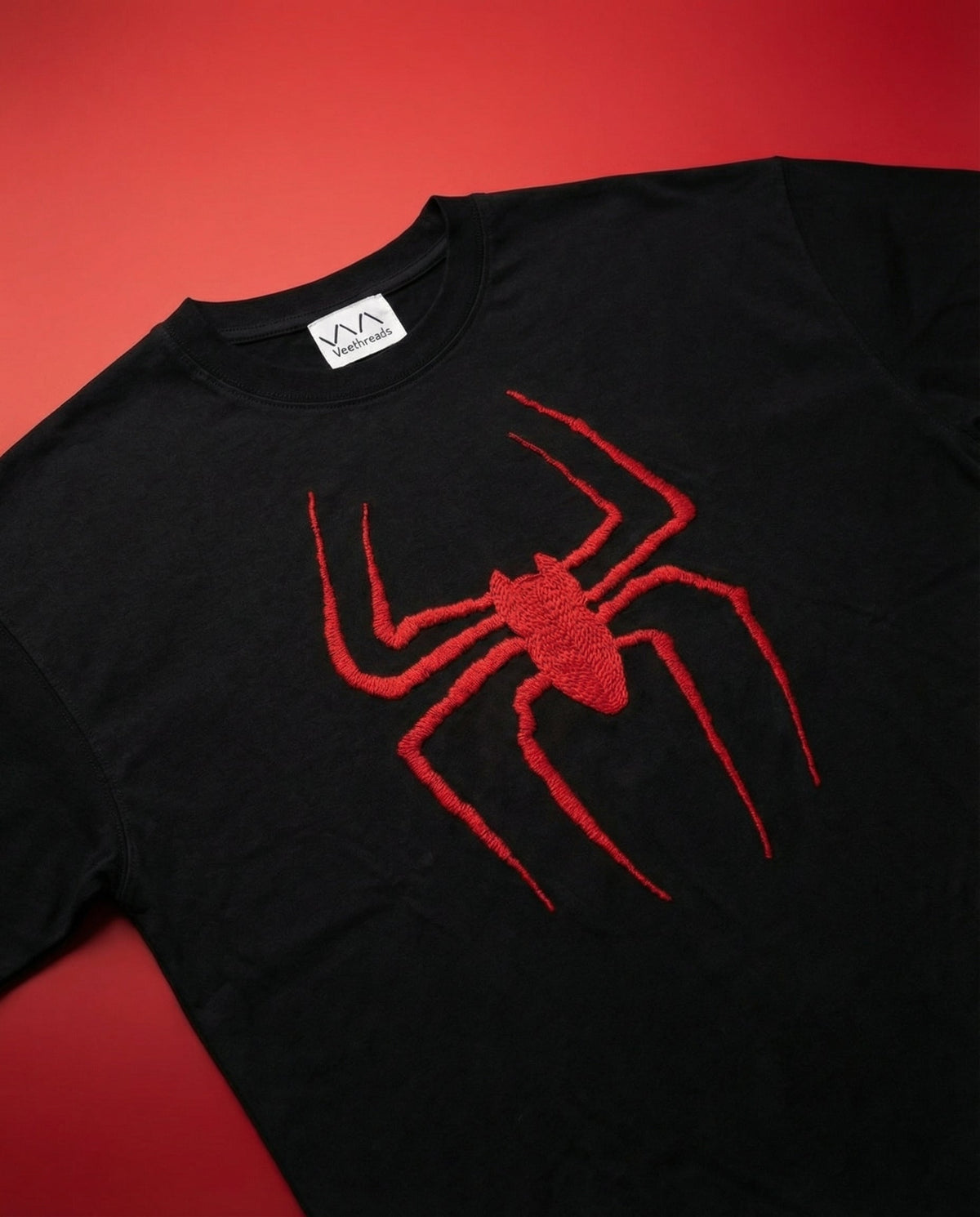
The short answer
A screen print sits on top of the fabric as a layer of plastic ink. Hand embroidery is thread pulled through the weave and knotted into it. On black cotton this difference shows up faster than on any other colour, because a cracked print on black is visible from across a room while black thread simply stays black.

Why black is the hardest colour to print well
Printing light ink on dark fabric requires an underbase, which is a layer of white ink laid down first so the colour on top is not swallowed by the fabric. That means two layers of plastisol instead of one, sitting on the surface, stiffer than the cotton underneath.
Every wash flexes the garment. The ink does not flex at the same rate as the cotton, so it fractures. This is why black printed tees develop that grey hairline cracking through the design while a printed white tee often looks fine for longer.
What thread does instead
An embroidered motif is not a layer. The thread passes through the fabric and is anchored on the reverse, so the design is structurally part of the garment rather than something applied to it. When the cotton flexes, the stitching flexes with it.

The failure mode is different too. A print fails by cracking and flaking, which looks like damage. Embroidery, if it eventually goes, loosens a stitch, which is repairable with a needle in two minutes.
How long does each actually last?
A mid-range screen print on a black tee typically starts showing hairline cracks somewhere between 20 and 40 washes, sooner if it goes in hot or gets tumble dried. Hand embroidery does not have an equivalent failure point. In practice the cotton wears out around the stitching rather than the other way round.
That is the honest comparison. It is not that embroidery lasts twice as long. It is that the decoration usually outlives the garment.
The cost question
A printed black tee runs roughly Rs 250 to Rs 400. Our spider web tee is Rs 1,517 on 220 GSM cotton with over 4,000 individual hand stitches, worked by women artisans in Bulandshahr.

The gap is labour and nothing else. A print is applied by machine in seconds. Those 4,000 stitches are hours of one person's hands. Whether that trade is worth it depends on how long you keep clothes. If you replace tees every season, print is the rational choice and we will say so. If you still have t-shirts from four years ago, embroidery is the cheaper option per wear.
What about machine embroidery?
Machine embroidery is real embroidery and it does not crack. It is also faster, cheaper and more uniform. What it does not do is vary. Every unit comes out identical, and the stitch direction is set by software rather than by someone deciding where the light should catch.
We do not machine embroider, but we would rather explain the difference than pretend it does not exist.
Frequently asked questions
How should I wash an embroidered black tee?
Inside out, cold water, hand wash or a gentle machine cycle. No tumble dryer and no bleach. The main thing you are protecting is the black dye, not the thread.
Does embroidery make the tee heavier or stiffer?
Slightly, in the stitched area only. On 220 GSM cotton the motif has a light physical rise you can feel with a fingertip. The rest of the garment is unaffected.
Can embroidery be repaired?
Yes, a loose stitch is a two-minute fix with a needle. A cracked print cannot be repaired at all.
Does the thread fade?
Good cotton thread holds colour well. Black on black is the most forgiving combination since any fading happens to both at once.











Share and get 15% off!
Simply share this product on one of the following social networks and you will unlock 15% off!