




Six free infographics on who does the work, what it earns, how long it takes and what buyers worry about. Use any of them on your own site with a credit link.
We run a small hand embroidery studio in Bulandshahr, Uttar Pradesh. People ask us the same questions every week: why a hand-stitched tee costs more than a printed one, how long it really takes, whether the thread will come loose in the wash. We got tired of answering from memory, so we pulled the official numbers, timed real pieces, and read every comment on 21 Reddit threads about embroidered clothes.
Everything below has a source. Where a number is our own, we say so.
1. Who makes India's handcrafts

India has an estimated 64.66 lakh handloom and handicraft artisans, according to a Press Information Bureau fact sheet from December 2025. Women are 64% of them. Among handloom weavers the share rises to 71%.
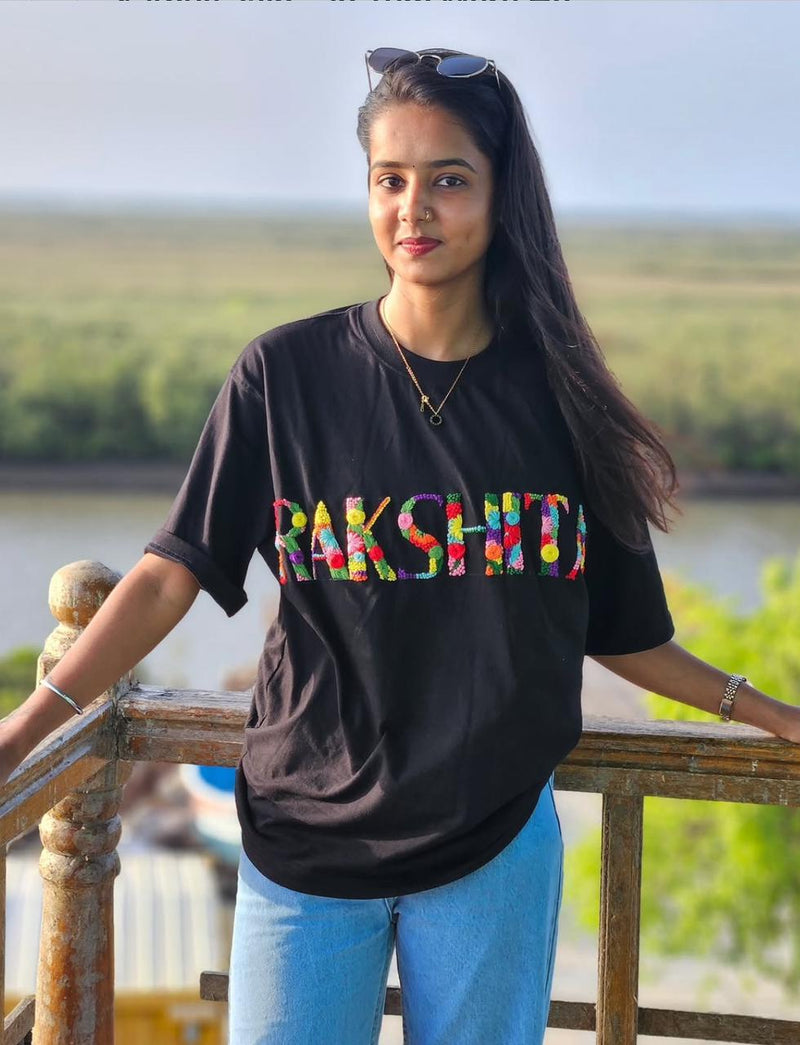
The same document names the states where artisans are most concentrated: Uttar Pradesh, Rajasthan, Assam, Odisha, West Bengal and Tamil Nadu. The five artisans you meet on our homepage work with our Bulandshahr studio and bring more than 90 years of experience between them: Sunita dadi (25+ years, fine floral detailing), Rukhsana (20+ years, heritage motifs), Lakshmi chachi (18+ years, name embroidery), Fatima (15+ years, beadwork) and Anjali (12+ years, minimal modern motifs).
Why it matters for buyers: when a brand says "made by women artisans", that describes most of the sector. The more useful question is how those women are paid and how regularly. We cover the questions to ask further down.
2. What Indian embroidery earns abroad

The Export Promotion Council for Handicrafts (EPCH) reports that India exported about Rs 4,350 crore (roughly US$514 million) of embroidered and crocheted goods in 2024-25. That was up 9.12% on the previous year in rupee terms and 6.87% in dollars.
Total handicraft exports, excluding hand-knotted carpets, were Rs 33,122.79 crore in the same year and slipped 0.97% in dollar terms. So embroidery grew while the wider category was flat, and it now makes up about 13% of the total by our calculation.
3. How long one piece takes

Commercial embroidery machines run at roughly 800 to 1,200 stitches a minute. At 1,000 stitches a minute, a 5,000 stitch chest logo is done in about five minutes of machine time.
By hand the scale changes completely:
- Our Parakeet and Floral oversized tee takes 24 hours of stitching.
- A maker on Reddit logged 25 hours for the front of a sashiko tee with a Dennis Rodman portrait and 50 hours once the back was finished.
- Another maker spent "the whole month of May" on a Public Enemy tee, in 2 to 4 hour sessions, and used 150 metres of floss.
This is the honest answer to "why does it cost more". Thread and fabric are a small part of the price. Hours are most of it.
4. What 395 Reddit comments say about embroidered clothes

We collected 21 Reddit threads about embroidered tees and sweatshirts (19,656 upvotes between them) and coded all 395 comments by theme. A comment could count in more than one theme.
- 38.2% were simply praise.
- 5.3% talked about the time and effort involved.
- 5.3% asked where to buy one or told the maker to open a shop. "You should sell those for real" got 43 upvotes on one thread.
- 4.1% asked how it was made, 3.3% talked about price, 2.0% about washing and 1.8% about hand versus machine.
Two of the most upvoted threads were gifts: a tee with a hand-embroidered Hertzsprung-Russell diagram that students gave their physics teacher (3,498 upvotes), and a cartoon portrait tee one Redditor stitched for their husband. People do not just admire hand embroidery. They read it as care.
Washing came up less often, but it is the worry that stops people wearing what they buy. One would-be stitcher wrote: "something i have to hand wash I'd avoid wearing, so I'm conflicted." Section 6 deals with that.
5. How to tell hand embroidery from machine in 30 seconds

The front of good machine embroidery can fool anyone. The back rarely does. Turn the garment inside out and look for:
- Knots and short tails where each colour starts and stops. That is handwork.
- A white bobbin line down the middle of satin areas. That is a machine.
- A stiff stabiliser patch cut around the design. Usually a machine.
- Two identical repeats. Hands do not make twins.
- An answer to "how many hours did this take?" Makers know the number.
No single check is proof. Some hand embroiderers finish the back very neatly, and some machine pieces use a backing that washes away. Use them together.
6. How to wash hand embroidery so it lasts

Hand stitches go through the fabric. They are not printed or glued on, so they cannot peel. What wears them out is friction, heat and twisting.
- Turn the garment inside out.
- Wash cold or cool, 30°C or below.
- Hand wash, or use the delicate cycle inside a mesh laundry bag.
- Use a mild detergent and no bleach.
- Do not wring. Press the water out with a towel and dry flat in the shade.
- Iron from the back, with the embroidery face down on a folded towel.
If a loop of thread snags, push it to the back with a needle. Never cut it.
Use these infographics on your site
All six images are free to use in articles, school projects, newsletters and social posts. The only condition is a visible credit link to this page. Copy this code, then swap in the address of the image you want (right-click any image above and copy its address):
<a href="https://www.veethreads.com/blogs/news/hand-embroidery-india-numbers">
  <img src="https://cdn.shopify.com/s/files/1/0649/3283/9609/files/vee-threads-infographic-women-artisans-india.png?v=1791220547" alt="64 out of every 100 handloom and handicraft artisans in India are women" width="1200">
</a>
<p>Infographic: <a href="https://www.veethreads.com/blogs/news/hand-embroidery-india-numbers">Vee Threads, Hand Embroidery in India by the Numbers</a></p>
Need a different size or the underlying data? Contact us and we will send it.
Sources
- Press Information Bureau, "Handicrafts at the Heart of India's Rural Economy", 9 December 2025.
- Export Promotion Council for Handicrafts, export data and Annual Report 2024-25.
- Manufacturer specifications for Tajima, SWF and Melco commercial embroidery machines.
- Vee Threads product page, Parakeet and Floral Hand Embroidered Oversized T-Shirt.
- Reddit threads collected 5 October 2026, including the Dennis Rodman sashiko tee (front), the same tee finished, the Public Enemy tee, the physics teacher's gift, the Bob's Burgers tee and the r/sashiko washing discussion.
- Ellen MacArthur Foundation, "A New Textiles Economy" (2017), for the wider context below.
A note on why any of this matters: the Ellen MacArthur Foundation found that the average number of times a garment is worn fell 36% in fifteen years, and that one garbage truck of textiles is burned or landfilled every second. A tee that took 24 hours to stitch is a tee people keep. That is the whole case for hand embroidery in one line.
Written by the Vee Threads studio team in Bulandshahr. Browse our hand-embroidered t-shirts or order a custom name embroidery piece.







Share and get 15% off!
Simply share this product on one of the following social networks and you will unlock 15% off!