



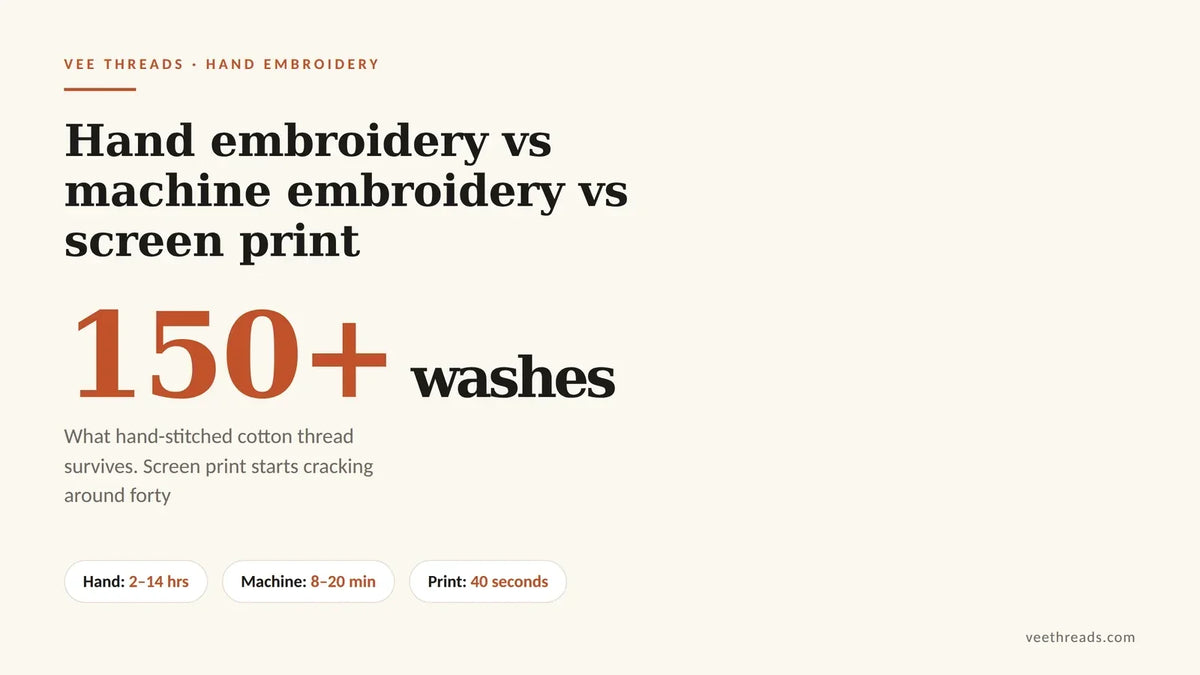
Short answer. Hand embroidery survives 150-plus washes and can be repaired. Machine embroidery survives just as long but stiffens where the backing sits. Screen print starts cracking around forty washes and cannot be fixed. Hand takes 2 to 14 hours per shirt, machine takes 8 to 20 minutes, screen print takes about forty seconds.

Three ways to put a design on a T-shirt, and the internet mostly compares them on cost. Cost is the least interesting axis. Here is what actually differs when you own the garment for three years.
Straight comparison

| Hand embroidery | Machine embroidery | Screen print | |
|---|---|---|---|
| Time per shirt | 2 to 14 hours | 8 to 20 minutes | About 40 seconds |
| Survives 50 washes | Yes, thread holds | Yes, backing stiffens | No, edges crack |
| Texture | Raised, uneven, tactile | Raised, perfectly even | Flat, sits on the fibre |
| Fine detail | Excellent, hand-controlled | Good, limited by stitch minimum | Excellent, ink is not stitch-limited |
| Repairable | Yes, restitch the pull | Rarely worth it | No |
| Cost at 1 unit | ₹1,199 to ₹4,464 | ₹600 to ₹1,200 | ₹250 to ₹600 |
| Cost at 500 units | Slow and expensive | Efficient | Cheapest by far |
| Best for | Gifts, keepers, custom names | Logos, uniforms, mid-volume | High-volume graphics, events |
Why print cracks and stitch does not
Screen print is a layer of plastisol or water-based ink sitting on top of the cotton. Every wash cycle flexes it. Every hot dry cycle bakes it. After roughly forty rounds the ink loses elasticity faster than the fabric does, and the edges go first.
Embroidery thread passes through the fabric. There is no layer to crack, because there is no layer. What fails on embroidery instead is a snagged thread pulled by a zip or a bag strap, and that is a fixable problem.
Print sits on the cotton, thread goes through it
A cross-section of the fabric. Tap a method to see what years of washing do to it.
Screen print is a layer. Plastisol or water-based ink sits on top of the cotton. Every wash flexes it and every hot dry cycle bakes it.
Around forty washes, the edges crack. The ink loses elasticity faster than the fabric does, and the edges go first. It cannot be fixed.
Machine embroidery goes through. Thread passes through the fabric, so there is no layer to crack. It lasts as long as hand work, but the backing under dense fills stays stiff.
Hand embroidery goes through too. No layer and no backing, so it survives 150-plus washes and the stitched area stays flexible.
What fails instead is a snag. A zip or bag strap pulls a thread. That is a fixable problem: the pull gets restitched.

The reverse-side test
If someone sells you machine embroidery as hand work, the front will not give it away. The back will, every time.
Hand work: knots, thread tails, floats running between motifs, tension that varies slightly because a person made it. Machine work: a uniform bobbin-thread grid, and usually a sheet of cut-away backing still attached and slightly stiff to the touch.
Ask for that photo before you pay. It is the first of nine checks we would run.
The reverse-side test
Tap to turn the shirt over and see what gives it away.
The front will not give it away. Machine embroidery sold as hand work can look the same on the face. The back gives it away every time.
Hand work: knots and tails. The reverse shows knots and thread tails. They are the first thing to look for.
Hand work: floats and tension. Thread floats run between motifs, and the tension varies slightly because a person made it.
Machine work: a bobbin grid. The back shows a uniform bobbin-thread grid, identical across the whole motif.
Machine work: the backing. Usually a sheet of cut-away backing is still attached, slightly stiff to the touch. Ask for a photo of the reverse before you pay.

When machine embroidery is the right call
We refer people to machine units regularly, so this is not a grudging admission. Machine embroidery is the correct choice for company logos, sports kit, school uniforms, anything past fifty identical pieces, and anything needed inside a week.
It is durable, it is consistent, and at volume it costs a fraction of hand work. Its only real flaw is that dense machine fills go stiff, which you feel through a thin tee.
When hand embroidery is the right call
One-offs. Names and dates. Gifts where the point is that a person made it for a person. Designs with organic shapes that machine fills flatten out, like the layered florals in our floral embroidery collection or the animals in animal embroidered designs.
And anything you plan to still own in five years. The cost-per-wear case is here.

Can you mix them?
Plenty of brands do: machine-stitched base logo, hand-stitched detail on top. It is legitimate work. It stops being legitimate when the listing says “hand embroidered” and the hand part is four French knots.
Ask what proportion is hand-stitched. A studio will tell you. Ours is hand-stitched throughout, which is why a full back panel takes fourteen hours and costs what it costs.

Frequently asked questions
Is hand embroidery better than machine embroidery?
Not better, different. Hand embroidery gives organic texture and is repairable, but takes 2 to 14 hours per shirt. Machine embroidery is faster, cheaper at volume and equally durable, though dense fills feel stiff.
How many washes does screen print survive?
Roughly 40 before the edges start cracking. Ink sits on top of the cotton and loses elasticity faster than the fabric. Embroidery thread passes through the fabric, so there is no layer to crack.
How can I tell hand embroidery from machine embroidery?
Look at the reverse of the fabric. Hand work shows knots, thread tails and uneven float. Machine work shows a uniform bobbin grid and usually a stiff backing sheet still attached.
Which is cheapest for 500 T-shirts?
Screen print by a wide margin, then machine embroidery. Hand embroidery has no setup cost to spread across a run, so the 500th shirt takes the same hours as the first.
Does machine embroidery feel different to wear?
Yes. Dense machine fills sit on a backing layer that stays stiff, which you notice through a thin tee. Hand stitching has no backing, so the area stays more flexible.
Who wrote this
Vee Threads is a hand-embroidery label run by Vikash Tomar and Mansi from a studio in Bulandshahr, Uttar Pradesh. Every piece is stitched by hand by women artisans on the studio floor, on 220 GSM combed cotton tees and 400 GSM sweatshirts. We have shipped more than 5,000 orders. Mansi runs the studio and quality control, Vikash handles the digital side. Prices, timings and hours quoted in this article come from our own production records, not from industry averages. Browse the hand embroidered T-shirt collection or start a custom hand embroidery order.











Share and get 15% off!
Simply share this product on one of the following social networks and you will unlock 15% off!