



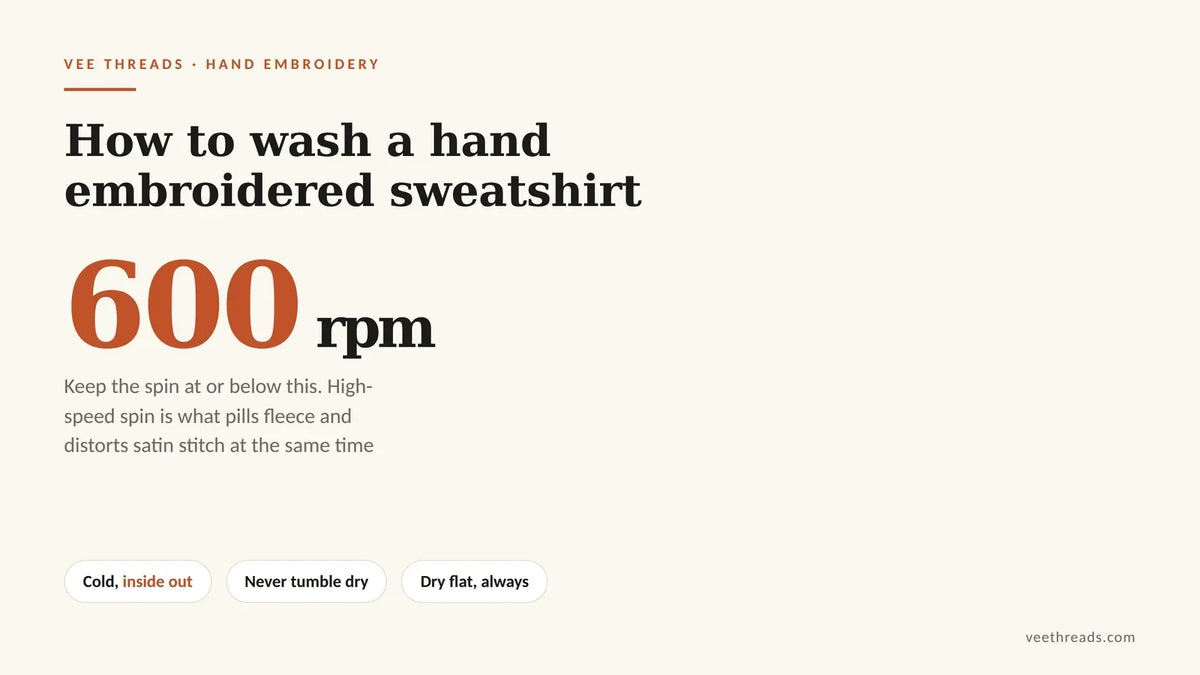
Short answer. To wash an embroidered sweatshirt, turn it inside out and wash at 30°C or below with mild detergent and no fabric softener, keep the spin at 600 rpm or under, and dry flat in shade. Never tumble dry. The same routine protects two different things at once: it slows fleece pilling and it stops satin stitch distorting.

General care for hand-embroidered clothing is covered in our laundry guide and the storing and ironing guide. This page is about the problem those two do not cover: fleece pilling, and why the sweatshirt is the one garment where washing habits decide how it looks in year two.
Fleece and embroidery fail in different ways, and it is lucky that one routine prevents both. Fleece pills where it rubs. Satin stitch distorts when it is twisted or crushed. High-speed spin does both at once, for four minutes, every wash.
The routine

| Step | Do this | What happens if you do not |
|---|---|---|
| 1. Turn inside out | Motif and outer pile both face away from the drum | Both rub the drum wall for the whole cycle |
| 2. Wash cold, 30°C max | Cool water only | Hot water felts the fleece and bleeds dyed floss |
| 3. Mild detergent, no softener | Skip fabric conditioner entirely | Softener coats fleece fibres and speeds up pilling |
| 4. Spin at 600 rpm or below | Change the setting, not just the cycle | High spin pills the fleece and distorts satin stitch |
| 5. Dry flat in shade | On a towel, motif face up | Wet 350 GSM is heavy enough to stretch its own shoulders |
| 6. Steam from the reverse | Then brush the nap back up | A hot plate on the face flattens both stitch and pile |

The fabric softener thing
This is the advice people most often refuse, so here is why.
Softener works by depositing a fine coating on fibres. On smooth cotton that reduces friction and feels nice. On fleece, where the whole surface is raised loops or brushed fibres, the coating makes individual fibres more likely to break free and tangle with their neighbours. Tangled loose fibres are precisely what a pill is.
Cotton fleece softens on its own with washing. It does not need help, and the help makes it bobble.
How softener turns into pills
Tap through. A close-up of the fleece surface, one step at a time.
Raised loops. On fleece the whole surface is raised loops or brushed fibres.
A fine coating. Softener works by depositing a fine coating on fibres. On smooth cotton that reduces friction and feels nice.
Fibres break free. On fleece the coating makes individual fibres more likely to break free.
They tangle with their neighbours. Tangled loose fibres are precisely what a pill is.
Skip conditioner entirely. Cotton fleece softens on its own with washing. It does not need help, and the help makes it bobble.

What to do when it pills anyway
It will, eventually. Every fleece does, at the inner arm and along the side seams first.
A battery fabric shaver, the ₹300 sort, takes them off in about five minutes and the garment looks close to new. Work around the motif rather than over it, because a shaver head will happily cut embroidery thread. This solves most of what people complain about in fleece reviews and almost nobody mentions it.
Where a sweatshirt wears, and what protects it
Tap a numbered spot to see what goes wrong there first.
Inner arm. Every fleece pills eventually, at the inner arm first. A battery fabric shaver, the ₹300 sort, takes pills off in about five minutes.
Side seams. The other place pills start. Fleece pills where it rubs, so turn it inside out and keep the spin at 600 rpm or below.
The motif. Work the shaver around the motif rather than over it: a shaver head will happily cut embroidery thread. Never scrub across it either.
Shoulders. Wet 350 GSM is heavy enough to stretch its own shoulders, so dry flat. Fold, do not hang: a hanger puts the whole weight through two shoulder points for eight months.
High-speed spin pills the fleece and distorts satin stitch at the same time.
Stains
- Oil or food: blot, work in a drop of mild detergent with a finger, cold rinse. Time rather than pressure.
- Never bleach or use an oxygen brightener. Both attack dyed floss before they touch the fleece, and a bleached patch on a red motif cannot be undone.
- Never scrub across the motif. Friction on satin stitch raises fuzz that never lies flat again. Work around it.
Storing it through summer
Fold, do not hang. A hanger puts the whole weight of 350 GSM through two shoulder points for eight months, and loose-fit sweatshirts show it badly.
Fold with the motif inward so raised stitching is not pressed against a zip in the next drawer, and keep it near the top of the pile rather than under a stack of jeans. Wash before storing, not after, because body oils oxidise over a summer and set.

Pulled threads
Do not cut it and do not pull the other end. A snagged loop can usually be worked back to the reverse with a blunt needle. A broken fill can be restitched, which is the practical advantage embroidery has over print. Send us a photo and we will tell you honestly whether it is a five-minute fix or a studio job.
How long this should last
Colourfast floss holds past 150 washes on this routine. In practice the fleece softens, thins and pills before the stitching gives out, which is the opposite of what happens with a printed sweatshirt where the graphic fails while the fabric is still fine.
A care card ships in every box. The five complaints owners actually have, most of which this routine prevents.

Frequently asked questions
How do you wash a hand embroidered sweatshirt?
Inside out at 30°C or below with mild detergent and no fabric softener, spin at 600 rpm or under, dry flat in shade, and steam from the reverse. Never tumble dry.
Why should I avoid fabric softener on fleece?
Softener coats fibres. On raised fleece that makes individual fibres more likely to break free and tangle with neighbours, which is exactly what a pill is. Cotton fleece softens on its own with washing.
What spin speed is safe for embroidered fleece?
600 rpm or below. High-speed spin pills the fleece and distorts satin stitch at the same time, and it is the single most damaging setting on the machine.
How do I remove pilling from an embroidered sweatshirt?
A battery fabric shaver takes pills off in about five minutes. Work around the motif rather than over it, because the shaver head will cut embroidery thread.
How should I store a sweatshirt over summer?
Wash it first, then fold rather than hang, with the motif facing inward. A hanger puts the full weight of 350 GSM fleece through two shoulder points for eight months.
See the stitching up close. New designs and studio detail shots go up on our Pinterest first. Shipping outside India is easiest through our Etsy shop, which handles the customs paperwork.
Who wrote this
Vee Threads is a hand-embroidery label run by Vikash Tomar and Mansi from a studio in Bulandshahr, Uttar Pradesh. Every piece is stitched by hand by women artisans on the studio floor, on 350 GSM cotton fleece for sweatshirts, 400 GSM for hoodies, and 220 GSM combed cotton for tees. We have shipped more than 5,000 orders. Mansi runs the studio and quality control, Vikash handles the digital side. Prices, timings and hours quoted here come from our own production records, not industry averages.
Browse hand embroidered sweatshirts and embroidered hoodies, start a custom order, or find us on Etsy and Pinterest.











Share and get 15% off!
Simply share this product on one of the following social networks and you will unlock 15% off!