



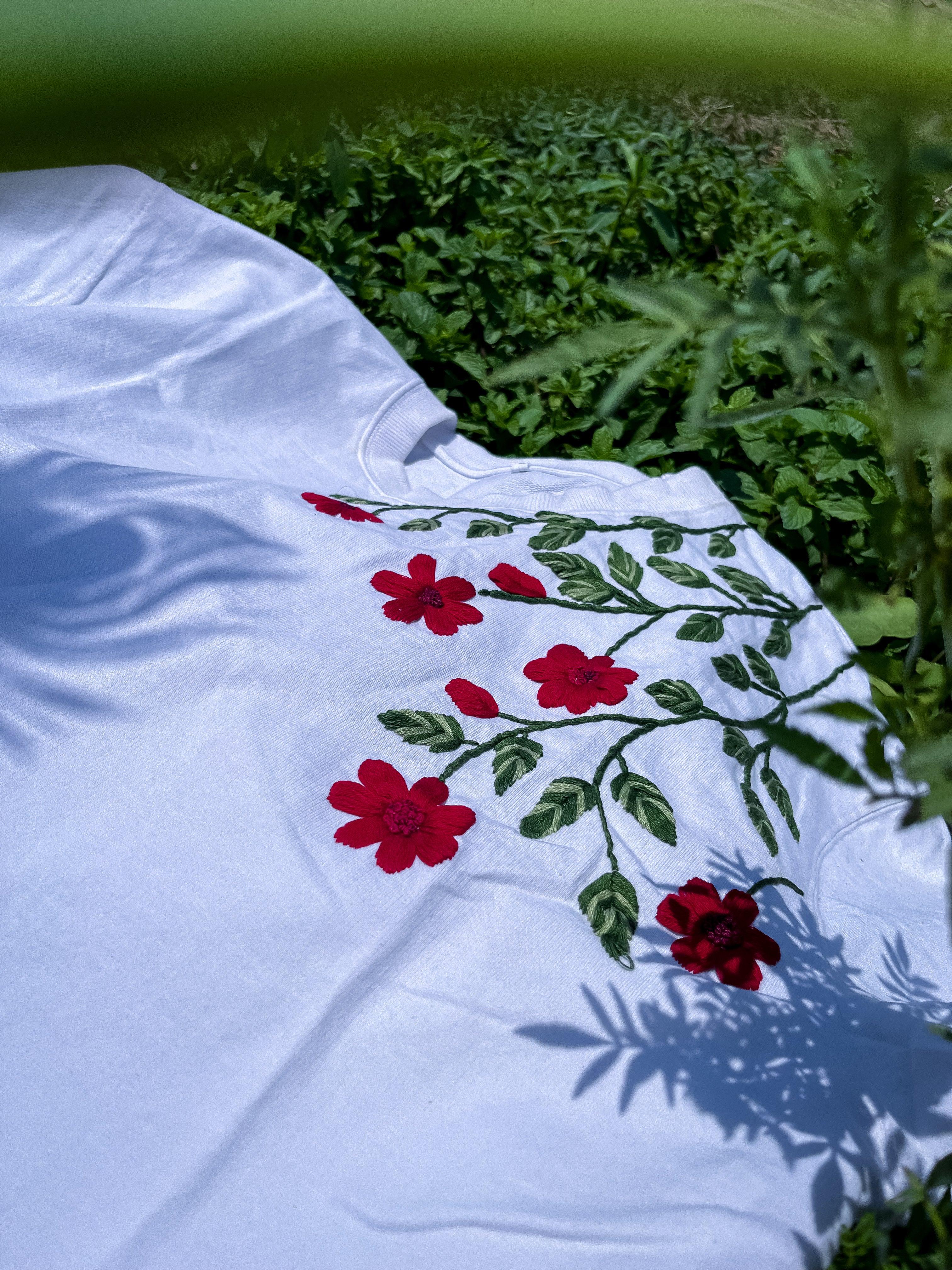
"Hand-embroidered" on a label does not tell you much on its own. These are the things that actually separate a tee you keep for years from one that pills and sags after a month.
Start with GSM, the fabric weight

GSM means grams per square metre, the weight of the cloth. Light tees run about 140 to 160 GSM and can feel thin and see-through. Midweight sits around 180 to 200. A heavyweight tee, roughly 220 GSM and up, holds its shape, drapes better, and survives more washes. Ours are 240 GSM cotton, on the heavier end on purpose.
The cotton matters as much as the weight
Weight alone is not quality. Smooth, tightly knit cotton resists pilling and gives embroidery a clean surface to sit on. Loose, fuzzy fabric pills at the cuffs and around the design. Run your hand across it: a good tee feels dense and even, not papery or rough.

Is the design actually stitched?
This is the big one. Print and vinyl sit on the surface and crack or peel over time. Real embroidery is thread pulled through the cloth, with raised texture you can feel. Turn the garment over: a stitched design shows thread work on the reverse. A print shows nothing but a flat, slightly rubbery patch.
Check the finish inside
The inside tells you who made it carefully. Loose thread tails, a stiff plastic backing, or a scratchy reverse mean corners were cut. A tidy reverse, trimmed threads, and a soft hand where the design sits mean it was finished by someone who expected you to wear it, not just photograph it.

A quick checklist before you buy
- GSM listed, and 220 or more for a tee that lasts
- Cotton that feels dense and smooth, not thin or fuzzy
- Raised, real stitching with thread on the reverse, not a flat printed patch
- A clean, soft inside with trimmed threads
- Honest sizing and care notes on the page
Where our tees land
For the record: 240 GSM cotton, hand-embroidered in real thread by artisans in Bulandshahr, with the reverse finished so it stays soft against skin. We list fit and care on every product page, because a good tee should not be a guessing game.
Frequently asked
What GSM is best for a t-shirt?
For everyday wear that lasts, 180 to 200 GSM is solid, and 220 or more is properly heavyweight. Lighter than 160 tends to feel thin and wear out faster.
Is embroidery better than print on a t-shirt?
For longevity, yes. Stitched thread is part of the fabric and does not peel; print sits on top and cracks over time. Print can be cheaper for big, colourful graphics.
How can I tell quality before buying online?
Look for a listed GSM, clear fabric details, real close-up photos of the stitching, and honest sizing and care notes. Vague listings usually hide thin fabric.
Does heavier cotton always mean better?
Mostly, but the knit matters too. A dense, smooth 200 GSM can beat a fuzzy 240. Weight plus a clean knit is the combination you want.
See how ours are made and described: browse the hand-embroidered tees.











Share and get 15% off!
Simply share this product on one of the following social networks and you will unlock 15% off!