



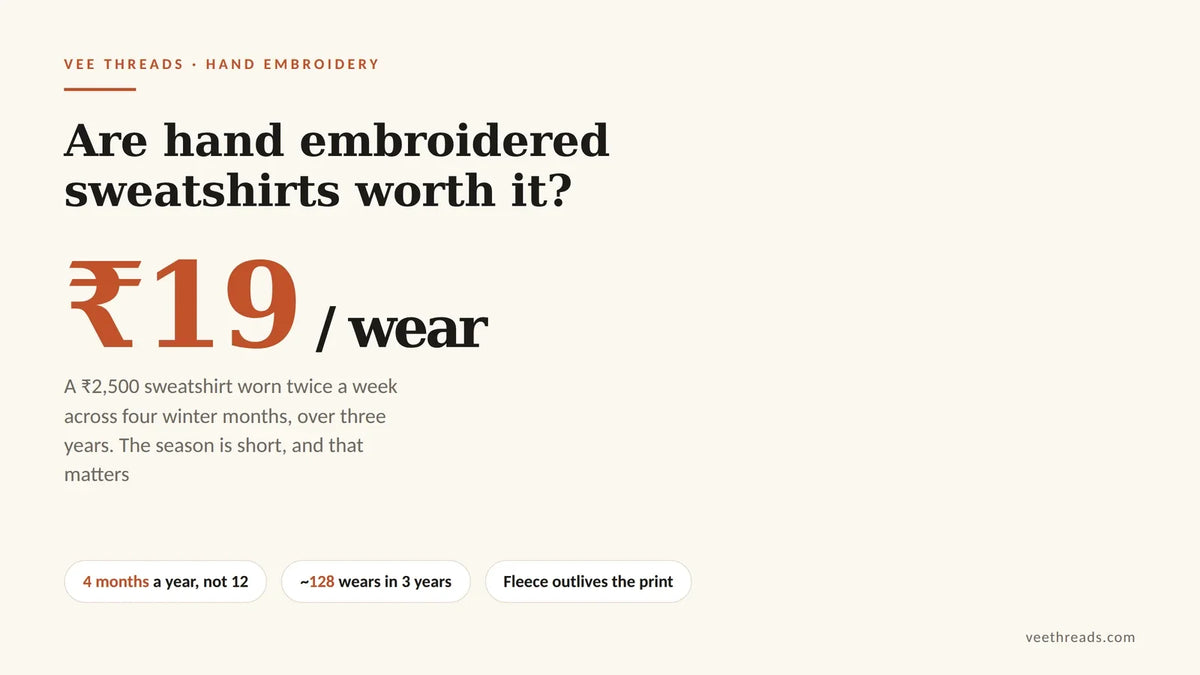
Short answer. Honestly, on pure cost per wear a printed sweatshirt wins. A ₹2,500 hand-embroidered one worn twice weekly across four winter months costs about ₹19.53 per wear over three years; a ₹899 printed one replaced once costs ₹14.05. The case for embroidery is not arithmetic. It is that the stitching outlives the garment.

I could have picked friendlier assumptions and made this come out the other way. Twelve months of wear, or a printed sweatshirt replaced twice instead of once, and embroidery wins comfortably. That would be dishonest, so here are the numbers as they actually fall.
The cost-per-wear numbers
Three years, two wears a week, four months a year. That is 128 wears. Printed fleece graphics crack around 40 washes, and a sweatshirt gets washed less often than a tee, so one replacement over three winters is realistic.
| What you buy | Cost over 3 winters | Cost per wear | Condition at year 3 |
|---|---|---|---|
| Hand embroidered, ₹2,500 | ₹2,500 | ₹19.53 | Thread intact, fleece softened, some pilling at the sides |
| Printed sweatshirt, ₹899, replaced once | ₹1,798 | ₹14.05 | Second one cracking at the edges |
| Fast-fashion fleece, ₹699, replaced twice | ₹2,097 | ₹16.38 | Third one thin and bobbled at the shoulders |

Cost per wear across three winters
Tap an option. Two wears a week, four months a year, three years: 128 wears.
Hand embroidered, ₹2,500. Bought once. ₹2,500 over three winters is ₹19.53 a wear, the highest of the three. At year 3 the thread is intact, the fleece has softened, with some pilling at the sides.
Printed, ₹899, replaced once. Graphics crack around 40 washes, so you buy two. ₹1,798 in total, ₹14.05 a wear. The cheapest per wear. At year 3 the second one is cracking at the edges.
Fast-fashion fleece, ₹699, replaced twice. Three purchases, ₹2,097 in total, ₹16.38 a wear. At year 3 the third one is thin and bobbled at the shoulders.
On this metric the printed sweatshirt wins. Bars are to scale.
So why buy the embroidered one
Three reasons that the per-wear number cannot capture.
The decoration outlives the garment. On a printed sweatshirt the graphic fails first and the fleece is still fine, which is what makes it feel wasteful to throw out. On an embroidered one the fleece pills and softens while the stitching stays exactly as it was. You retire it because it is worn, not because it looks broken.
It is repairable. A snagged thread on satin stitch can be worked back through. A cracked print cannot be fixed by anyone at any price.
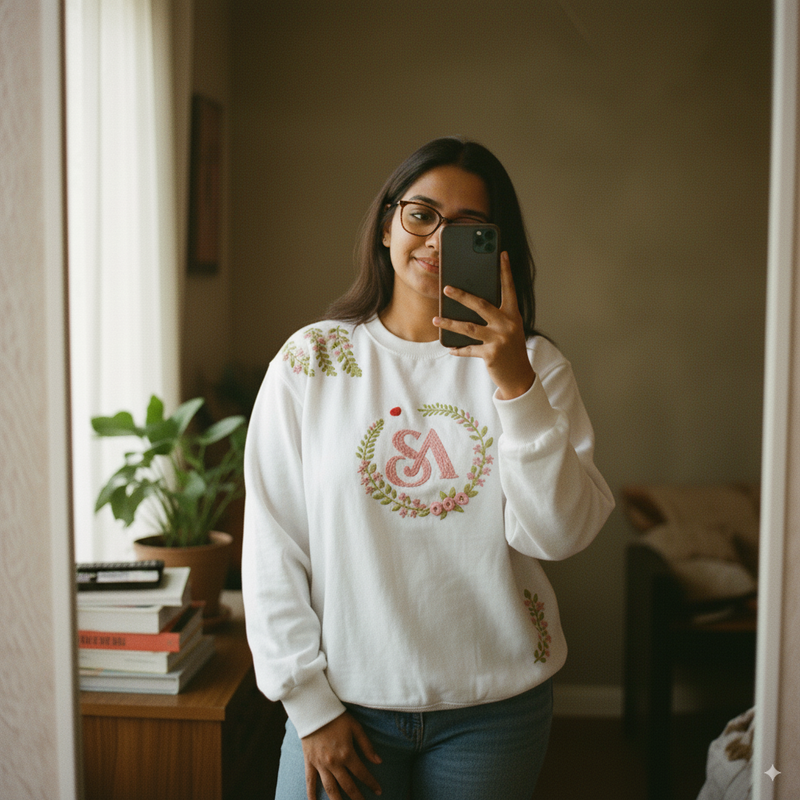
Nobody else has it. A printed sweatshirt is a run of thousands. A monogram wreath with your initial in it is a run of one.
What fails first: the graphic or the garment
Step through the washes and watch which part gives up.
New. Both look the same on day one. The difference only shows with washing.
Around 40 washes. Printed fleece graphics crack around here, while the fleece underneath is still fine. That is what makes throwing it out feel wasteful.
Past 150 washes. Hand-stitched cotton floss holds well past 150. The fleece pills and softens while the stitching stays exactly as it was, so you retire it because it is worn, not because it looks broken.
A snagged thread on satin stitch can be worked back through. A cracked print cannot be fixed.

If the pullovers you already own are the thing prompting this, seven signs it is the buying pattern rather than the garments.

Where the case genuinely collapses
- You live somewhere warm. If your fleece season is six weeks rather than four months, cost per wear roughly triples and none of this holds.
- It is too nice to wear. Some people buy something hand-stitched and then save it. If that is you, buy the printed one, wear it constantly, and be happier.
- Kids. Outgrown in a season. Bad value at any quality level.
- Gym and daily rough wear. Friction pills fleece and abrades stitching. Buy printed.
Does the case collapse for you?
Tick any that apply. Each one shows why.
of 4 apply
None of these? Then the reasons to buy embroidered still stand. Start with one piece around ₹1,785 from the entry range, wear it through one winter, and see whether you reach for it.
Printed fleece is the better buy here.
Even one of these and printed fleece is the better buy.
The gifting case is different
This is where the arithmetic stops being the point. Nobody costs a gift per wear. A stitched name, a wedding date in Roman numerals, an anniversary year, these land differently from a slogan pullover, and the recipient keeps them for reasons that have nothing to do with fleece quality.
Which is why our Roman Numeral Anniversary Sweatshirt and the couples range sell hardest in December and February rather than across the season evenly.

Where to start
Not at the top. Buy one piece around ₹1,785 from the entry range, wear it through one winter, and see whether you reach for it. That test costs less than being wrong at ₹4,463.

If you want the full price picture first, it is here.
Frequently asked questions
Are hand embroidered sweatshirts worth the money?
On pure cost per wear, no. About ₹19.53 per wear against ₹14.05 for a printed sweatshirt replaced once. The case rests on the stitching outliving the garment, being repairable, and being one of one.
How many wears do you get from a sweatshirt in India?
About 128 over three years, assuming two wears a week across a four-month season. That short season is exactly why sweatshirt cost-per-wear maths is weaker than the equivalent for a T-shirt.
Does embroidery last longer than print on fleece?
Yes. Printed graphics crack around 40 washes. Hand-stitched cotton floss holds well past 150. On an embroidered sweatshirt the fleece wears out before the decoration does.
When should I not buy an embroidered sweatshirt?
If your cold season is only a few weeks, if you would treat it as too special to wear, if it is for a growing child, or if it is for the gym. Printed fleece is the better buy in all four cases.
Is an embroidered sweatshirt a good gift?
It is the strongest case for one. Gifts are not costed per wear, and a stitched name, wedding date or year reads as a decision rather than a purchase.
See the stitching up close. New designs and studio detail shots go up on our Pinterest first. Shipping outside India is easiest through our Etsy shop, which handles the customs paperwork.
Who wrote this
Vee Threads is a hand-embroidery label run by Vikash Tomar and Mansi from a studio in Bulandshahr, Uttar Pradesh. Every piece is stitched by hand by women artisans on the studio floor, on 350 GSM cotton fleece for sweatshirts and hoodies and 220 GSM combed cotton for tees. We have shipped more than 5,000 orders. Mansi runs the studio and quality control, Vikash handles the digital side. Prices, timings and hours quoted here come from our own production records, not industry averages.
Browse hand embroidered sweatshirts and embroidered hoodies, start a custom order, or find us on Etsy and Pinterest.







Share and get 15% off!
Simply share this product on one of the following social networks and you will unlock 15% off!