



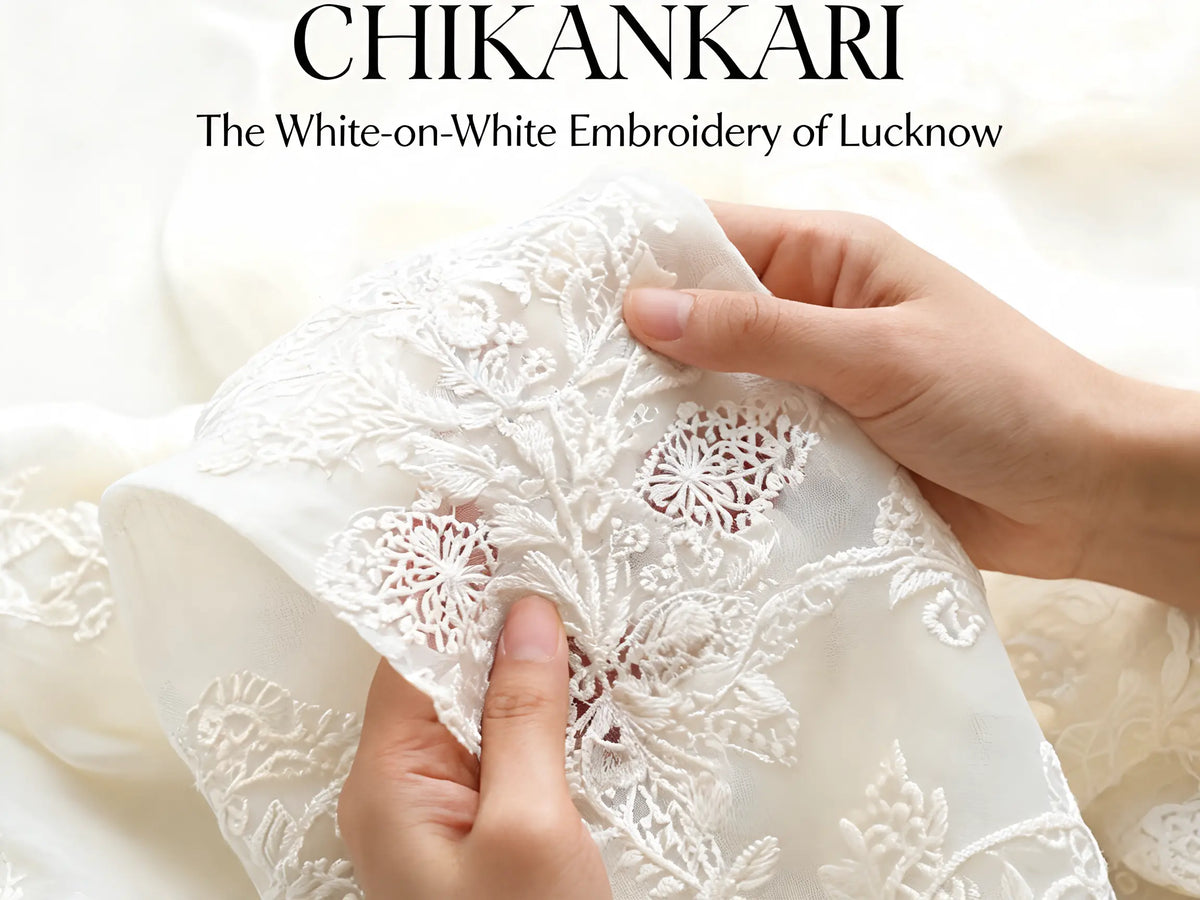
Chikankari is white thread on white cloth. That sounds like a limitation until you see it done properly, at which point it becomes obvious why it's survived for four hundred years.
Because there's no colour contrast, everything is carried by texture, shadow and the transparency of the fabric underneath. It is the most technically restrained embroidery tradition in India and arguably the most difficult to fake.

Where it comes from
Chikankari is centred on Lucknow, in Uttar Pradesh, and the craft is Geographical Indication protected, meaning “Lucknow chikan” is legally tied to the place.
The tradition is usually traced to the Mughal courts, most often to Nur Jahan, though the historical record for that specific attribution is thin. What's clear is that fine white-on-white needlework was established in the region by the seventeenth century and became a defined Lucknow craft under the Nawabs, worked on the fine muslins that suited the climate.
Shadow work: the signature
If chikankari has one defining feature, it's bakhiya: shadow work.
The embroiderer works a herringbone stitch on the reverse of the fabric. On the front, you don't see the stitching itself. You see the massed thread showing through the cloth as a soft, cloudy shape, with a fine outline where the stitches cross the edge of the motif.
That's why chikankari needs a fine, semi-transparent base. On thick opaque fabric shadow work simply doesn't read.
It's also why chikankari is soft on both faces. Turn a genuine piece over and the reverse is orderly and comfortable against skin. Turn a machine imitation over and you'll find stiff bobbin thread and a stabiliser layer.

The stitch vocabulary
Around 30 stitches are named within the tradition. Most garments use six to ten. The ones worth knowing:
- Bakhiya: shadow work, worked from the reverse. The defining stitch.
- Tepchi: a long running stitch, used for outlines and to sketch a design quickly.
- Murri: tiny rice-grain knots, usually forming flower centres. Dense, slow, and a reliable marker of skilled work.
- Phanda: a smaller, rounder knot than murri. Finer and harder.
- Jaali: the extraordinary one. Threads of the fabric are teased apart with the needle to open a lattice of tiny holes, without cutting a single thread. The result looks like net let into the cloth. Real jaali is the single hardest thing to imitate by machine.
- Hool: a small eyelet, with the hole made by parting threads rather than cutting.
- Keel kangan, zanzeera, banarsi: further named stitches for edging and detail.

Fabrics
Traditionally fine cotton muslin, chosen for the climate and for how it carries shadow work. Modern chikankari appears on:
- Cotton and mulmul: the classic, best for shadow work
- Georgette: drapes well, very common commercially
- Chanderi: slight sheen, formal
- Organza: sheer and structured; shadow work reads strongly
- Silk: luxurious, unforgiving of error
How to spot genuine hand chikankari
- Turn it over. Hand chikan is neat and soft on the reverse. Machine work has uniform bobbin thread and stabiliser backing.
- Look for jaali. Genuine jaali is threads parted, not cut, and the lattice is subtly irregular. Machine “jaali” is punched and perfectly even.
- Check the knots. Murri and phanda are individually formed. Machine knots repeat exactly.
- Look for drift. Two hand-worked flowers on the same garment will differ slightly.
- Feel the weight. Hand chikan on muslin is almost weightless. Heavy stiffness usually means backing.
- Question the price. A hand-embroidered chikan kurta at ₹600 is not hand-embroidered. Genuine work starts several times higher because it represents days of labour.

Caring for chikankari
- Hand wash in cold water with a mild detergent. The fabric is usually finer than the thread
- Never wring. Press water out flat between towels
- Dry flat in shade. Sun yellows white cotton over time
- Iron on the reverse, slightly damp, to keep the shadow work raised
- Store folded in cotton, not plastic. Plastic traps moisture and yellows white thread
- Keep it away from perfume sprayed directly. Alcohol marks white cotton
Why it matters now
Chikankari is one of the largest craft employers in Uttar Pradesh, and the great majority of the people doing the work are women working from home. It's also one of the most heavily imitated crafts in India: machine-embroidered “chikan” sold at prices genuine work can't match.
You can't legislate that away, but a buyer who can turn a garment over and read the reverse is the practical defence. That's most of why this guide exists.

WATCH MORE ABOUT CHIKANKARI AT
Read next: Chikankari, Kantha, Phulkari and Mirror Work: A Plain Guide · About our Bulandshahr studio
Vee Threads works in hand embroidery from Bulandshahr, Uttar Pradesh, about 300km from Lucknow, in the same needlework belt.








Share and get 15% off!
Simply share this product on one of the following social networks and you will unlock 15% off!