



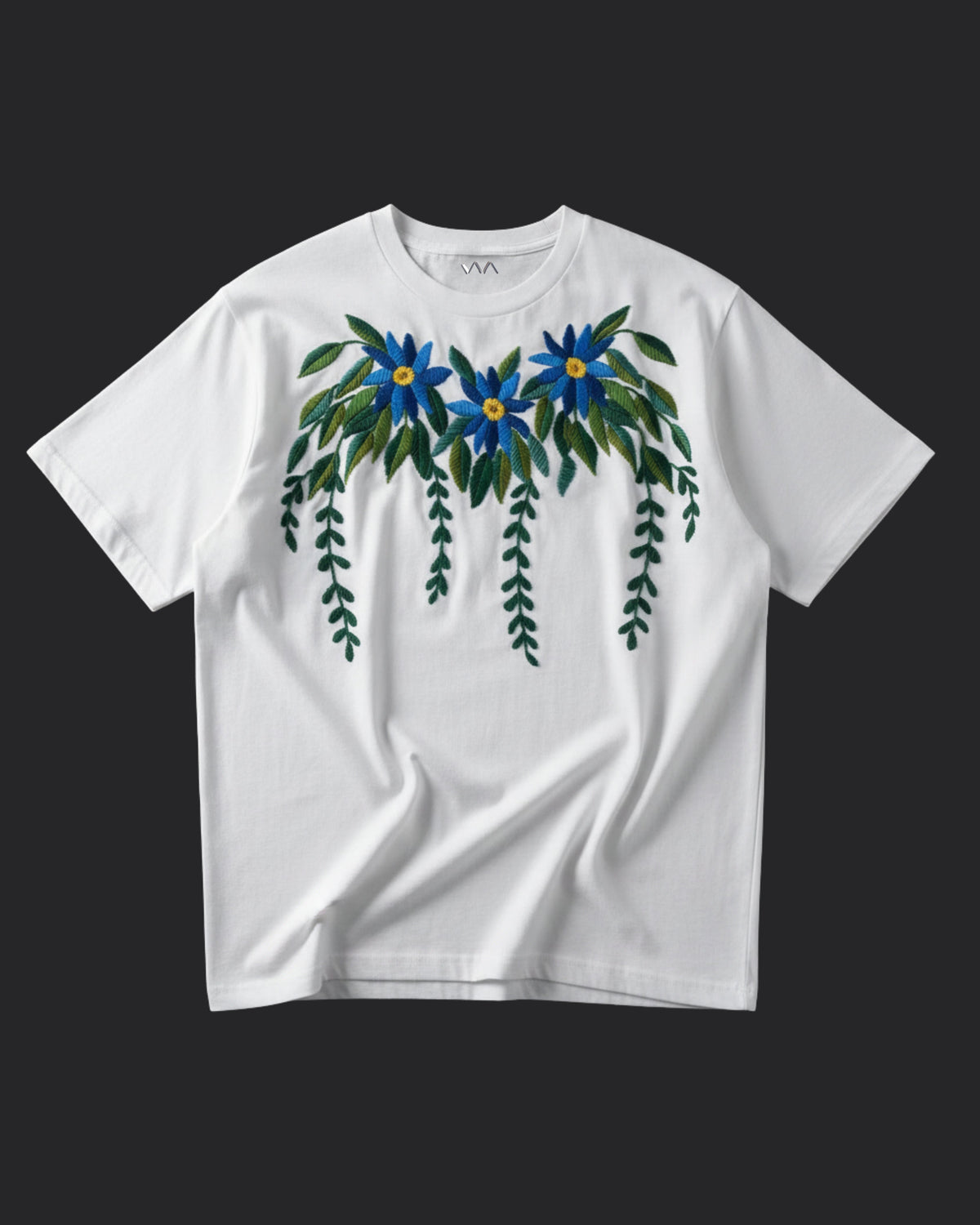
Search for “embroidered t-shirt” in India and you'll get thousands of results. Almost none of them are hand embroidered. Most are machine-embroidered, some are heat-pressed patches, and a fair number are just prints designed to look like thread.
That difference is worth understanding before you spend money, because it changes what the garment costs, how it ages, and whether two of them ever look exactly alike.
What “hand embroidered” means
A hand-embroidered t-shirt is stitched by a person holding a needle. The fabric is stretched in a hoop, the design is traced on, and someone works through it stitch by stitch. A dense floral panel across a neckline can run past 20,000 individual stitches. On our sweatshirts, one piece takes a full working day.
Machine embroidery is a different process. A design is digitised into a file, loaded onto a multi-head machine, and the machine stitches it out identically hundreds of times. It's real thread and it's durable — but it's a reproduction, not a made object.
Neither is dishonest. They're just different products at different prices. The problem is that “embroidered” gets used for both.


How to tell them apart
You can usually spot the difference in a product photo if you know what to look for.
Look at the back of the stitching. Machine embroidery leaves a neat, uniform bobbin thread pattern on the reverse, and almost always a layer of backing or stabiliser fabric. Hand embroidery has knots, thread tails, and no stabiliser.
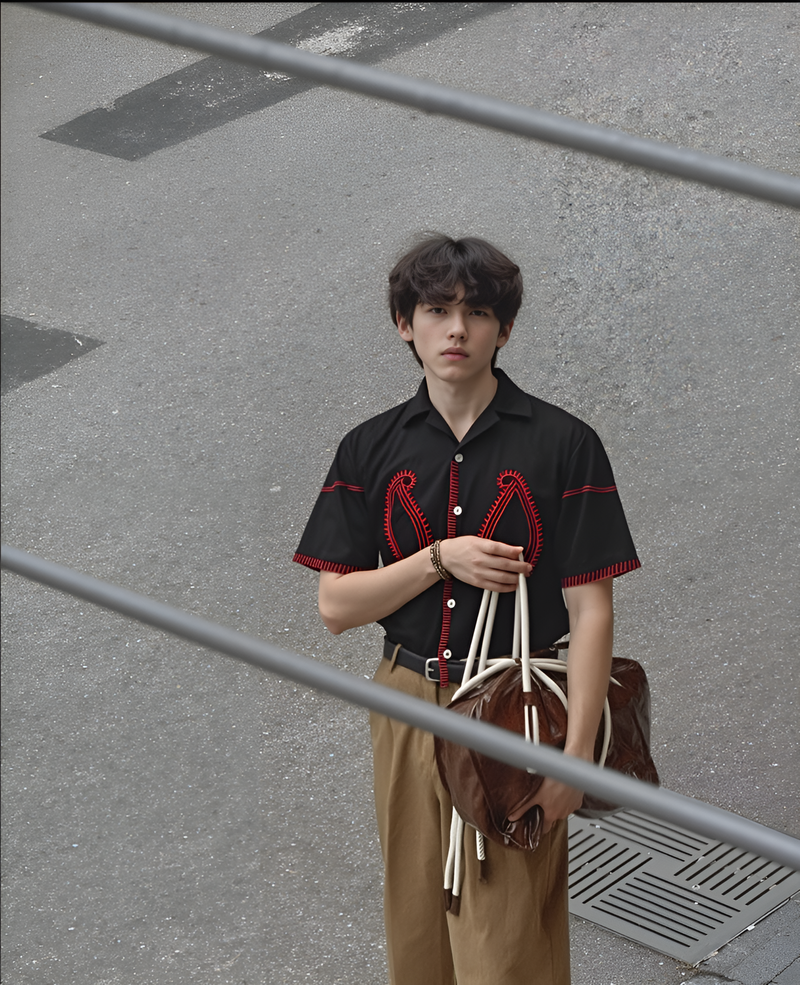
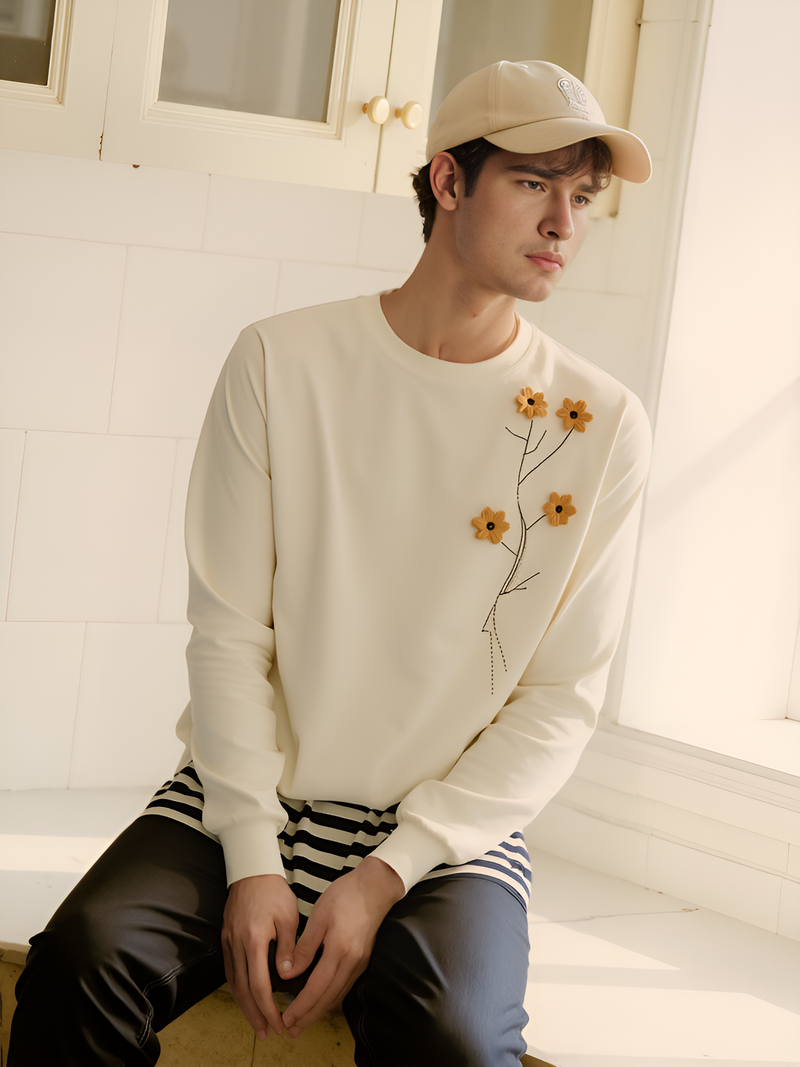
Look for repetition. If a design has six identical flowers spaced at identical intervals, it was digitised. Hand-stitched flowers drift — one petal sits slightly wider, one stem curves a little differently.
Look at the density and the edges. Machine satin stitch has a hard, glassy edge. Hand satin stitch has a softer, slightly irregular boundary where individual strands catch the light differently.
Ask about turnaround. Any seller offering 500 identical embroidered tees on 48-hour dispatch is running machines. That's fine — just know what you're paying for.
Check whether the listing shows one photo or many. Hand-embroidered sellers photograph pieces individually because they can't reuse a single hero image across a run.
Watch the two side by side
What it should cost in India
Rough bands as of 2026, for a cotton tee:
| Type | Typical price |
|---|---|
| Screen-printed “embroidery-look” tee | ₹400 – ₹700 |
| Machine-embroidered logo or small motif | ₹700 – ₹1,200 |
| Hand-embroidered small motif or initials | ₹1,300 – ₹1,900 |
| Hand-embroidered detailed artwork panel | ₹2,000 – ₹4,500 |
The jump at the hand-embroidered tier is labour, not markup. A detailed thread-painted design — a bird, a landscape, a dense garden panel — is a day or more of one artisan's time. If someone is selling that at ₹800, something in the description isn't accurate.
Base fabric matters too. A 180 GSM tee will distort under dense embroidery. We work on 220 and 240 GSM cotton for exactly this reason: heavier fabric carries the thread weight without puckering or sagging at the neckline. If you want the full picture, read what 180, 220 and 240 GSM cotton actually feels like.
Where hand embroidery works best on a tee
Placement isn't just aesthetic — it decides whether the garment survives.
Chest and left-chest. The most stable area. Low stretch, low abrasion. Best for logos, initials, small motifs.
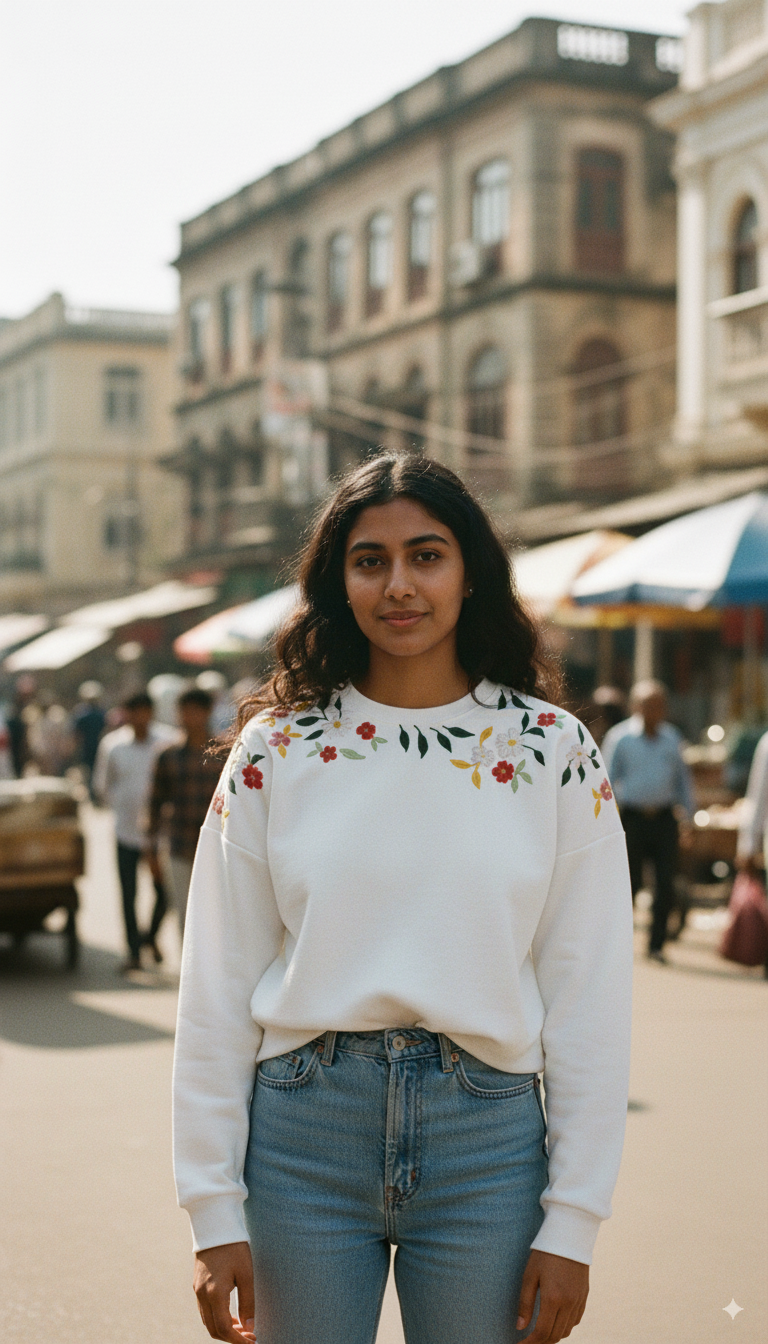
Neckline and shoulders. Visually the strongest placement, and increasingly the one people search for. The trade-off is that the neckline stretches every time the shirt goes over your head, so the stitching needs to be worked with some give.

Full front panel. Highest impact, highest cost, and the placement that shows off thread painting properly. Needs a heavier base fabric.
Sleeve and cuff. Underused. Small, subtle, and the fabric there barely moves.
Back yoke. Good for larger scenic designs. Nothing rubs against it except a chair.
Avoid dense embroidery directly over the underarm or the side seam. Those areas flex constantly and thread will eventually pull.
Custom and personalised: what's realistic
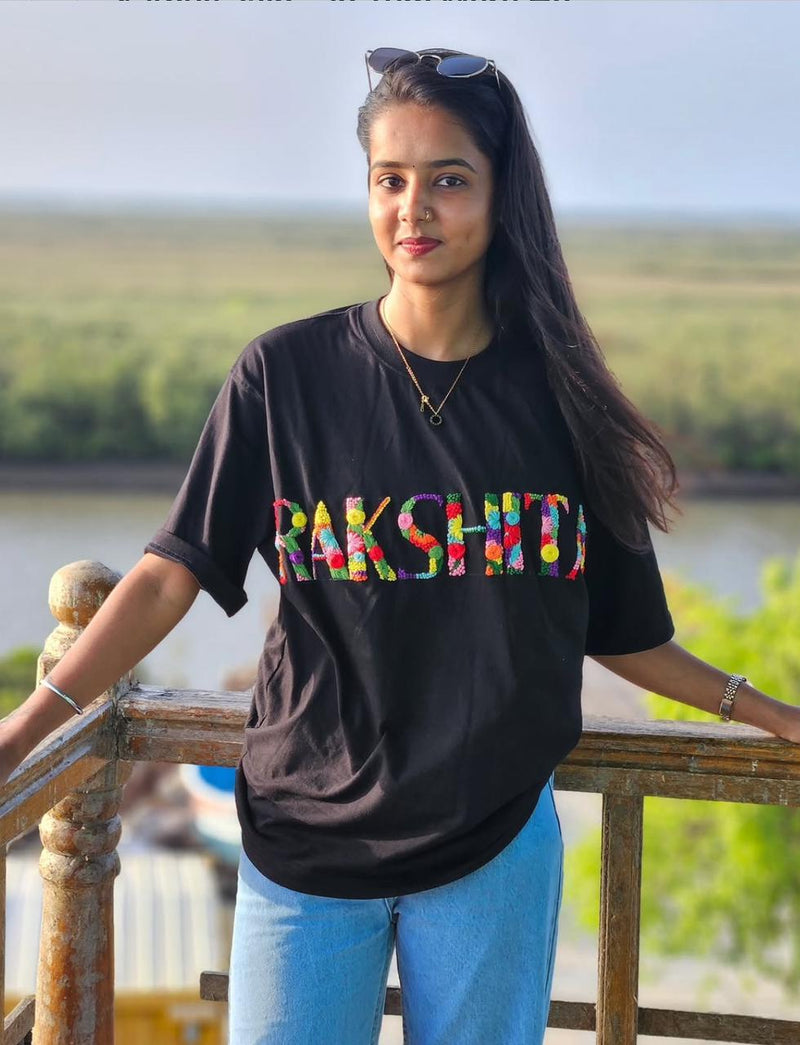
Most people searching for a custom embroidered t-shirt in India want one of three things: a name, a set of initials, or a logo.

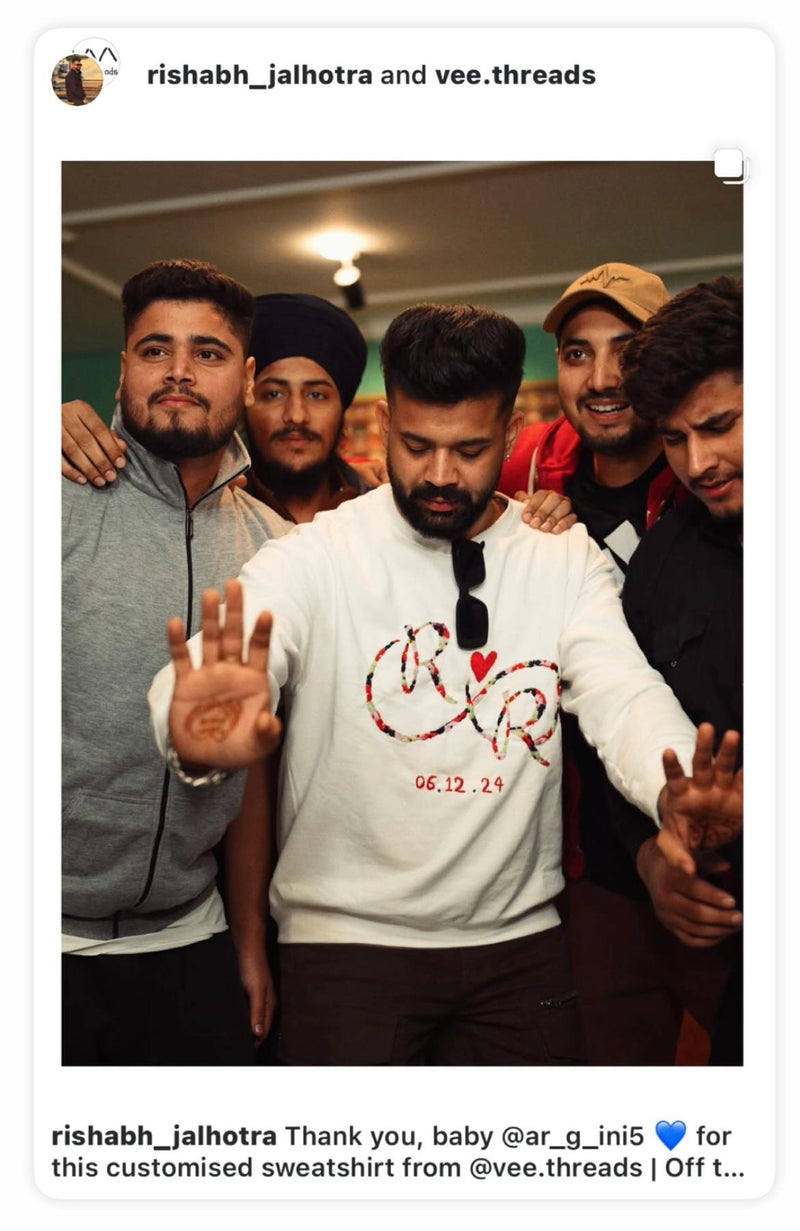
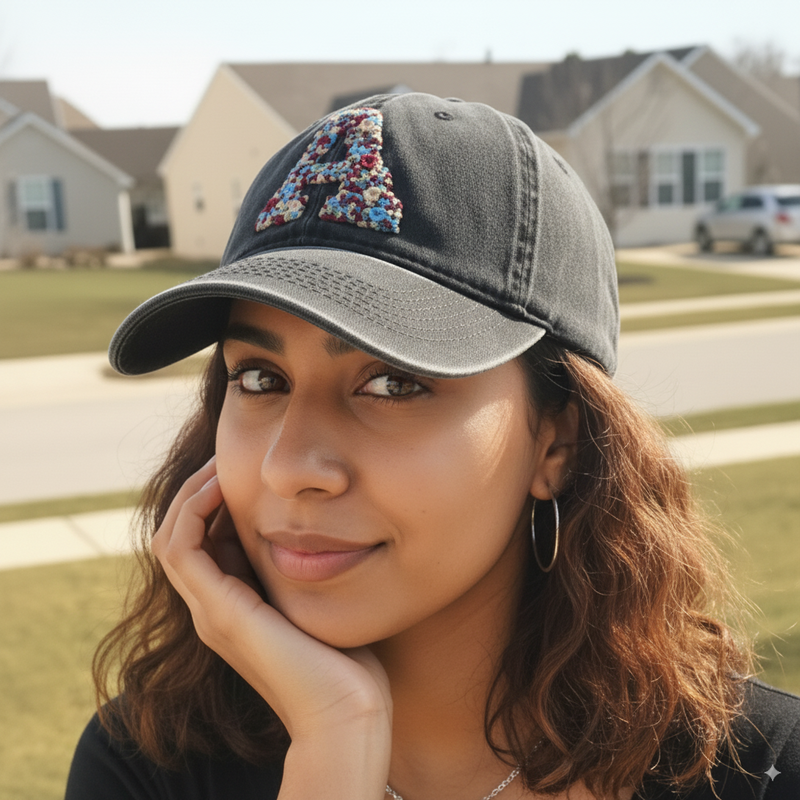
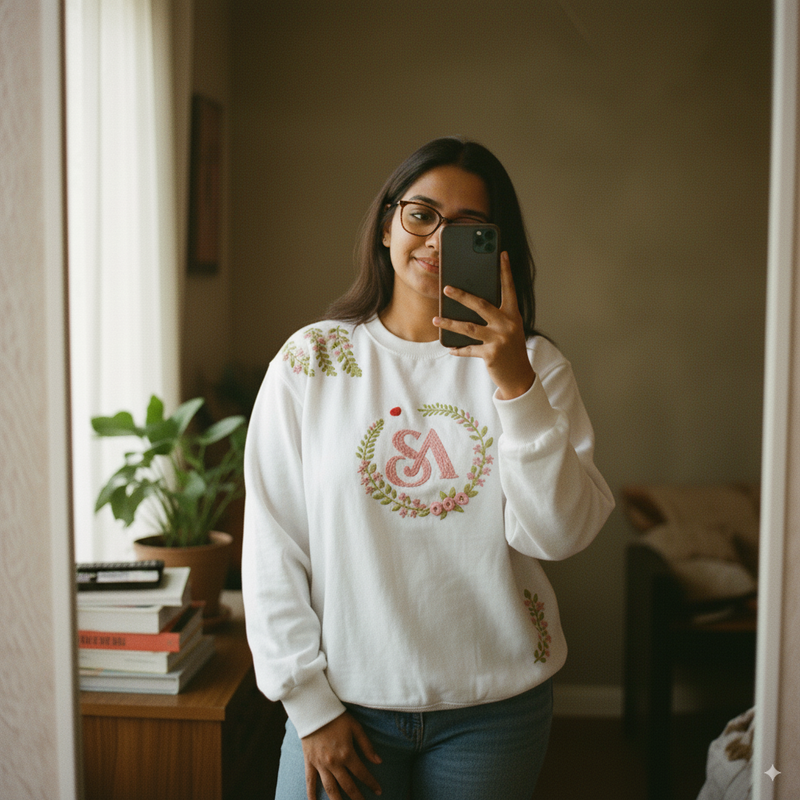
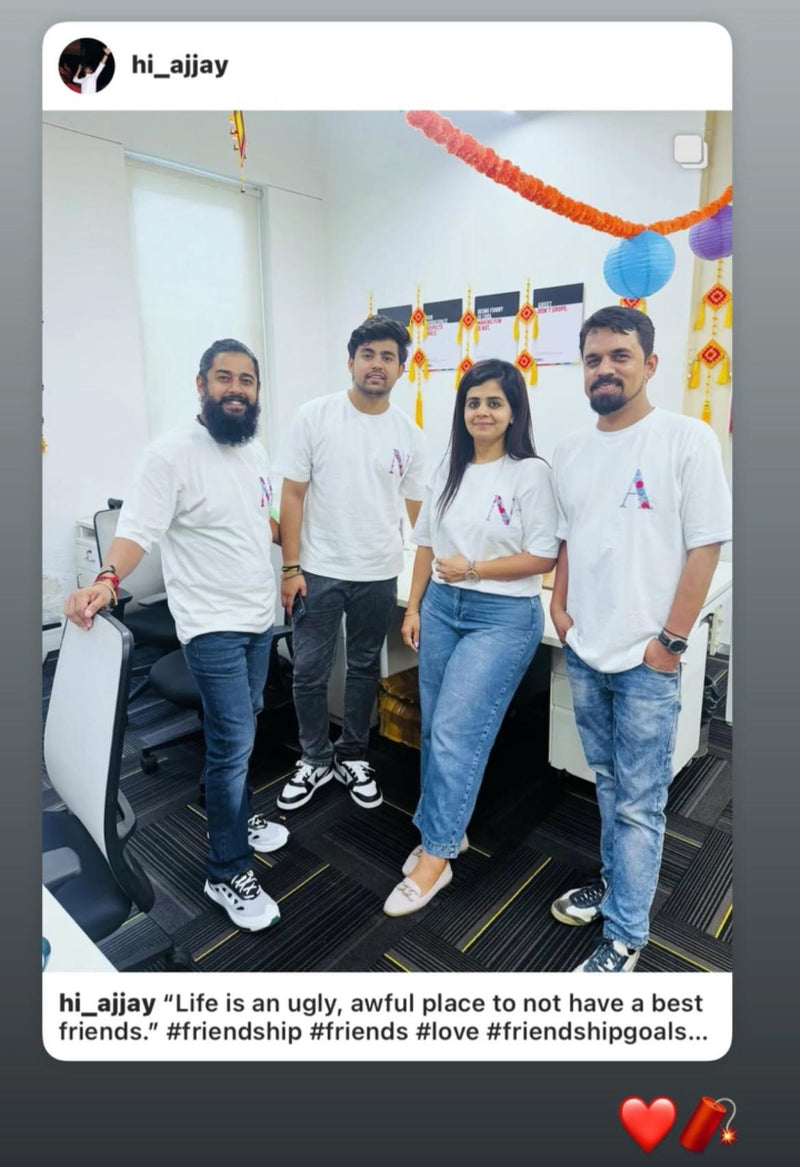
Names and initials are the easiest and cheapest to hand-embroider. Script, block, or a stitched signature — a signature copied from a piece of paper is the version people tend to keep longest. Expect ₹300 – ₹600 on top of the base garment, and a few extra days.
Logos are harder. A hand-embroidered logo will never be pixel-identical to the vector file, and if brand consistency across 200 units matters to you, machine embroidery is the correct choice. If you want twenty pieces where the hand-made quality is the point — founder gifts, a small launch run, client hampers — hand embroidery is worth it.
Artwork. Send a reference image and expect an interpretation, not a copy. Thread has limits that a printer doesn't: very fine lines, gradients across small areas, and photographic detail don't translate.
Ask any custom seller three questions before ordering: Will I see a mockup or a stitch-out before you start? What's the turnaround? What happens if the spelling is wrong on delivery?
Caring for it
Hand embroidery lasts years if you don't fight it.
- Wash inside out, cold, gentle cycle. Or hand-wash. The single biggest killer of embroidery is a washing machine agitator catching a raised stitch.
- Never wring the embroidered area. Press the water out flat.
- Skip the dryer. Heat shrinks cotton thread at a different rate than cotton fabric, and that's what causes puckering around the design.
- Dry flat, in shade. Direct sun fades dyed thread faster than it fades the garment.
- Iron on the reverse, or with a cloth over the top. Never directly on the stitching — you'll flatten the texture that made it worth buying.
- If a thread pulls, don't cut it. Work it back through from the reverse with a needle, or send it back to whoever made it. Most hand-embroidery makers, us included, will repair a pulled stitch.
Is it worth it?
If you want ten identical shirts for a team, no — machine embroidery does that job better and cheaper.
If you want one shirt that nobody else has, made by someone whose hands you could name, and that will still look good in five years because thread doesn't crack the way a print does — that's what you're paying the extra ₹800 for.
Every Vee Threads piece is hand-embroidered by artisans in Bulandshahr, Uttar Pradesh. Real thread, no prints, no iron-on patches.
Browse: Hand Embroidered T-Shirts · Custom Embroidered T-Shirts · Name & Initial Embroidery · Mens Embroidered Shirts







Share and get 15% off!
Simply share this product on one of the following social networks and you will unlock 15% off!