



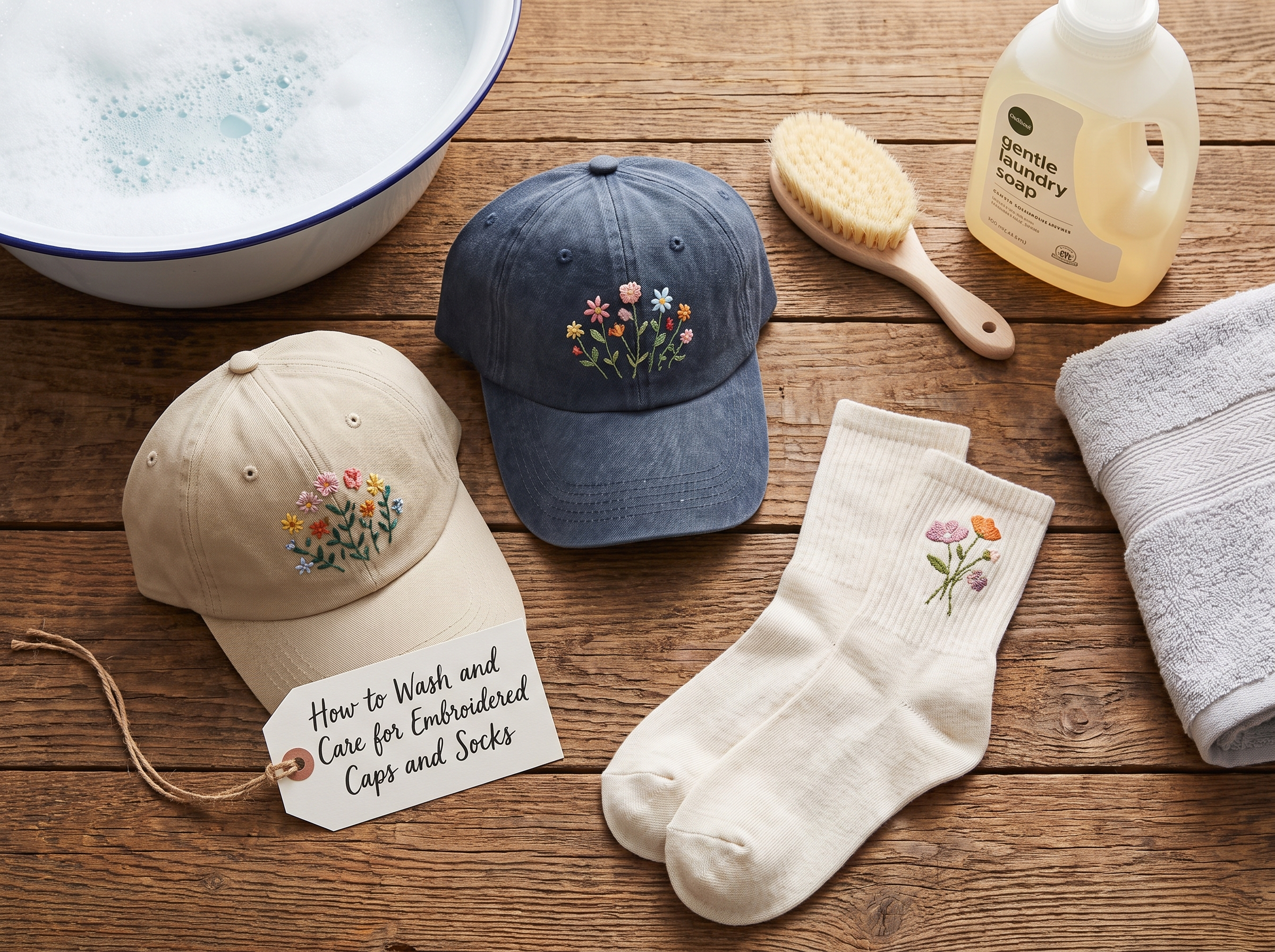
Most care advice for embroidered clothing assumes you are washing a t-shirt. Caps and socks are different problems. One has a structured shape that water can ruin, the other goes through the harshest wash cycle in your house.

Caps: never put one in the washing machine

This is the single most important line in this article.
A cap has a stiffened front panel and a curved brim, and both hold their shape because of an internal structure. A washing machine drum soaks that structure, then throws it against the sides for forty minutes. The brim warps, the crown collapses, and no amount of drying gets either back.
The embroidery is usually the least of your problems. It is the shape that does not recover.
How to clean a denim cap properly

Spot clean first, and most of the time that is all it needs.
Take a cloth, dampen it with cold water and a small amount of mild detergent, and work on the mark only. Blot rather than scrub, especially anywhere near the stitching. Then go over the same spot with a cloth dampened in plain water to lift the detergent out.
If the whole cap needs cleaning, wash it by hand in a bowl of cold water. Keep the brim out of the water as much as you can. Move it gently rather than wringing or twisting it, because twisting is what distorts the crown.
To dry it, press it between two towels to take out the worst of the water, then stand it on something roughly head shaped to hold the crown while it dries. A rolled towel works. So does a mixing bowl. Let it air dry away from direct sunlight, which fades denim unevenly.
Never tumble dry a cap. The heat shrinks the structure permanently.
Why denim behaves differently
Acid washed denim is dyed on the surface rather than all the way through the fibre, which is what gives it that faded character in the first place.
That means it keeps releasing colour for a while. Wash a denim cap in hot water and the dye lifts unevenly. Wash it next to something pale and the dye goes onto that instead. Cold water and washing it alone solves both.
It also means embroidery thread sitting on denim can pick up loose dye. Blotting rather than rubbing during spot cleaning keeps the thread clean.
Socks: the opposite problem

Socks get worn against skin all day, so they genuinely need a proper wash. You cannot spot clean your way out of it.
The risk here is not shape, it is snagging. Embroidery on socks sits on the cuff, where it rubs against everything else in the drum, and a long stitch caught on a zip or a hook comes loose.

Turn them inside out. This puts the stitching on the inside of the tube, away from whatever else is in the machine.
Use a mesh laundry bag. This is the single best thing you can do for embroidered socks. It costs very little and it stops the cuff catching on anything.
Wash cold, on a gentle cycle. Hot water shrinks the ribbed cuff and loosens the elastic that holds the sock up.
Air dry. Tumble drying is what kills sock elastic, and once the cuff has gone slack the sock slides down whatever the embroidery looks like.
Things that damage embroidery on both
A few habits worth dropping.
Fabric softener. It coats fibres to make them feel soft, and it coats embroidery thread too, dulling the colour over time. It also builds up on sock elastic and makes it slack.
Bleach and stain sticks with bleach in them. Coloured embroidery thread has no defence against it.
Ironing the front of stitching. Flattens the thread and removes the raised texture, particularly French knots. If a cap or sock needs pressing, do it from the reverse.
Leaving them wet in a pile. Damp cotton against damp cotton for a day is how dye transfers and how mildew starts.
Storing them
Caps keep their shape best stacked upright or hung on a hook by the strap, not squashed flat under something heavy. A crushed brim is difficult to correct.
Socks are easier. Fold them rather than rolling one into the other and stretching the cuff, which is the habit most people have.
If a stitch comes loose
It happens, usually from snagging rather than washing, and it is not the end of the piece.
Hand embroidery is anchored into the weave and knotted off, so a loose thread does not unravel the whole design the way a pulled thread in a knit does. Do not cut it flush and do not pull it. Ease it back through to the reverse with a needle if you can, or leave it and write to us.
This is the practical advantage of stitching over printing. A cracked print cannot be repaired at all. We cover what actually happens over time in will hand embroidery peel, fade or come undone.
Watch it done
The short version
Caps: spot clean, hand wash cold if you must, dry on something head shaped, never machine wash, never tumble dry.
Socks: inside out, mesh bag, cold gentle cycle, air dry, no softener.
For t-shirts and sweatshirts the routine is different and slightly easier. Our laundry guide covers those, and the storage and ironing guide covers the rest. You can find the pieces themselves in our hand embroidered caps and embroidery socks.












Share and get 15% off!
Simply share this product on one of the following social networks and you will unlock 15% off!