



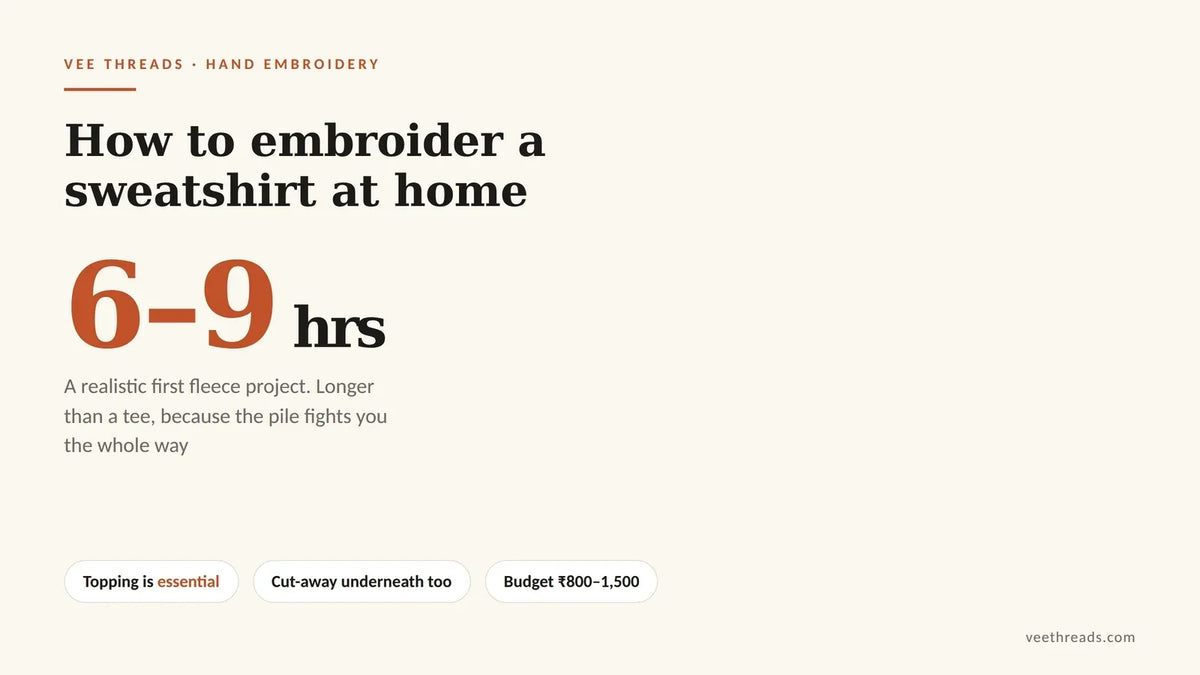
Short answer. Yes, and the one thing that decides whether it works is a water-soluble topping film laid over the fleece pile before you stitch. Without it the thread sinks between the fibres and the motif looks half-buried. You also need cut-away stabiliser inside, a 320 GSM or heavier sweatshirt, and about six to nine hours for a first project.

We sell these and I still think you should try it once. Four hours of fighting fleece pile teaches you more about why the finished ones cost ₹2,500 than anything I could write.
The technique is genuinely different from embroidering a T-shirt. If you have done jersey, unlearn two habits.
What you need
| Item | What to get | Rough cost |
|---|---|---|
| Blank sweatshirt | 320 GSM minimum, brushed cotton if you can find it | ₹600 to ₹1,200 |
| Water-soluble topping | Film, not spray. The single essential item | ₹150 to ₹300 |
| Cut-away stabiliser | Iron-on, for the inside. Not tear-away | ₹120 to ₹250 |
| Hoop | Wooden, 5 to 7 inch, screw tightened | ₹80 to ₹150 |
| Cotton floss | 6 to 8 shades. Three strands on fleece, not two | ₹150 to ₹300 |
| Needles | Embroidery size 5 to 7, heavier than jersey needles | ₹40 to ₹80 |

The six steps

- Buy 320 GSM or heavier. Thin fleece ripples permanently around dense stitching. This is not snobbery, it is the difference between a finished piece and a wavy one.
- Iron cut-away stabiliser inside. At least 3cm clear of the design on every side. Cut-away, not tear-away, because tear-away sheds fibres into the stitching over time.
- Lay water-soluble topping over the pile. The step everyone skips. Tack it at the corners so it does not shift. You will stitch through film and fabric together.
- Trace onto the topping, not the fabric. A marker line will not show on brushed fleece at all. Draw on the film.
- Hoop loosely, and re-check every hour. Here is the habit to unlearn: on jersey you tension firmly. On fleece that crushes the pile under the ring and leaves a permanent circle. Just enough to sit flat, no more.
- Stitch shorter and denser. Keep satin stitches under 6mm, use three strands rather than two, and expect to go slower. Long stitches sink between the loops and look sparse.
Then rinse in cold water until the film is gone, dry flat, and steam from the reverse while brushing the pile back up around the motif.

What will go wrong the first time
- The motif looks sunken. You skipped the topping, or you used a spray instead of film. Film is the one that works.
- A visible hoop ring. Too much tension. Steam lifts some of it, not all. Loosen next time.
- White crusting in the thread. Topping residue. Rinse longer, in colder water, and do not use warm which sets it.
- Sparse-looking fill. Stitches too long, or two strands where you needed three. Fleece eats coverage.
How long it actually takes
Six to nine hours for a first chest motif, including undoing. An experienced artisan on our floor does the same design in four. That gap closes around your fifth or sixth piece, faster than you would expect.
A back panel is not a beginner project. Eighteen hours of fill on fleece with no error tolerance is how people quit the craft.

When to just buy one
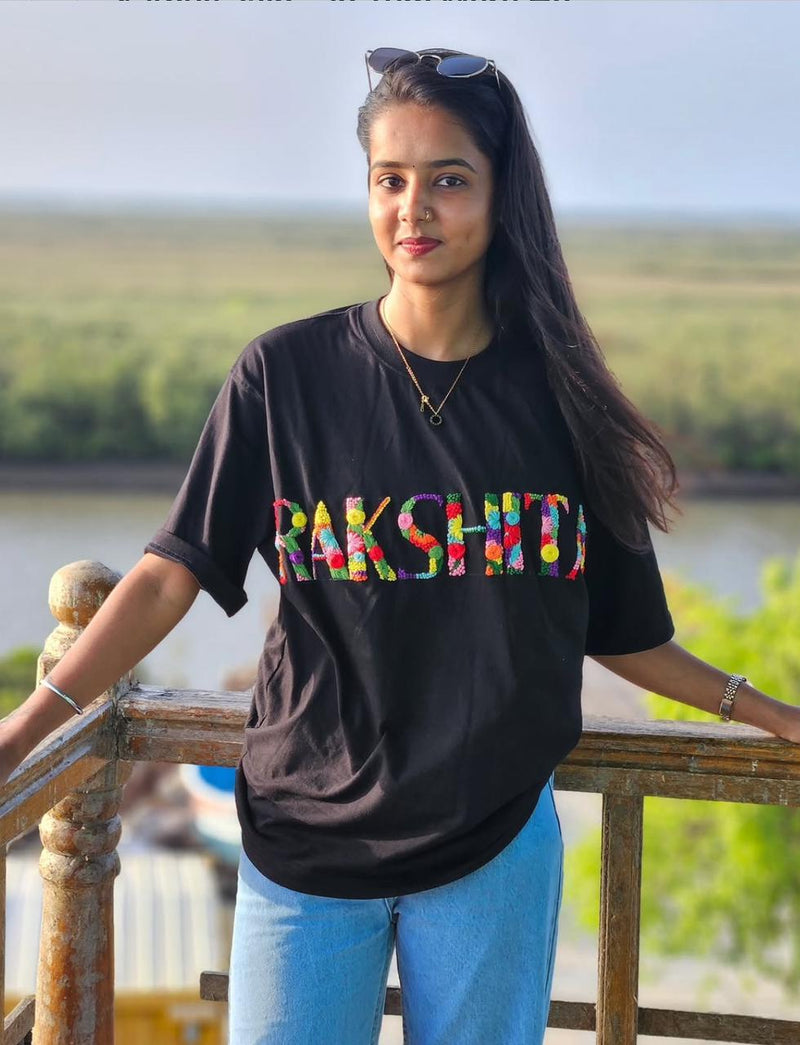
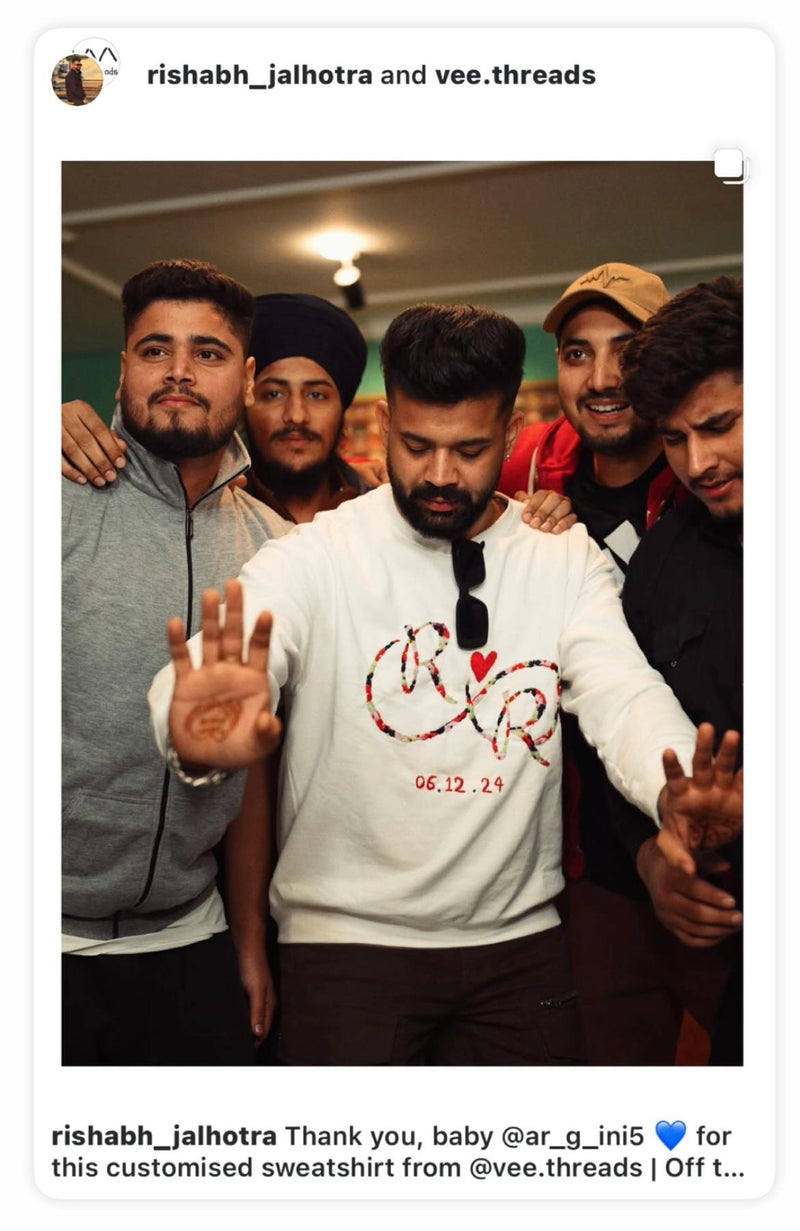
If it is a gift with a date attached, or a name in a script you do not write. Names on fleece are unforgiving, and eight hours is a lot to lose to one wrong letter, which is why every custom order we take gets a written proof first.
See custom hand embroidery, or read the full studio process if you want to know what you are up against.

Frequently asked questions
Can you hand embroider a sweatshirt at home?
Yes. A chest motif is a realistic first project at six to nine hours. You need a 320 GSM or heavier sweatshirt, water-soluble topping film, cut-away stabiliser, a wooden hoop and cotton floss.
What is water-soluble topping and do I really need it?
A thin film laid over the fleece pile so stitches sit on the surface instead of sinking between the fibres. On fleece it is essential. Use film rather than spray, and rinse it out in cold water afterwards.
How is embroidering fleece different from a T-shirt?
Two habits change. Hoop much more loosely, because firm tension crushes the pile and leaves a permanent ring. And use three strands with stitches under 6mm, because fleece swallows thin sparse work.
Why does my fleece embroidery look sunken?
You stitched straight onto the pile without a topping film. The thread settles between the fibres. Spray stabiliser does not solve this; water-soluble film does.
How many strands of floss for a sweatshirt?
Three, against two for a T-shirt. Fleece needs more coverage to read, and two strands on 350 GSM looks sparse however neatly it is worked.
See the stitching up close. New designs and studio detail shots go up on our Pinterest first. Shipping outside India is easiest through our Etsy shop, which handles the customs paperwork.
Who wrote this
Vee Threads is a hand-embroidery label run by Vikash Tomar and Mansi from a studio in Bulandshahr, Uttar Pradesh. Every piece is stitched by hand by women artisans on the studio floor, on 350 GSM cotton fleece for sweatshirts and hoodies and 220 GSM combed cotton for tees. We have shipped more than 5,000 orders. Mansi runs the studio and quality control, Vikash handles the digital side. Prices, timings and hours quoted here come from our own production records, not industry averages.
Browse hand embroidered sweatshirts and embroidered hoodies, start a custom order, or find us on Etsy and Pinterest.








Share and get 15% off!
Simply share this product on one of the following social networks and you will unlock 15% off!