



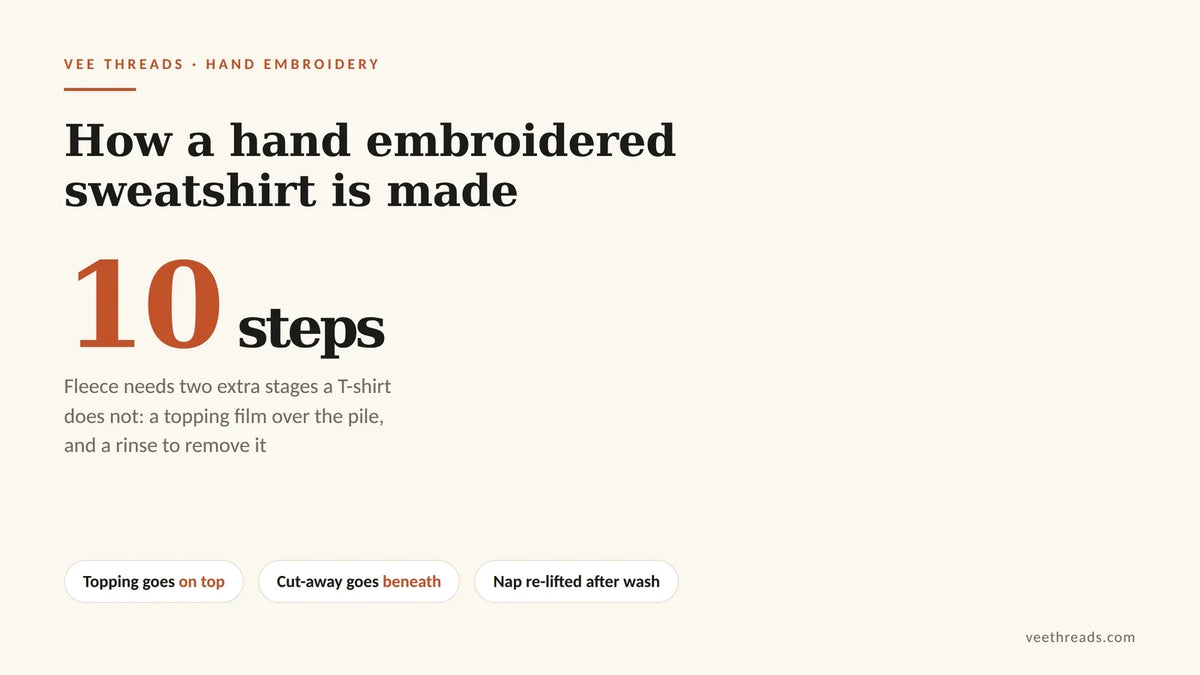
Short answer. Hand embroidered sweatshirts are made in ten steps. Sketch the motif thicker than the tee version, transfer it onto a water-soluble film, iron cut-away stabiliser inside, lay the topping over the pile, hoop loosely, stitch for 2.5 to 18 hours, knot off, rinse the topping out, steam and re-lift the nap, then quality check and pack.

The process for a sweatshirt is not the tee process on thicker fabric. Two stages exist only for fleece, and one habit from jersey work will ruin a sweatshirt if you carry it across.
The ten steps

| Step | What happens | What goes wrong if it is rushed |
|---|---|---|
| 1. Sketch and thicken | Motif redrawn heavier than the tee version | Thin lines vanish into pile and read as smudges |
| 2. Transfer | Traced onto the topping film, not the fabric | Marker will not show on brushed fleece at all |
| 3. Stabilise | Cut-away ironed inside, 3cm clear on every side | Tear-away sheds fibres into the stitching over time |
| 4. Top | Water-soluble film laid over the pile | Skipped, and the whole motif sinks and looks fuzzy |
| 5. Hoop loosely | Just enough tension to sit flat | A tight hoop leaves a permanent ring in fleece |
| 6. Stitch | 2.5 to 18 hours, shorter denser stitches than jersey | Long stitches sink between the loops and look sparse |
| 7. Knot off | Every tail secured under the stabiliser | One loose tail and a wash unravels a fill |
| 8. Rinse | Cold water dissolves the topping | Residue dries into white crusting in the thread |
| 9. Steam and re-nap | Pile brushed back up around the motif | Flattened pile rings the design like a halo |
| 10. QC and pack | Tension, spelling, ribbing checked, motif folded inward | Raised stitch abrades against itself in transit |
Why fleece needs a film on top
Tap each stage to see where the stitches sit in the pile.
Step 4 skipped. Fleece pile swallows thread. Without topping the whole motif sinks between the loops and looks fuzzy.
Step 4, topping on. A water-soluble film is laid over the pile, with the design traced onto it rather than the fabric. It holds each stitch on the surface while it is worked.
Step 8, rinsed. Cold water dissolves the topping, leaving the motif sitting proud of the pile. Step 9 then steams and brushes the nap back up around it.
Step 8 rushed. Residue left in the thread dries into white crusting.
Steps 4 and 8 exist only for fleece. A T-shirt needs neither.

Step 5 is where fleece punishes tee habits
On jersey you tension a hoop firmly and the fabric forgives you. On 350 GSM fleece the same tension crushes the pile under the ring, and when you release it the crushed band stays. Steam lifts some of it. Not all.
Our artisans hoop fleece noticeably looser than jersey and re-check every hour as the fabric relaxes. It is slower and it is the difference between a clean finished garment and one with a faint circle around the motif that the customer notices in daylight.
Step 5, under the hoop ring
Tap a state to see what hoop tension does to the pile.
Jersey. On jersey you tension a hoop firmly and the fabric forgives you.
Fleece at the same tension. On 350 GSM fleece the same tension crushes the pile under the ring.
After release. The crushed band stays. Steam lifts some of it, not all, and the customer notices a faint circle around the motif in daylight.
Hooped loosely. Our artisans hoop fleece noticeably looser than jersey and re-check every hour as the fabric relaxes. It is slower, and it is the difference between a clean finished garment and one with a faint circle around the motif.

Which stitch, and why fleece changes the answer
| Stitch | Used for | On fleece |
|---|---|---|
| Satin stitch | Solid fills, letterforms, petals | Kept under 6mm. Longer and it sinks between loops |
| Back stitch | Outlines, lettering, stems | Doubled on fleece. A single line disappears |
| Long and short stitch | Shaded fills, fur, gradients | Slowest of all, and the hardest to keep even on pile |
| Chain stitch | Borders, thick lines | Works well. The raised texture suits fleece |
| French knot | Flower centres, texture | Needs a tighter wrap or it vanishes into the nap |
Five stitches, adjusted for fleece
Tap a stitch to see it on pile and what changes from jersey.
Satin stitch. Solid fills, letterforms, petals. On fleece it is kept under 6mm. Longer and it sinks between the loops.
Back stitch. Outlines, lettering, stems. Doubled on fleece, because a single line disappears.
Long and short stitch. Shaded fills, fur, gradients. The slowest of all and the hardest to keep even on pile. Layered shading across a full panel takes eighteen or more hours.
Chain stitch. Borders, thick lines. Works well, as the raised texture suits fleece. A design that is mostly chain and satin comes off the frame in six or seven hours.
French knot. Flower centres, texture. Needs a tighter wrap or it vanishes into the nap.
A design that is mostly chain and satin, like the Branch Motif, comes off the frame in six or seven hours. Layered long-and-short shading across a full panel, like Botanical Orbit, takes eighteen or more.

Who does the work
Women artisans on our floor in Bulandshahr. One person takes a garment from hooping through to knot-off rather than passing it along a line, which is slower but keeps tension consistent across a single piece. On fleece that consistency matters more than on jersey, because uneven tension shows up as uneven pile compression.
Mansi runs the floor and does the step 10 check herself, including reading every custom name against the customer's written proof.

Why there are days before stitching starts
A queue. Orders are stitched in sequence, 4 to 5 days out, longest from October to January when everyone wants fleece at once. The full timeline is here.

If you would rather try it yourself, the home version is here, and it will teach you more about step 4 than this article can. Studio process shots go up on Pinterest as we make things.
Frequently asked questions
How is a hand embroidered sweatshirt made?
In ten steps: sketch thicker than a tee design, transfer onto water-soluble film, iron cut-away stabiliser inside, lay topping over the pile, hoop loosely, stitch 2.5 to 18 hours, knot off, rinse the topping, steam and re-lift the nap, then check and pack.
Why do you put film over the fleece before stitching?
Fleece pile swallows thread. A water-soluble topping film holds the stitches on the surface while they are worked, then rinses away in cold water, leaving the motif sitting proud of the pile.
Why hoop fleece more loosely than jersey?
Because a firm hoop crushes the pile under the ring, and the crushed band does not fully recover. Steam lifts some of it, not all. Artisans re-check tension hourly as the fabric relaxes.
How long does hand embroidery take on a sweatshirt?
2.5 hours for a single initial, about 8 for a monogram wreath, and 18 or more for a full panel. That is roughly 30 per cent longer than the same motif on a 220 GSM tee.
Does one artisan make the whole sweatshirt?
Yes, from hooping through to knot-off. It is slower than a production line but keeps stitch tension consistent, which on fleece is what prevents uneven pile compression around the motif.
See the stitching up close. New designs and studio detail shots go up on our Pinterest first. Shipping outside India is easiest through our Etsy shop, which handles the customs paperwork.
Who wrote this
Vee Threads is a hand-embroidery label run by Vikash Tomar and Mansi from a studio in Bulandshahr, Uttar Pradesh. Every piece is stitched by hand by women artisans on the studio floor, on 350 GSM cotton fleece for sweatshirts and hoodies and 220 GSM combed cotton for tees. We have shipped more than 5,000 orders. Mansi runs the studio and quality control, Vikash handles the digital side. Prices, timings and hours quoted here come from our own production records, not industry averages.
Browse hand embroidered sweatshirts and embroidered hoodies, start a custom order, or find us on Etsy and Pinterest.












Share and get 15% off!
Simply share this product on one of the following social networks and you will unlock 15% off!