



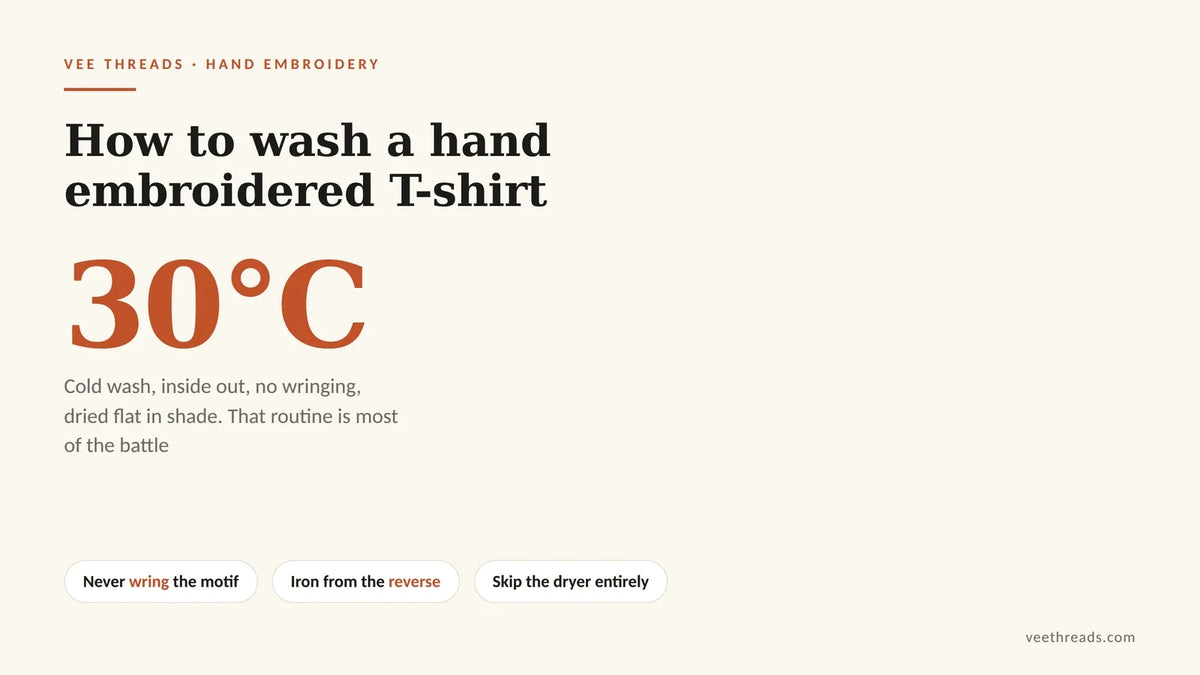
Short answer. To wash an embroidered T-shirt, turn it inside out and wash at 30°C or below with a mild detergent and no bleach. Do not wring it. Press the water out flat between two towels, dry flat in shade, and iron from the reverse over a towel. That routine keeps hand-stitched floss intact past 150 washes.

Embroidery rarely fails because the stitching was bad. It fails because someone wrung it out, or hung it wet, or put a hot iron directly on a satin-stitched petal.
Six steps, and they take no longer than washing anything else.
The routine

| Step | Do this | What happens if you do not |
|---|---|---|
| 1. Turn inside out | Motif faces inward, away from the drum | Stitches abrade against zips and the drum wall |
| 2. Cold water only | 30°C or below | Hot water is what makes dyed cotton floss bleed into white fabric |
| 3. Mild detergent | No bleach, no oxygen brightener | Both attack dyed thread before they touch the cotton |
| 4. Never wring | Press water out flat between two towels | Twisting distorts satin stitch and it does not recover |
| 5. Dry flat in shade | On a towel, motif face up | Hanging wet jersey stretches the knit around the stitched area permanently |
| 6. Iron from the reverse | Over a towel, steam on | A hot plate on the face flattens raised stitching for good |
The six-step routine, one tap at a time
Tap a step to see what to do and what happens if you skip it.
Turn it inside out. The motif faces inward, away from the drum. Skip it and the stitches abrade against zips and the drum wall.
Cold water only, 30°C or below. Hot water is what makes dyed cotton floss bleed into white fabric.
Mild detergent. No bleach, no oxygen brightener. Both attack dyed thread before they touch the cotton.
Never wring. Press water out flat between two towels. Twisting distorts satin stitch and it does not recover.
Dry flat in shade. On a towel, motif face up. Hanging wet jersey stretches the knit around the stitched area permanently.
Iron from the reverse. Over a towel, steam on. A hot plate on the face flattens raised stitching for good.

Machine washing is fine, with one setting change
You do not need to hand-wash hand embroidery. Inside out, in a mesh laundry bag, on a delicate or wool cycle at 30°C, is fine and is what most of our customers do.
The setting that matters is spin speed. Keep it at 600 rpm or below. High-speed spin is mechanically the same problem as wringing, applied for longer.
Skip the tumble dryer entirely. Heat plus tumbling is the fastest way to distort a stitched area.
Your machine, set for embroidery
Tap a control to see the setting.
30°C or below. Hot water is what makes dyed floss bleed. A cold machine wash is fine for hand embroidery.
Keep spin at 600 rpm or below. High-speed spin is mechanically the same problem as wringing, applied for longer. This is the setting that matters.
Delicate or wool cycle. Inside out, in a mesh laundry bag. It is what most of our customers do, and you do not need to hand-wash.
No tumble dryer. Heat plus tumbling is the fastest way to distort a stitched area. Dry flat in shade instead.

Stains, and what not to reach for
- Oil or food: blot, then a drop of mild detergent worked in with a finger, then a cold rinse. Give it time rather than pressure.
- Never use bleach or a stain pen with optical brighteners. These target dyed thread first, and a bleached patch on a red floss motif cannot be undone.
- Never scrub the motif. Work around it. Friction on satin stitch raises fuzz that never lies flat again.

Storing them
Fold, do not hang. Hanging puts the garment's whole weight through the shoulders, and on an oversized tee with a heavy back panel that shows within a season. Fold with the motif facing inward so raised stitching is not pressed against a zip in the next drawer.
If you are stacking, keep embroidered pieces at the top of the pile rather than under a stack of jeans.
What to do about a pulled thread
Do not cut it, and do not pull the other end. A snagged loop can usually be worked back through to the reverse with a blunt needle. If a fill has actually broken, it is restitchable, which is the practical advantage embroidery has over print. Message us with a photo and we will tell you honestly whether it is a five-minute fix or a studio job.
A pulled thread, handled right
Tap each option to see which ones to avoid and what actually fixes it.
Do not cut it. A snagged loop can usually be worked back through to the reverse, so leave it where it is.
Do not pull the other end. Leave both ends alone and work the loop back instead.
Use a blunt needle. A snagged loop can usually be worked back through to the reverse with a blunt needle.
If a fill has actually broken. It is restitchable, which is the practical advantage embroidery has over print. Message us with a photo and we will tell you honestly whether it is a five-minute fix or a studio job.
How long this should last
Colourfast floss holds its shade past 150 washes on this routine, which is roughly three years of weekly wear. In practice the cotton usually softens and thins before the stitching gives out, which is the opposite of what happens with print. The durability comparison is here.
A care card ships in every box. If you want to see what survives that long: hand embroidered T-shirts and embroidered sweatshirts.

Frequently asked questions
How do you wash a hand embroidered T-shirt?
Inside out at 30°C or below with a mild detergent, no bleach. Do not wring it. Press the water out flat between two towels, dry flat in shade, and iron from the reverse over a towel.
Can I machine wash embroidered clothing?
Yes. Inside out, in a mesh bag, on a delicate cycle at 30°C, with the spin speed kept at 600 rpm or below. Skip the tumble dryer entirely.
Can you iron over embroidery?
Never directly on the face. Iron from the reverse, over a towel, with steam. A hot plate pressed onto satin stitch flattens the raised texture permanently.
Why should I dry an embroidered T-shirt flat?
Because hanging wet jersey lets the garment's own weight stretch the knit around the stitched area, and the distortion is permanent. Dry flat on a towel, motif face up.
What do I do if a thread pulls?
Do not cut it and do not pull the other end. A snagged loop can usually be worked back through to the reverse with a blunt needle. A broken fill can be restitched, which is something print can never offer.
Who wrote this
Vee Threads is a hand-embroidery label run by Vikash Tomar and Mansi from a studio in Bulandshahr, Uttar Pradesh. Every piece is stitched by hand by women artisans on the studio floor, on 220 GSM combed cotton tees and 400 GSM sweatshirts. We have shipped more than 5,000 orders. Mansi runs the studio and quality control, Vikash handles the digital side. Prices, timings and hours quoted in this article come from our own production records, not from industry averages. Browse the hand embroidered T-shirt collection or start a custom hand embroidery order.











Share and get 15% off!
Simply share this product on one of the following social networks and you will unlock 15% off!