



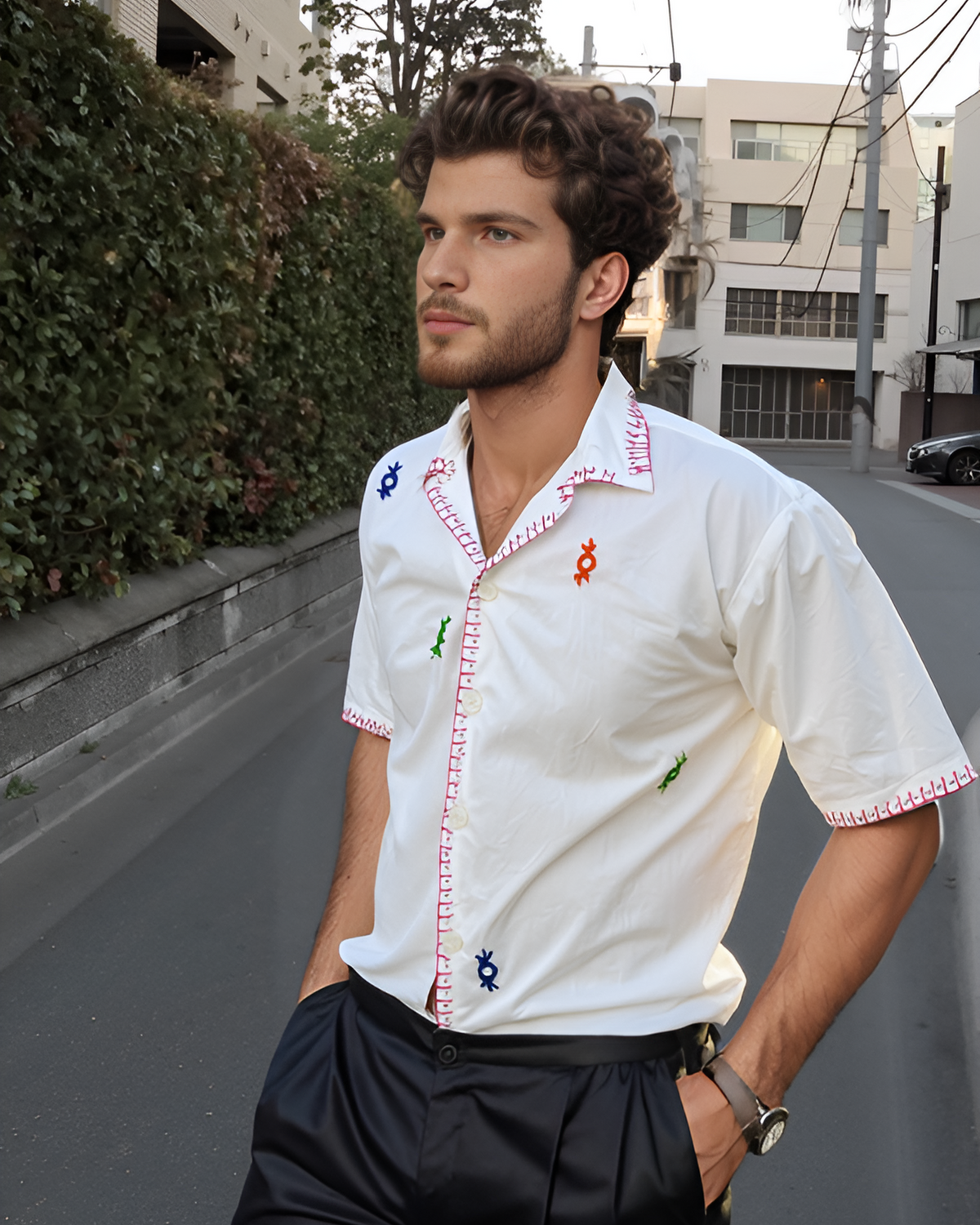
India has more distinct hand embroidery traditions than any other country. Most of them are regional, most are centuries old, and several carry Geographical Indication protection — a legal marker that the craft belongs to a specific place.
What follows is a working guide to the nine you're most likely to encounter: where each comes from, the stitch that defines it, and how to recognise it.
Quick comparison
| Tradition | Region | Defining feature | Typical garment |
|---|---|---|---|
| Chikankari | Lucknow, UP | White thread on white cloth, shadow work | Kurta, saree |
| Phulkari | Punjab | Darn stitch from the reverse, silk floss | Dupatta, shawl |
| Kantha | West Bengal, Odisha | Running stitch, layered old cloth | Saree, quilt, shirt |
| Zardozi | Lucknow, Delhi, Bhopal | Metal thread, wire, sequins | Bridal, formal |
| Kasuti | Karnataka | Counted thread, no knots, reversible | Ilkal saree |
| Kutch | Gujarat | Dense colour, mirrors, geometric | Blouse, bag, wall art |
| Kashida | Kashmir | Sozni and crewel, nature motifs | Shawl, pheran |
| Aari / Adda | North India, Kashmir | Hooked needle, chain stitch, worked on a frame | Lehenga, kurta |
| Shisha (mirror work) | Gujarat, Rajasthan | Mirrors held by worked thread | Shirt, blouse, skirt |
Five traditions defined by the stitch
Tap one to see a close-up of what makes it recognisable.
Chikankari, Lucknow, Uttar Pradesh. White thread on fine white cloth. Shadow work is stitched from the reverse so the motif shows through as a soft shape. Genuine chikankari is soft on both faces.
Phulkari, Punjab. Silk floss in darning stitch, worked from the reverse onto coarse khaddar cotton. Dense geometric floral fields in saturated colour.
Kantha, West Bengal and Odisha. Plain running stitch through layered old cotton. Look for the ripple and an irregular rhythm; machine kantha is dead flat and evenly spaced.
Kasuti, Karnataka. Counted thread, worked without knots, so the reverse is nearly as neat as the face. Geometric motifs from temples, chariots, lamps and birds.
Aari, North India and Kashmir. A hooked needle pulls thread up through cloth stretched on an adda frame, giving a fast, even chain stitch. Aari is the tool, adda the frame.

1. Chikankari — Lucknow
White untwisted thread on fine white cloth. The signature is shadow work, where the stitching is worked from the reverse so the motif shows through the fabric as a soft shape rather than a hard line. Around 30 named stitches exist within the tradition; a skilled worker uses a handful in one garment.
Traditionally worked on muslin, now common on cotton, georgette and chanderi. GI-protected. Genuine chikankari is soft to the touch on both faces — machine imitations feel stiff on the reverse.
2. Phulkari — Punjab
The name means “flower work.” Worked in silk floss using a darning stitch, and — unusually — stitched from the reverse of the cloth, so the embroiderer works blind to the finished face. Dense geometric floral fields in saturated colour on coarse khaddar cotton.
Historically made by women for their own families rather than for sale, which is why antique pieces carry so much regional variation. GI-protected.
3. Kantha — West Bengal and Odisha
The simplest stitch in this list and one of the most affecting. Layers of worn cotton are quilted together with a plain running stitch, historically to give old cloth a second life. The slight rippling that results is the point, not a defect.
Modern kantha appears on sarees, stoles and shirts. Look for the ripple and for the irregular stitch rhythm — machine kantha is dead flat and perfectly spaced.
4. Zardozi — Lucknow, Delhi, Bhopal
Metal-thread work: gold and silver wire, coiled dabka, sequins, beads and stones, couched onto silk or velvet with a hooked needle on an adda frame. Historically real precious metal, now largely metallic-coated alternatives.
The most expensive work in this list by a wide margin — a heavily zardozi bridal piece can represent hundreds of hours. GI-protected in Lucknow.
5. Kasuti — Karnataka
Counted-thread embroidery worked without knots, traditionally so precise that the reverse is nearly as neat as the face. Four named stitches — gavanti, murgi, negi and menthe — produce geometric motifs drawn from temple architecture, chariots, lamps and birds.
Classically worked on Ilkal sarees. GI-protected.

6. Kutch — Gujarat
Not one style but a family of them, varying by community across the Kutch region: Rabari, Ahir, Sodha, Mutwa and others. Common threads are dense saturated colour, geometric structure, and mirrors.
Mutwa work in particular uses mirrors small enough to test the eyes. Several Kutch styles are GI-protected.
7. Kashida — Kashmir
Kashmiri embroidery covers several techniques, chiefly sozni (fine needlework, sometimes worked so both faces are usable) and crewel (chain stitch in wool with a hooked needle). Motifs come from the valley: chinar leaves, almonds, irises, paisley.
A fine sozni shawl can take a year. GI-protected.
8. Aari and Adda work
Named for the tool and the frame rather than a region. The aari is a hooked needle, like a fine crochet hook, which pulls thread up through fabric stretched on an adda frame — producing a fast, even chain stitch.
Because the hook is far quicker than a straight needle, aari is the workhorse technique behind much Indian bridal and formal embroidery. Zardozi is usually worked on an adda too. Aari describes the tool, adda the frame, zardozi the materials — which is why the three terms get confused.
9. Shisha — mirror work
Small mirrors secured to cloth by a worked thread frame — no glue, no adhesive backing. A ring of stitches traps the mirror, then decorative stitching finishes the edge.
Native to Gujarat and Rajasthan and now used everywhere. The reason printed or foil imitations look wrong is simple: real shisha moves light as the wearer moves. See our mirror work shirts.

Four defined by material and colour
Metal, mirrors, wool and saturated colour. Tap to compare.
Zardozi, Lucknow, Delhi, Bhopal. Metal thread, coiled dabka, sequins and beads couched onto silk or velvet. The most expensive work of the nine; a bridal piece can be hundreds of hours.
Kutch, Gujarat. A family of community styles, from Rabari to Mutwa. Dense saturated colour, geometric structure, and mirrors.
Kashida, Kashmir. Sozni needlework and crewel chain stitch in wool. Motifs from the valley: chinar leaves, almonds, irises, paisley.
Shisha, Gujarat and Rajasthan. Mirrors held by a worked thread frame, never glue. Real shisha moves light as the wearer moves; printed imitations look dead.
How to tell hand from machine
- Check the reverse. Machine work has uniform bobbin thread and a stabiliser layer. Hand work has knots and thread tails.
- Look for drift. Identical motifs at identical intervals means digitised.
- Feel it. Hand work is soft on both faces. Machine work is stiff on the reverse.
- Check the price against the density. Dense work is hours. Hours cost money.

Why these traditions are worth knowing
Every one of these crafts is under commercial pressure from digitised machine embroidery that reproduces the look at a fraction of the cost. Machines aren't the enemy — but a market that can't tell the difference is, because it prices skill out.
Knowing the difference is the practical thing a buyer can do.
Vee Threads works in hand embroidery from Bulandshahr, Uttar Pradesh.
Shop: Mirror Work Shirts · Mens Embroidered Shirts · Hand Embroidered T-Shirts










Share and get 15% off!
Simply share this product on one of the following social networks and you will unlock 15% off!