



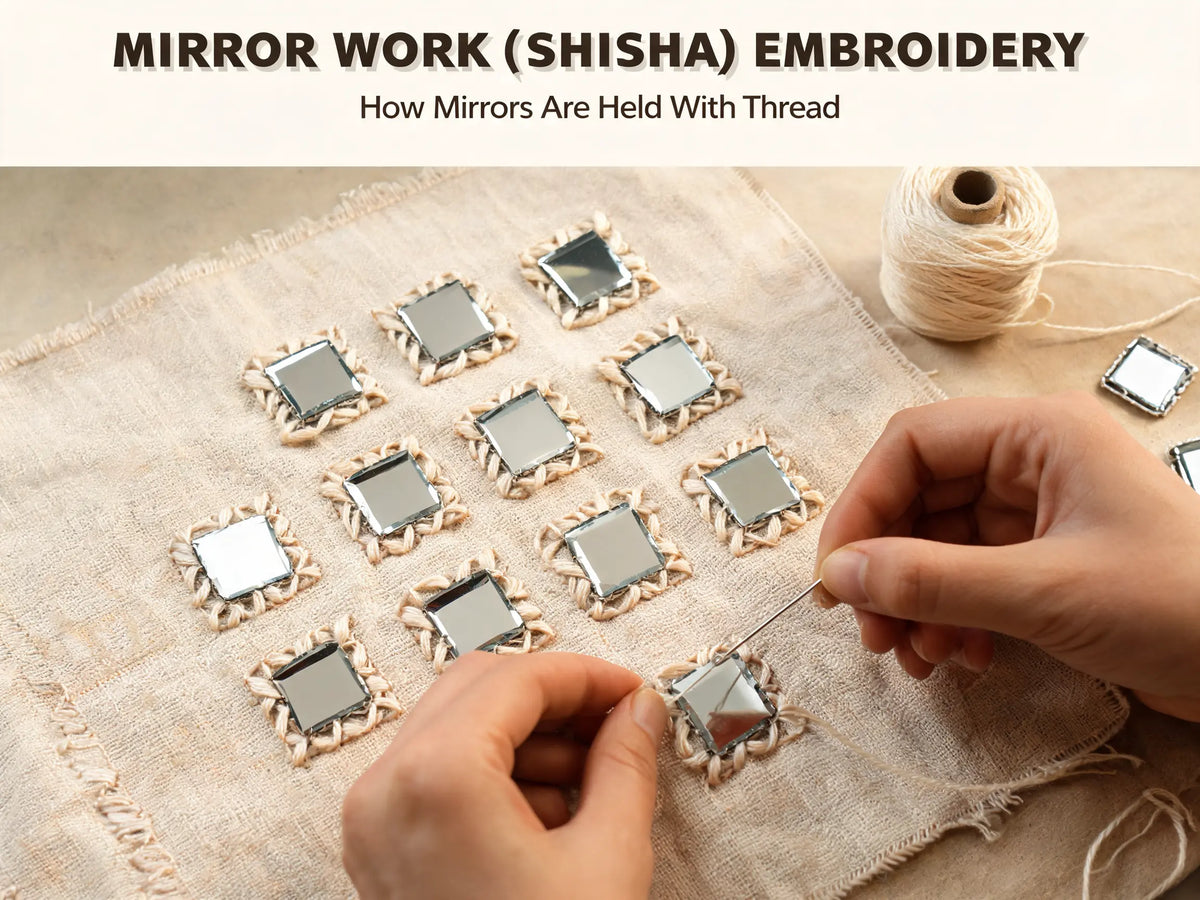
The first thing to understand about mirror work is that there is no glue in it.
A small mirror is held to the cloth entirely by thread: a lattice worked across the mirror to trap it, then a ring of stitches around the edge that both secures and decorates. If you can see adhesive, or if the mirror has a plastic rim, it isn't shisha work.
Where it comes from

Shisha, from the Persian for glass, is associated above all with Gujarat and Rajasthan, and within Gujarat especially with the communities of Kutch: Rabari, Ahir, Mutwa and others, each with recognisably different styles.
The technique travelled through Persia into India and became most fully developed here. Originally the mirrors were mica, then hand-blown silvered glass broken into irregular pieces, which is why antique pieces have mirrors of varying shape and thickness. Modern shisha uses machine-cut glass, uniform and slightly less alive for it.
How the stitch actually works
This is the part worth understanding, because it explains the whole aesthetic.
- The mirror is positioned on the fabric and held with a finger.
- A grid is laid across it. Four or more straight stitches are worked across the face of the mirror, crossing each other to form a lattice. At this stage the mirror is trapped but the grid is ugly. It's structural.
- The retaining ring is worked. The embroiderer comes up at the edge of the mirror, hooks under the grid threads, and works around the circumference. Each stitch pulls a section of the grid outward toward the rim.
- The grid disappears. By the end of the round, the straight threads that crossed the mirror have all been drawn to the edge, leaving the glass clear and a worked thread collar holding it.
- Decorative edging, usually chain or buttonhole stitch, finishes the rim.
That's the whole trick: the structural threads become the decorative frame. Nothing is wasted and nothing is stuck on.

Why glue fails
Glued mirrors come off. Not immediately. After a few washes, or a season in a humid climate, or the first time the fabric flexes hard. Adhesive goes brittle, and there's nothing else holding the glass.
A thread-set mirror is mechanically trapped. Even if a stitch in the ring breaks, the rest of the collar holds. Properly worked shisha outlives the garment.
The other reason glue is wrong: adhesive shows through the glass edge as a grey halo. Once you've noticed it you can't stop noticing it.

Mirror shapes and sizes
| Type | Size | Character |
|---|---|---|
| Round, standard | 8–15 mm | The default. Easiest to work |
| Round, small (Mutwa) | 2–5 mm | Extremely fine. Exceptional skill |
| Large statement | 20–40 mm | Bold, heavy, best on structured fabric |
| Square and diamond | Varies | Harder: corners need extra work |
| Irregular (traditional) | Varies | Hand-cut. Every collar is bespoke |
Wearing it
Mirror work does something no other embroidery does: it changes as you move. Under a fixed light it looks like scattered bright points; walk across a room and it flickers.
Practical consequences:
- It photographs badly and looks far better in person. Don't judge it from a product photo.
- It reads best on darker fabric where the contrast is sharpest.
- It carries an outfit on its own. Wear it with plain everything.
- Mirrors add weight. Dense mirror work needs a fabric with body.

How to spot an imitation
- Look for the thread collar. No worked ring means no shisha.
- Check for a plastic rim. Some manufacturers use pre-rimmed mirrors sewn on through the rim. That's a shortcut, not the craft.
- Look at the reverse. Hand mirror work shows the ring stitching on the back. Glued mirrors show nothing.
- Press a mirror gently. A thread-set mirror has a fraction of give. A glued one is rigid.
- Look for foil or print imitations. They exist and they're obvious in person. They don't catch light, they just sit there.
Care
- Hand wash, cold, gentle detergent. Machine agitation catches mirror edges
- If you must machine wash, turn inside out and use a mesh bag on the gentlest cycle
- Never wring: twisting stresses the thread collars
- Dry flat in shade
- Never iron directly over a mirror. The glass heats and can crack, and you'll flatten the collar. Iron around them, or on the reverse with a cloth
- If a mirror loosens, it can be re-set, unlike a glued one, which is simply gone
Our mirror work shirts use real sheesha mirrors, set by hand in worked thread. No glue, no plastic rims.
Read next: Chikankari, Kantha, Phulkari and Mirror Work: A Plain Guide

















Share and get 15% off!
Simply share this product on one of the following social networks and you will unlock 15% off!