



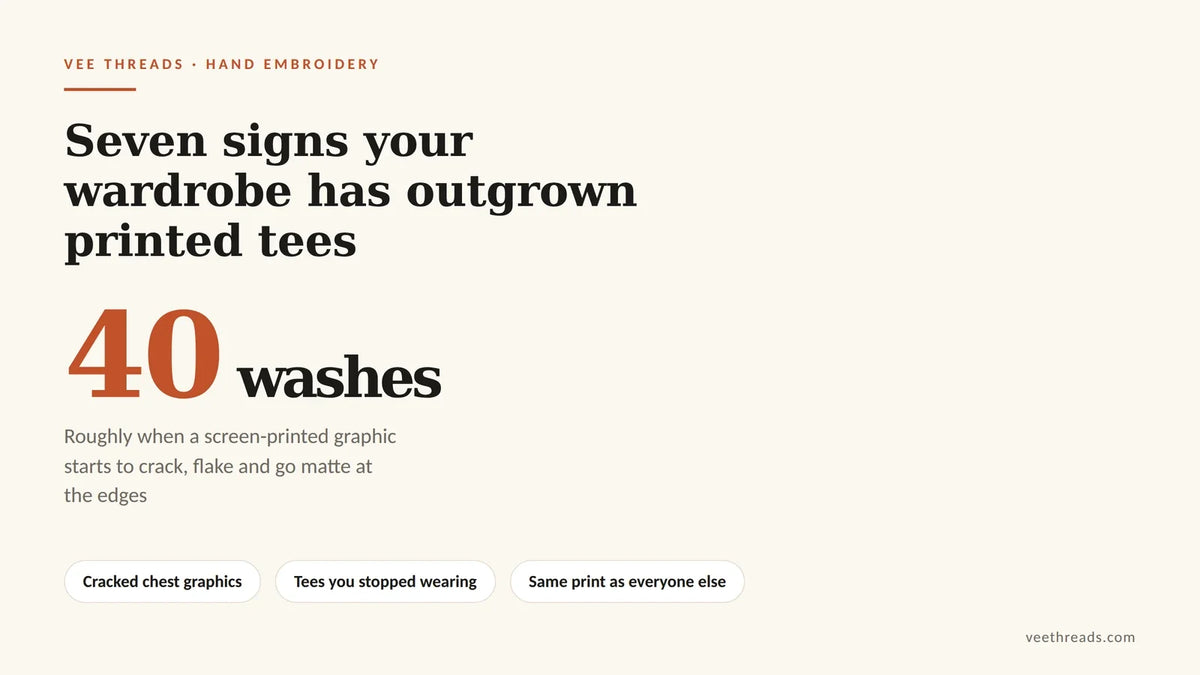
Short answer. Comparing embroidered T-shirts vs printed T-shirts, the clearest sign to switch is a cracked chest graphic on a tee you still like. Screen print breaks down around forty washes. If you own eight printed tees and wear three, keep replacing the same one, or met someone in your exact shirt, the method is the problem.

Nobody wakes up wanting to spend ₹1,517 on a T-shirt. What happens instead is a slow accumulation of small annoyances with the ones you already own.
Seven signs

| Sign | What is actually happening | What fixes it |
|---|---|---|
| Your favourite tee's print is cracking | Ink sits on the fibre and loses elasticity after about 40 washes | Thread passes through the fabric. Nothing to crack |
| You own eight tees and wear three | The five you skip were bought on price | Buy fewer, at a price that makes you wear them |
| Graphics have gone matte and grey | Print pigment fades every wash cycle | Cotton floss holds shade past 150 washes |
| Someone wore your exact tee | Screen print is a run of thousands | Hand work is a run of one |
| You hide logos under jackets | A brand logo reads as theirs, not yours | A monogram or name reads as yours |
| Gifting feels generic | A printed slogan is a purchase. A stitched name is a decision | Custom names and dates |
| You keep re-buying the same tee | Three ₹599 replacements cost ₹1,797 | One ₹1,517 tee that survives |
Print against thread, wash by wash
Tap a wash count to see what happens to each method.
New. Both look crisp on day one. The difference is where the colour sits: ink on the fibre, thread through the fabric.
About 40 washes. Screen print ink loses elasticity and the edges begin cracking. Forty washes is roughly a year of weekly wear. Thread passes through the fabric, so there is nothing to crack.
Past 150 washes. Print pigment fades every wash cycle and goes matte and grey. Colourfast cotton floss holds its shade past 150 washes with cold-water care.

The one that convinces people
It is usually the replacement one. You do not notice the money because it leaves in ₹599 pieces eighteen months apart. Then you count, and three replacements of the same black graphic tee have cost more than a hand-embroidered one that would still be intact.
We did the full arithmetic in the cost-per-wear piece: ₹9.72 per wear against ₹11.52. Narrow, but pointing the same direction.
How ₹599 pieces add up
Tap through the replacements, then compare with one embroidered tee.
One printed tee, ₹599. Cheap enough that you do not notice the money.
Eighteen months later. The graphic has cracked and you buy the same black tee again.
Three replacements, ₹1,797. The money leaves in ₹599 pieces eighteen months apart, so it only shows when you count.
One ₹1,517 tee that survives. Three replacements cost more than a hand-embroidered one that would still be intact.
The cost-per-wear piece puts it at ₹9.72 per wear against ₹11.52. Narrow, but pointing the same direction.

Signs that mean you should NOT switch
Worth saying, because this is not a universal upgrade.
- Most of your tees are gym or work tees. Sweat, friction and hot washes are hard on dense stitching. Keep buying printed.
- You buy tees for the graphic itself. Band merch, film art, illustration that needs full-colour detail. Print does things thread cannot.
- You are dressing children who are growing. Bad value at any level of quality.

Where to start if three or more of the seven are true
How many of the seven are true for you?
Tick the ones that sound like your wardrobe. Each shows what is really happening.
of 7 signs
Nothing ticked yet.
Keep going. Three or more is the point where the method is the problem.
Three or more: the decoration method is the thing to change. Start small, with a name, an initial or a simple motif.
Not at the top. Start with something small and wearable: a name or initial, a piece from the under ₹1,000 edit, or a simple motif from floral embroidered T-shirts.
Wear it for a month, wash it four times, and see whether you reach for it. That answers the question better than any comparison table, including ours.
If you want to understand the durability difference properly first, here is print against stitch across six criteria.

Frequently asked questions
How long do printed T-shirt graphics last?
Roughly 40 washes before the edges begin cracking. Ink sits on top of the cotton and loses elasticity faster than the fabric does, particularly with hot washes and tumble drying.
Is embroidery better than printing on a T-shirt?
For durability and repairability, yes. Thread passes through the fabric so there is no layer to crack, and a pulled stitch can be restitched. For full-colour illustration and high volume, print is better.
Should I replace all my printed T-shirts?
No. Keep printed tees for gym, work and rough daily wear, and for graphics that need full-colour detail. Switch the pieces you want to still own in three years.
How many embroidered T-shirts do I actually need?
Start with one. Wear it for a month and wash it four times. If you keep reaching for it, buy a second. If it lives in the cupboard, the cost-per-wear case collapses.
Do embroidered T-shirts fade?
The cotton fades slightly, as all cotton does. Colourfast embroidery floss holds its shade past 150 washes with cold-water care, which is why old embroidery often looks brighter than the fabric around it.
Who wrote this
Vee Threads is a hand-embroidery label run by Vikash Tomar and Mansi from a studio in Bulandshahr, Uttar Pradesh. Every piece is stitched by hand by women artisans on the studio floor, on 220 GSM combed cotton tees and 400 GSM sweatshirts. We have shipped more than 5,000 orders. Mansi runs the studio and quality control, Vikash handles the digital side. Prices, timings and hours quoted in this article come from our own production records, not from industry averages. Browse the hand embroidered T-shirt collection or start a custom hand embroidery order.










Share and get 15% off!
Simply share this product on one of the following social networks and you will unlock 15% off!