



The short answer
The spider web is one of the few motifs that means roughly the same thing almost everywhere it appears: something was made slowly, by hand, out of almost nothing. It shows up as a weaver goddess in Greece, a trickster storyteller in West Africa, a protector in Ojibwe craft, and a symbol of patience in Japanese and Native American storytelling. For an embroidery studio, it is close to a self-portrait.

Arachne, and the oldest version of the story
The Greek myth is about a weaver, not a spider. Arachne was a mortal woman good enough at the loom that she said so out loud, which in Greek myth is never a safe thing to do. Athena challenged her, lost, and turned her into a spider so she could keep weaving forever.
What is interesting is what the story assumes: that spinning thread is a skill worth being proud of, and that a woman doing it exceptionally well was noteworthy enough to become a myth. Every embroidery tradition since sits somewhere downstream of that.
Anansi, the spider who owned the stories
In Akan folklore from Ghana, Anansi is a spider who bargains his way into owning all the world's stories. He is small, physically unimpressive, and wins through patience and cleverness rather than strength. The stories travelled with enslaved West Africans to the Caribbean and the American South, where Anansi survived under new names.
The web here is not decoration. It is the tool of someone who wins by being careful and unhurried.
The dream catcher, and why the web is protective
The Ojibwe dream catcher is a woven web inside a hoop, hung above a sleeping child. In the traditional telling, the web catches what should not reach the sleeper and lets the rest pass through. It is a made object whose entire function is care.
This is the version of the spider web furthest from the horror-film reading, and it is worth knowing about if the only association you have with the motif is Halloween.
Patience, in Japanese and Indian tellings

Across a number of Asian traditions the spider carries a quieter meaning: patience, and the reward of steady work. A web takes a full night to build, gets destroyed by weather or a passing animal, and gets rebuilt the next night without complaint.
In parts of India, a spider appearing in the house is read as a small good sign rather than something to sweep away. The reasoning is the same everywhere: it is an animal that produces something intricate and useful out of its own body, every single day.
Why we embroider it

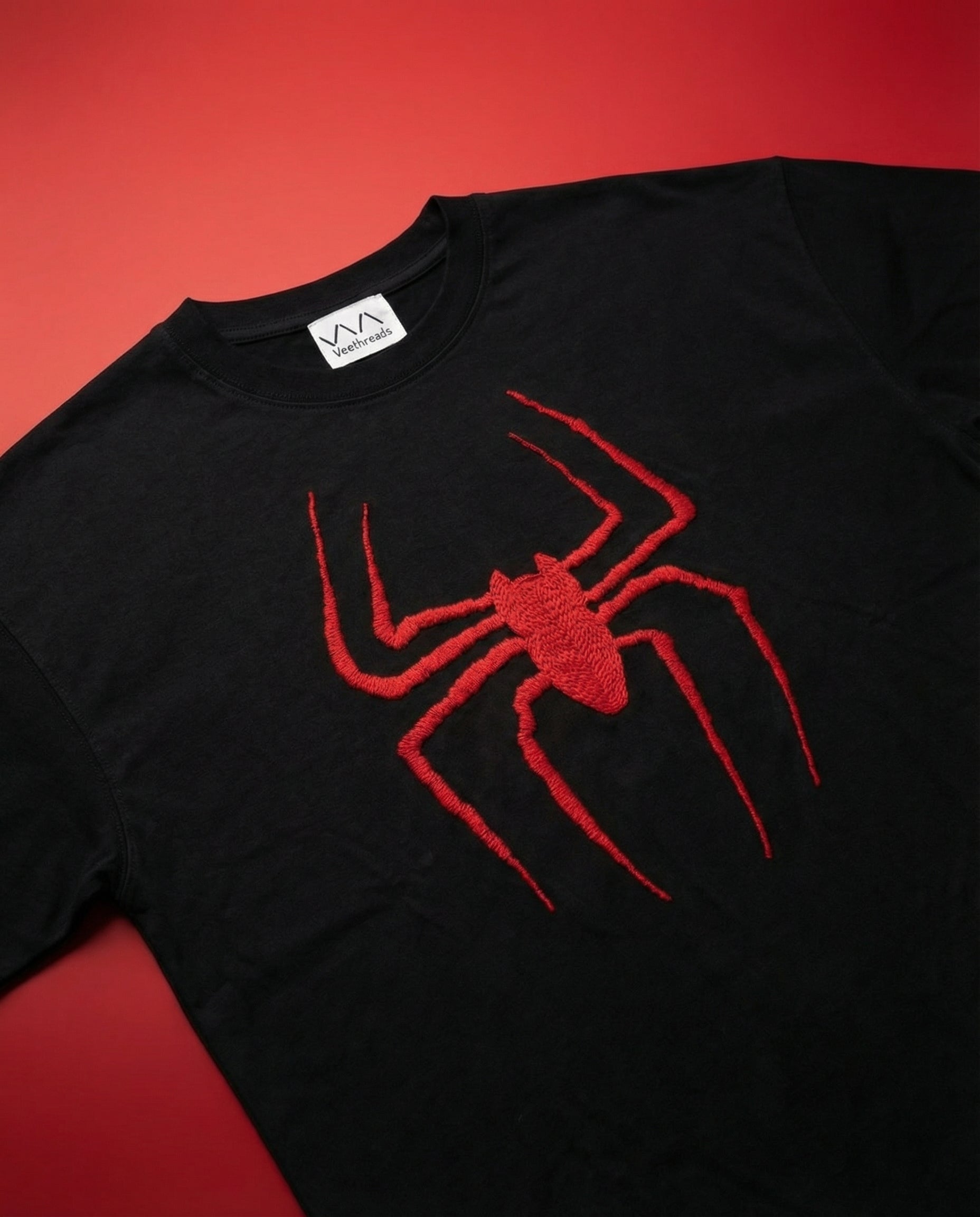
Our spider web tee carries over 4,000 individual hand stitches on 220 GSM cotton. It takes hours. It is worked outward from the centre, one round at a time, in almost exactly the order a spider builds a real web.
That is the reason the motif belongs on hand-embroidered clothing more than on almost anything else. A printed spider web is a picture of patience. A stitched one is patience.
Frequently asked questions
Is a spider web motif considered unlucky?
In most traditions, no. Greek, West African, Ojibwe, Japanese and Indian readings all lean positive, treating the spider as a maker, a protector or a symbol of patience. The horror association is recent and largely a product of Western film.
Is spider web embroidery only for Halloween?
No. In black thread on a dark tee it reads as a fine-line geometric motif year round. Halloween is when people go looking for it, not when it stops working.
How many stitches are in the design?
Over 4,000 on our spider web tee, all worked by hand by women artisans in Bulandshahr, Uttar Pradesh. No machine embroidery at any stage.










Share and get 15% off!
Simply share this product on one of the following social networks and you will unlock 15% off!