



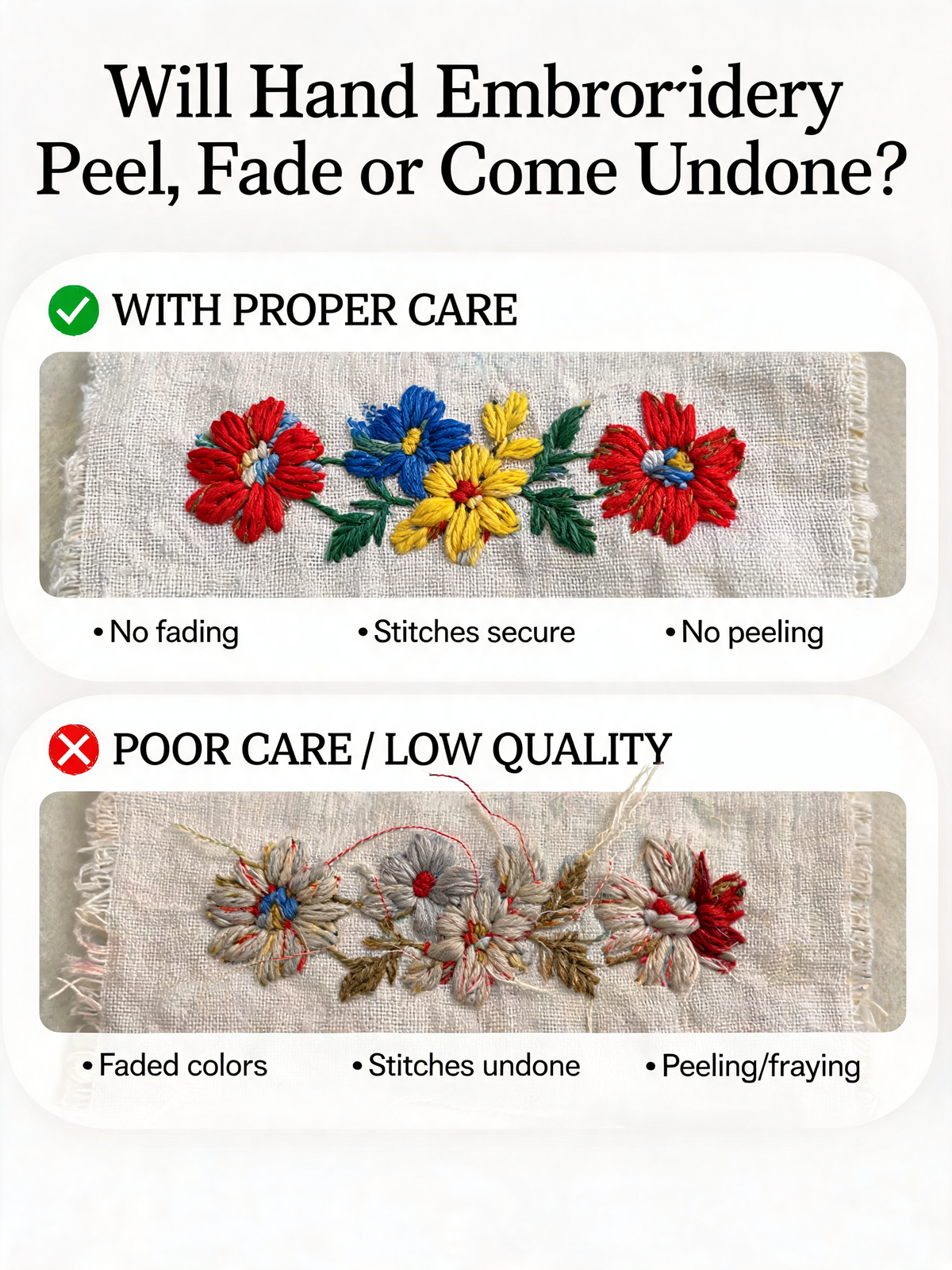
It's the question we get more than any other, and it's a fair one. If you're paying ₹1,800 for a hand-embroidered t-shirt instead of ₹500 for a printed one, you want to know it'll still look right in two years.
The short answer: hand embroidery doesn't peel, crack or flake, because there's nothing sitting on the surface to peel off. It can fade, and it can pull. Both are slower and more fixable than what happens to a print.
The longer answer is below.
Why embroidery fails differently to print
A screen print is a layer of ink bonded to the surface of the fabric. It's a coating. Coatings crack when the fabric underneath flexes, and once cracked they flake. Every printed tee you've owned has failed this way.
Embroidery isn't on the fabric. It's through it. The thread is structurally part of the garment. There's no layer to separate, which is why the peel-and-crack failure mode simply doesn't exist.
Bend the fabric and watch what happens
A print is on the cloth. Embroidery is through it. That one difference decides how each one fails.
Print, new. A layer of ink bonded to the surface. It looks perfect on day one.
Print, after flexing. Coatings crack when the fabric underneath bends, and once cracked they flake. Every printed tee fails this way.
Embroidery, after flexing. The thread is part of the garment, so there is no layer to separate. Peeling and cracking simply cannot happen.
Embroidery fails in three other ways instead:
- A pulled thread: a raised stitch catches on something and lifts. Repairable.
- Colour fade: dyed thread loses saturation, mostly from sunlight rather than washing.
- Puckering: the fabric shrinks around stitching that doesn't, usually from heat.
All three are preventable. None are sudden.
The three ways embroidery does fail
All three are slow and all three are preventable. Tap one for the cause and the fix.
Pulled thread. Mechanical, not material: a raised stitch catches on a zip, a strap or the washing machine. Wash inside out, use a mesh bag. Never cut it; work it back through, or send it to us.
Fading. Sunlight does far more than washing. Reds and bright pinks go first, deep blues and blacks hold best. Dry in shade, wash cold, never bleach.
Puckering. Heat shrinks the cotton fabric around thread that does not shrink as much. Cold water, no dryer, dry flat. A base fabric under about 180 GSM puckers anyway.

The three failure modes, in detail
Pulled threads
The most common issue, and almost always mechanical rather than material. A raised stitch catches on a zip, a watch strap, a bag buckle, or the agitator in a top-loading washing machine.
Prevention: wash inside out, always. It puts the embroidery on the inside of the tumble and removes most of the risk in one step. A mesh laundry bag removes most of the rest.
Fix: do not cut a pulled thread. Use a fine needle to work it back through to the reverse from the front, then secure it on the back. If you'd rather not, send it to us. We repair pulled stitches on anything we've made.

Fading
Dyed cotton thread fades. So does dyed cotton fabric. The thing worth knowing is that thread usually fades faster than the garment, because the dye is applied to a much finer fibre with more surface area exposed.
Sunlight does far more damage than washing. A tee dried in direct Indian sun loses more colour in ten dryings than in fifty gentle washes.
Prevention: dry in shade, always. Wash inside out. Cold water. Never bleach. Bleach destroys thread dye long before it affects the garment.
Some colours are more vulnerable: reds and bright pinks fade fastest, deep blues and blacks hold best, and metallic thread degrades faster than any cotton.

Puckering
The fabric around a motif goes wavy and won't press flat. It looks like bad stitching. Usually it's heat.
Cotton fabric and cotton thread shrink at different rates. Put them through a hot wash or a tumble dryer and the fabric contracts around stitching that doesn't move, and the surface distorts. Once that's happened it's largely permanent.
Prevention: cold water, no dryer, dry flat. That's the entire answer.
The other cause is a base fabric that was too light to begin with. Anything under about 180 GSM will pucker under dense embroidery regardless of how it's washed, which is why we work on 220 GSM and above.
The care rules that actually matter
- Inside out, every time. If you do only one thing, do this.
- Cold water, gentle cycle. Or hand wash.
- No dryer. The biggest single cause of permanent damage.
- Dry flat, in shade. Sun fades thread faster than fabric.
- Never wring the embroidered area. Press water out flat.
- Iron on the reverse only. Direct heat flattens the texture you paid for.
- No bleach, ever.
So how long does it actually last?
Treated normally, meaning machine washed cold, inside out and air dried, hand embroidery on a good base fabric outlasts the garment. The collar goes, the fabric thins at the shoulders, and the embroidery is still fine.
Treated badly, meaning hot washes, a tumble dryer and drying in direct sun, expect visible fading within a year and puckering around dense areas.
Same embroidery, three different futures
What decides how long it lasts. Tap a scenario.
Treated normally. Machine washed cold, inside out, air dried. On a good base fabric, hand embroidery outlasts the garment: the collar goes, the fabric thins at the shoulders, and the embroidery is still fine.
Treated badly. Hot washes, tumble dried, dried in direct sun. Expect visible fading within a year and puckering around dense areas.
Base fabric too light. Anything under about 180 GSM will pucker under dense embroidery regardless of how it's washed, which is why we work on 220 GSM and above.
The comparison worth holding onto: a print gets worse-looking as it ages. Embroidery gets softer. Thread relaxes into the fabric over time and the piece settles. That is a different relationship with a garment.

If a stitch ever pulls on something we made, send it back. We'll repair it.
Read next: Embroidered vs Printed T-Shirts · Why Hand-Embroidered Clothing Costs More · Cotton Types Explained













Share and get 15% off!
Simply share this product on one of the following social networks and you will unlock 15% off!