



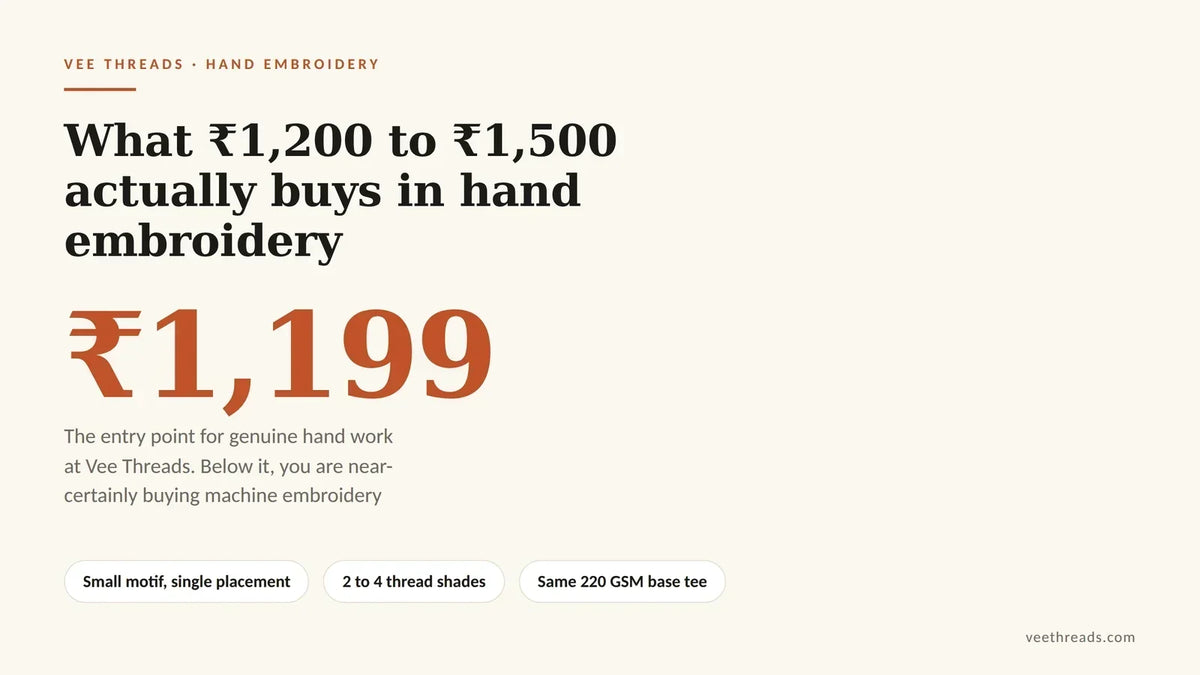
Short answer. ₹1,199 is the entry point for genuine hand embroidery in India. At that price you get a small single-placement motif in two to four thread shades, on the same 220 GSM cotton as the expensive pieces. Below roughly ₹1,100, the maths stops working and you are almost certainly buying machine embroidery.

“Cheap hand embroidery” is mostly a category error. Not because affordable hand work does not exist, but because the cheap listings are usually machine work wearing the wrong label.
Here is what genuinely exists at the bottom of the range, and what you give up to get there.
Real hand work under ₹1,600

| Design | Price | What you get |
|---|---|---|
| Sleepy Cat | ₹1,199 | Small chest motif, 3 shades, about 2 hours |
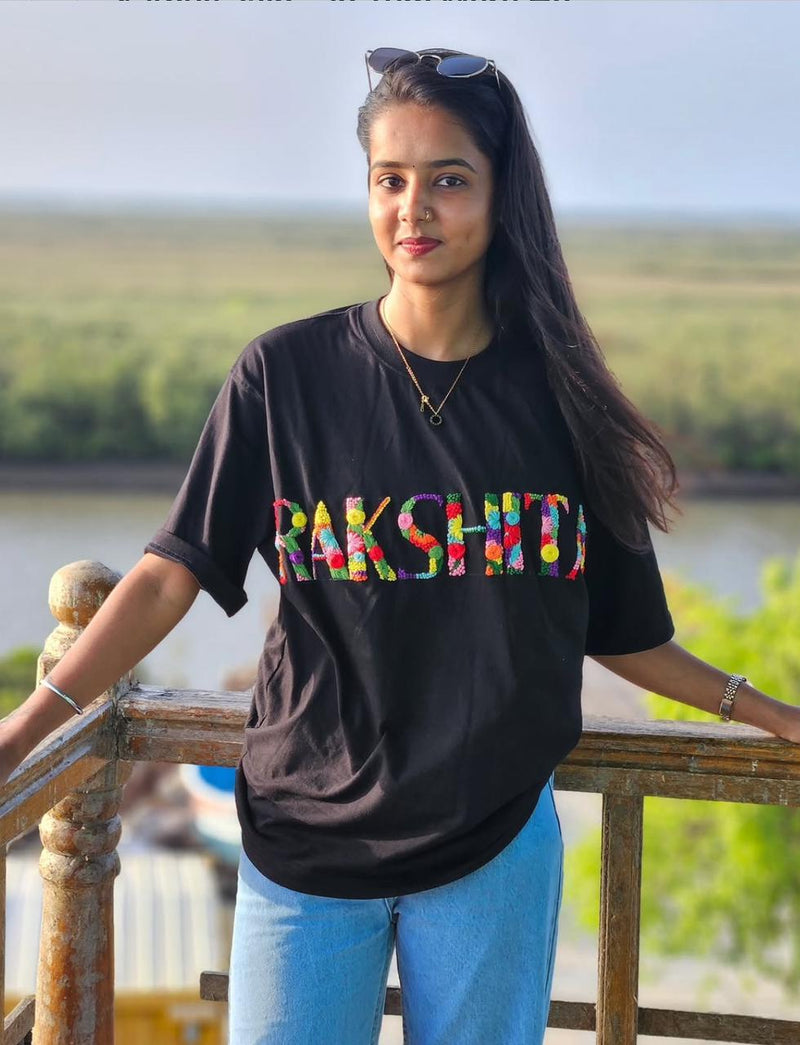
| Hindi Name Tee | ₹1,294 | Custom Devanagari name, chest, written proof included |
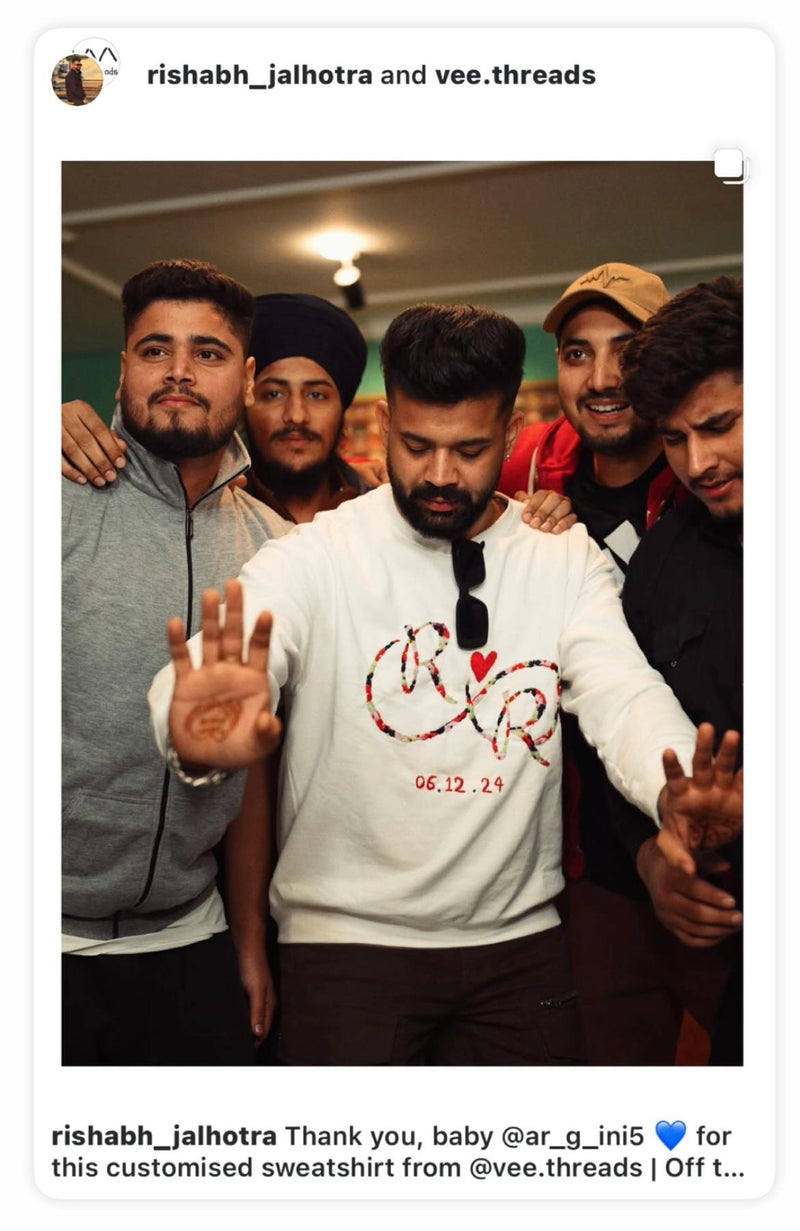
| Couple Initials & Heart | ₹1,299 | Two letters plus a motif, 2 shades |
| Sunflower Monogram | ₹1,300 | Initial inside a small floral, 4 shades |
| Custom Name, double-shade | ₹1,330 | Name in two thread shades, oversized fit |
| Birth Year Tee | ₹1,388 | Four numerals, custom year, clean placement |
| Single Initial & Heart | ₹1,428 | One letter plus heart, about 2 hours |
| Evil Eye Tee | ₹1,499 | Layered fill motif, 4 shades |
| Red Heart Tee | ₹1,500 | Solid satin fill, minimal placement |
What you give up at the entry price
- Size. A chest motif, not a back panel. Surface area is the main thing you are buying.
- Shade count. Two to four thread colours instead of eight or nine. Fewer stops, less colour matching, faster.
- Shading. Long-and-short gradient fill is the slowest technique there is and it does not appear under ₹1,600.
What you do not give up: the base garment, the artisan doing the work, the wash and press, the QC, or the written spelling proof on custom names. Those are the same on a ₹1,199 tee as on a ₹4,464 one. We do not run a lower-quality tier.
What ₹1,199 to ₹1,500 gives up, and what it keeps
Tap each trade-off to compare the entry price with a larger design.
Size. A chest motif, not a back panel. Surface area is the main thing you are buying.
Shade count. Two to four thread colours instead of eight or nine. Fewer stops, less colour matching, faster.
Shading. Long-and-short gradient fill is the slowest technique there is, and it does not appear under ₹1,600.
What you do not give up. The base garment, the artisan, the wash and press, the QC and the written spelling proof. There is no lower-quality tier.

The corners that are safe to cut
If ₹1,500 is your ceiling, spend it on placement rather than size. A small, well-placed monogram on a good tee reads better than a large motif stitched thinly to hit a price. Sparse fill is the visible compromise, and it is the one that makes cheap embroidery look cheap.
Second: pick a stock design over a custom one if the budget is tight. Stock motifs are faster for the artisan on the fiftieth repeat, and that time saving is real money.

The corner that is not safe to cut
Fabric. A 180 GSM tee costs ₹80 less and ripples permanently around any dense stitching. Every tee we sell sits on 220 GSM combed cotton for exactly this reason, and it is why you will not see a ₹999 option here. The full price picture is here.
Below ₹1,100, do this one check
Ask for a photo of the reverse of the fabric. Hand work shows knots, thread tails and uneven float. Machine work shows a uniform bobbin grid and a stiff backing sheet. The difference explained properly.
The one check below ₹1,100: turn it over
Ask for a photo of the fabric reverse. Tap each sign to see where to look.
Knots. Hand work shows knots on the reverse.
Thread tails. Loose tails of thread on the back are normal for hand work.
Uneven float. Hand work shows uneven float, not a regular pattern.
Uniform bobbin grid. Machine work shows a uniform bobbin grid across the design.
Stiff backing sheet. Machine work shows a stiff backing sheet behind the stitching.
Machine embroidery at ₹700 is a perfectly good product. It only becomes a problem when it is sold as hand work.

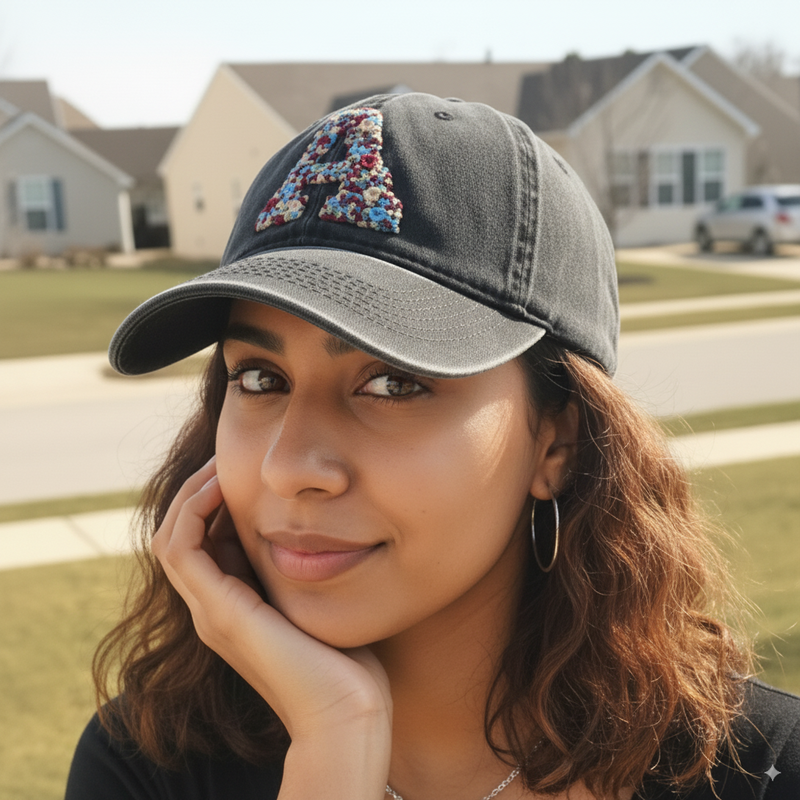
Smaller pieces if the budget is tighter still: embroidered socks, embroidered caps, gifts under ₹1,000.
Frequently asked questions
What is the cheapest genuine hand embroidered T-shirt?
₹1,199 at Vee Threads, for a small chest motif in three thread shades and about two hours of stitching, on the same 220 GSM cotton as the ₹4,464 pieces.
Is a ₹700 hand embroidered T-shirt real?
Almost never. Blank tee, courier and payment fees alone reach about ₹450, leaving nothing for hours of hand work. Ask for a photo of the fabric reverse before buying.
What do you lose by buying an affordable embroidered T-shirt?
Design size, thread shade count and shaded gradient fill. What stays the same is the 220 GSM base garment, the artisan, the wash and press, the quality check and the spelling proof.
Should I buy a bigger design or a better fabric?
Better fabric, every time. A 180 GSM tee saves about ₹80 and ripples permanently around dense stitching. Spend on placement rather than surface area.
Are stock designs cheaper than custom ones?
Slightly, yes. Artisans are meaningfully faster on a motif they have stitched fifty times, and stock designs skip the proof cycle. That time saving is real money.
Who wrote this
Vee Threads is a hand-embroidery label run by Vikash Tomar and Mansi from a studio in Bulandshahr, Uttar Pradesh. Every piece is stitched by hand by women artisans on the studio floor, on 220 GSM combed cotton tees and 400 GSM sweatshirts. We have shipped more than 5,000 orders. Mansi runs the studio and quality control, Vikash handles the digital side. Prices, timings and hours quoted in this article come from our own production records, not from industry averages. Browse the hand embroidered T-shirt collection or start a custom hand embroidery order.








Share and get 15% off!
Simply share this product on one of the following social networks and you will unlock 15% off!