



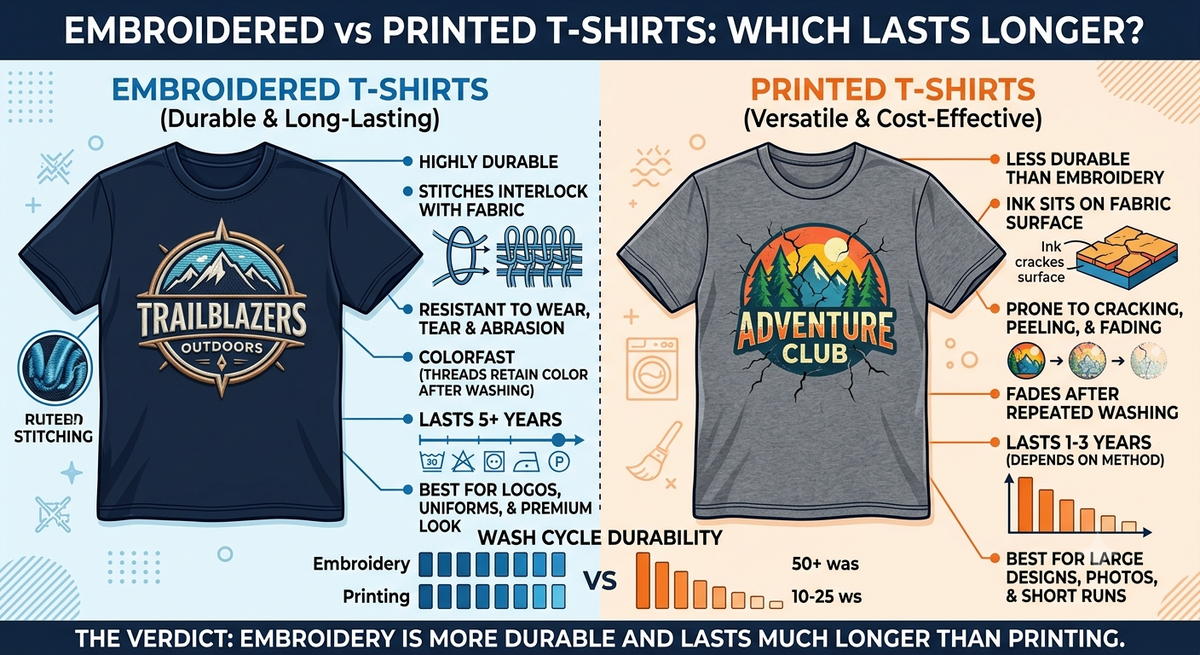
We sell embroidered t-shirts, so you'd expect us to say embroidery wins. On durability it does, comfortably. On several other things print is genuinely better, and it's worth being straight about which is which.
The comparison
| Hand embroidered | Machine embroidered | Screen printed | DTG printed | |
|---|---|---|---|---|
| Typical price (India) | ₹1,300–4,500 | ₹700–1,200 | ₹400–700 | ₹500–900 |
| Lifespan | Outlasts the garment | Outlasts the garment | 1–3 years | 1–2 years |
| Failure mode | Thread pulls (repairable) | Thread pulls | Cracks and flakes | Fades and cracks |
| Fine detail | Good | Good | Excellent | Excellent |
| Photographic images | No | No | Limited | Yes |
| Gradients | Possible, slow | Limited | Limited | Excellent |
| Texture | Raised, tactile | Raised | Flat, slight film | Flat |
| Breathability at the motif | Good | Reduced (stabiliser) | Poor | Moderate |
| Consistency across units | Low (by nature) | Very high | Very high | High |
| Best for 100 units | No | Yes | Yes | Yes |
| Best for 1 unit | Yes | Marginal | No | Yes |
Durability: the real difference
A print is a layer of ink bonded onto the surface. It's a coating, and coatings crack when what's underneath flexes. Every printed tee you've owned has failed the same way — fine cracks, then flaking, then a patchy ghost of the original design.
Embroidery is thread passing through the fabric. It's structurally part of the garment. There is no layer to separate, so the crack-and-flake failure simply doesn't happen.
Embroidery can pull a thread, and it can fade. A pulled thread is repairable. A cracked print is not.
In numbers: a mid-range screen print on a black tee usually starts showing hairline cracks somewhere between 20 and 40 washes, sooner if it goes in hot or gets tumble dried. Hand embroidery has no equivalent failure point. In practice the cotton wears out around the stitching, not the other way round. Our durability guide covers what can and can't happen to the thread over time.

On dark fabric specifically
This is where the gap is widest.
Printing light ink on dark fabric requires an underbase — a layer of white ink laid down first so the colour on top reads true. That means two layers of ink instead of one. It's thicker, stiffer, less breathable, and it cracks sooner, because there's more coating to fail.
Embroidery has no such problem. Thread colour is thread colour, and on black fabric it reads more vividly than on white because the contrast is higher. A red rose on a black tee is the clearest case — embroidered, it glows; printed with an underbase, it sits slightly grey and stiff and starts cracking within a year.

If you're choosing between the two on a dark garment, the decision is easier than on a white one. Most of our embroidered t-shirts come in black for exactly this reason.

When print is the better choice
Being honest about this matters:
- Photographs and photorealistic art. Thread can't do this. Don't try.
- Smooth gradients across small areas. Embroidery shades by overlapping stitches, which needs space to work.
- Large volume identical units. 200 team shirts should be printed or machine embroidered.
- Very fine text. Below about 8mm, embroidered letters lose legibility.
- Full-coverage all-over designs. Embroidering an entire garment surface would cost more than most people will spend.
- Tight budgets. A good print at ₹500 beats bad embroidery at ₹900. Cheap embroidery is worse than good print.
When embroidery is worth it
- You want it to last. This is the main one.
- It's a gift. Thread reads as considered in a way ink doesn't.
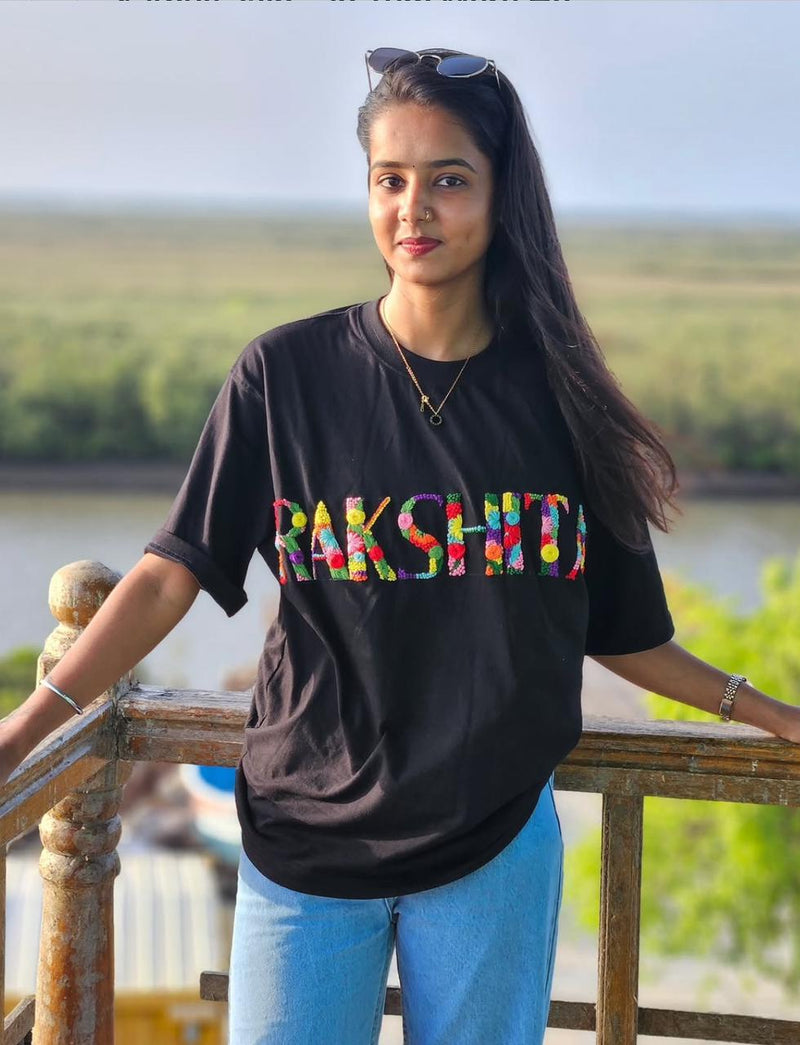
- It's personalised. A stitched name has weight; a printed one looks like a merchandise stall. See our custom embroidered t-shirts.
- It's on dark fabric. See above.
- The design suits thread. Botanical, linear, textural, illustrative work is what embroidery does best. Our floral embroidered t-shirts are the clearest example.
- You want texture. Print is flat. Embroidery has physical relief, and that's most of why it reads as expensive.

How the costs break down
The price gap isn't margin, it's time.
A screen print takes seconds per garment once the screen is set up — the setup cost amortises across the run. Machine embroidery takes a few minutes per garment. Hand embroidery takes hours, and on a dense design a full working day for one person.
So the ₹500 tee and the ₹1,800 tee aren't the same product at different markups. One is a manufactured item, the other is several hours of someone's skilled labour.
Feel and comfort
Underrated in most comparisons.
Screen printing leaves a plastic-feeling film that doesn't breathe. On a large chest print in an Indian summer, you notice.
Hand embroidery leaves the fabric between stitches completely open, so a motif breathes almost as well as bare cloth. Machine embroidery sits in between — the stabiliser backing reduces breathability behind the design.
Against skin: hand embroidery is finished so knots and tails don't sit against you. Machine embroidery has a stabiliser layer you can feel. Print you feel as a smooth patch.

The short version
Buying ten identical shirts for a team? Print or machine embroider.
Buying one shirt you want to still like in five years? Embroider it.
The price difference works out to roughly the cost of replacing a printed tee twice, except at the end of it you still have the shirt.
Frequently asked questions
How should I wash an embroidered black tee?
Inside out, cold water, hand wash or a gentle machine cycle. No tumble dryer and no bleach. The main thing you are protecting is the black dye, not the thread.
Does embroidery make the tee heavier or stiffer?
Slightly, in the stitched area only. On 220 GSM cotton the motif has a light physical rise you can feel with a fingertip. The rest of the garment is unaffected.
Can embroidery be repaired?
Yes, a loose stitch is a two-minute fix with a needle. A cracked print cannot be repaired at all.
Does the thread fade?
Good cotton thread holds colour well. Black on black is the most forgiving combination, since any fading happens to both at once.
Read next: Will Hand Embroidery Peel, Fade or Come Undone? · Why Hand-Embroidered Clothing Costs More · Hand Embroidery vs Machine Embroidery
Shop: Embroidered T-Shirts · Floral Embroidered T-Shirts · Custom Embroidered T-Shirts








Share and get 15% off!
Simply share this product on one of the following social networks and you will unlock 15% off!