



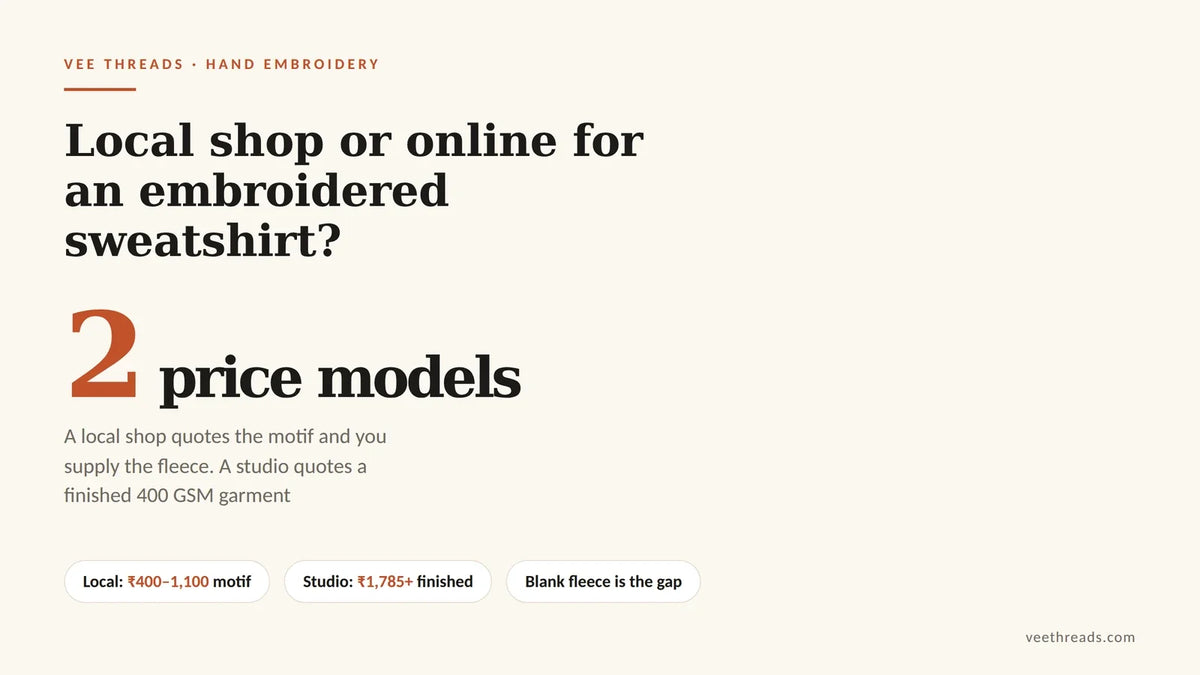
Short answer. A local shop quotes ₹400 to ₹1,100 for the motif and you supply the sweatshirt. A studio quotes ₹1,785 and up for a finished 350 GSM garment. Add a ₹600 to ₹1,200 blank and the local route reaches ₹1,000 to ₹2,300, so the real gap is smaller than it looks and mostly buys you fabric control.

You walk into a shop with a sweatshirt, get quoted ₹600, and then see ₹2,310 online for what looks like the same thing. It reads as a scandal until you line up what each price actually covers.
The two quotes are not for the same product

| Local shop | Online studio | |
|---|---|---|
| What is quoted | The motif only | The finished sweatshirt |
| Blank fleece | You buy it, ₹600 to ₹1,200 | Included, 350 GSM |
| GSM control | Whatever you happened to buy | 350 GSM, stated on the page |
| Water-soluble topping | Rarely used | Every piece |
| Hand or machine | Usually a machine head | Hand, reverse photo on request |
| Spelling proof | Verbal, at the counter | Written, before hooping |
| Placement advice | You point at the garment | Checked against seam positions first |
| If it goes wrong | Your problem, your sweatshirt | Restitched or replaced |
| Turnaround | 2 to 4 days | 4 to 5 day queue, then courier |
| Real total | ₹1,000 to ₹2,300 | ₹1,785 to ₹4,463 |

Where local genuinely wins
Four situations, and I would use a local shop for all of them.
- You already own the sweatshirt. Adding initials to fleece you love is a job for someone you can hand it to.
- You need it this week. Two to four days beats our seven to eleven, and in December it is not close.
- It is a repair. A karigar restitching a pulled thread is faster and cheaper than posting anything anywhere.
- You want to watch. Underrated, and you learn something.
Is this a job for a local shop?
Tick any that fit. Each is a case where local genuinely wins.
of 4 reasons to go local
Nothing ticked yet. If none of these fit, start small online: a name or initials piece around ₹1,785 tells you what you need to know for the least money.
One is enough.
Any one of these is enough: go local. Buy the blank first, then ask two questions before leaving it: do you use a topping film on fleece, and is this a machine head or hand work.

The two problems specific to fleece
On a tee, the local route mostly risks shrinkage. On a sweatshirt there are two sharper issues.
You are choosing the blank. Most market fleece is 280 to 320 GSM because it is cheaper and feels thick enough on the rack. Dense stitching on 280 GSM distorts the fabric around the motif and it does not come back. You will not know the GSM of what you bought, and neither will the seller.
Almost nobody uses topping. Walk-in shops run machine heads at speed, and the topping stage costs time they are not being paid for. So the motif sinks into the pile and looks slightly out of focus, which is exactly the look people describe as “cheap embroidery” without being able to say why. Check 3 here explains what to look for.
Two fleece problems, seen from the side
Tap a state. A side view through the fabric, pile on top, motif in terracotta.
You are choosing the blank. Most market fleece is 280 to 320 GSM. Dense stitching on 280 GSM distorts the fabric around the motif and it does not come back. You will not know the GSM of what you bought.
A studio states it. The online studio blank is included in the price, 350 GSM, stated on the page.
Almost nobody uses topping. Walk-in shops run machine heads at speed, and the topping stage costs time they are not paid for. The motif sinks into the pile, the look people call cheap embroidery.
Topping on every piece. Water-soluble topping is why the stitching sits above the pile rather than sinking into it.
Ask a local shop two questions: do you use a topping film on fleece, and is this a machine head or hand work.

The honest arithmetic
Local: ₹600 motif plus a ₹800 blank is ₹1,400. Machine-stitched, unknown GSM, no topping, no proof, and the shrinkage and distortion risk is yours.
Studio: ₹1,785 to ₹2,310 finished. Hand-stitched on stated 350 GSM, topping used, written proof on names, replaced if wrong.
A gap of roughly ₹400 to ₹900 for a materially different garment. Whether that is worth paying depends entirely on whether you wanted hand embroidery on good fleece or just wanted a design on a sweatshirt. Both are reasonable answers and I am not going to pretend otherwise.
Lining up the two quotes
Tap through. Grey is the local route, terracotta the studio. Same rupee scale in every step.
The quotes as you see them. ₹600 at the counter against ₹2,310 online. It reads as a scandal until you line up what each price covers.
Add the blank you supply. ₹600 motif plus a ₹800 blank is ₹1,400. The shop only ever quoted the motif.
The real gap. ₹1,400 local against ₹1,785 to ₹2,310 finished: roughly ₹400 to ₹900, for hand stitching on stated 350 GSM, topping, a written proof and a replacement if it goes wrong.
The full ranges. Local, with a ₹600 to ₹1,200 blank: ₹1,000 to ₹2,300. Studio: ₹1,785 to ₹4,463.
Whether the gap is worth paying depends on whether you wanted hand embroidery on good fleece or just a design on a sweatshirt.

If you go local anyway
Buy the blank first and ask the shop two questions before leaving it: do you use a topping film on fleece, and is this a machine head or hand work. The answers take ten seconds and tell you what you are getting.
If you go online
Start small. A name or initials piece around ₹1,785 tells you what you need to know for the least money. Run the six brand checks first.

Frequently asked questions
Is it cheaper to get a sweatshirt embroidered locally?
The quote looks cheaper because it covers the motif only. Add a ₹600 to ₹1,200 blank and the local total is ₹1,000 to ₹2,300, against ₹1,785 and up for a finished 350 GSM studio garment.
Do local embroidery shops use topping on fleece?
Rarely. Walk-in shops run machine heads at speed and the topping stage costs time they are not paid for, so the motif sinks into the pile and reads as slightly out of focus.
What GSM is market fleece?
Usually 280 to 320 GSM, because it is cheaper and feels thick enough on the rack. Dense stitching on 280 GSM distorts the fabric around the motif permanently.
When should I use a local embroidery shop for a sweatshirt?
When you already own the garment, when you need it within a week, when it is a repair, or when you want to watch the work happen.
What should I ask a local shop before leaving my sweatshirt?
Two questions: do you use a water-soluble topping film on fleece, and is this hand work or a machine head. The answers tell you what you are actually buying.
See the stitching up close. New designs and studio detail shots go up on our Pinterest first. Shipping outside India is easiest through our Etsy shop, which handles the customs paperwork.
Who wrote this
Vee Threads is a hand-embroidery label run by Vikash Tomar and Mansi from a studio in Bulandshahr, Uttar Pradesh. Every piece is stitched by hand by women artisans on the studio floor, on 350 GSM cotton fleece for sweatshirts, 400 GSM for hoodies, and 220 GSM combed cotton for tees. We have shipped more than 5,000 orders. Mansi runs the studio and quality control, Vikash handles the digital side. Prices, timings and hours quoted here come from our own production records, not industry averages.
Browse hand embroidered sweatshirts and embroidered hoodies, start a custom order, or find us on Etsy and Pinterest.







Share and get 15% off!
Simply share this product on one of the following social networks and you will unlock 15% off!