



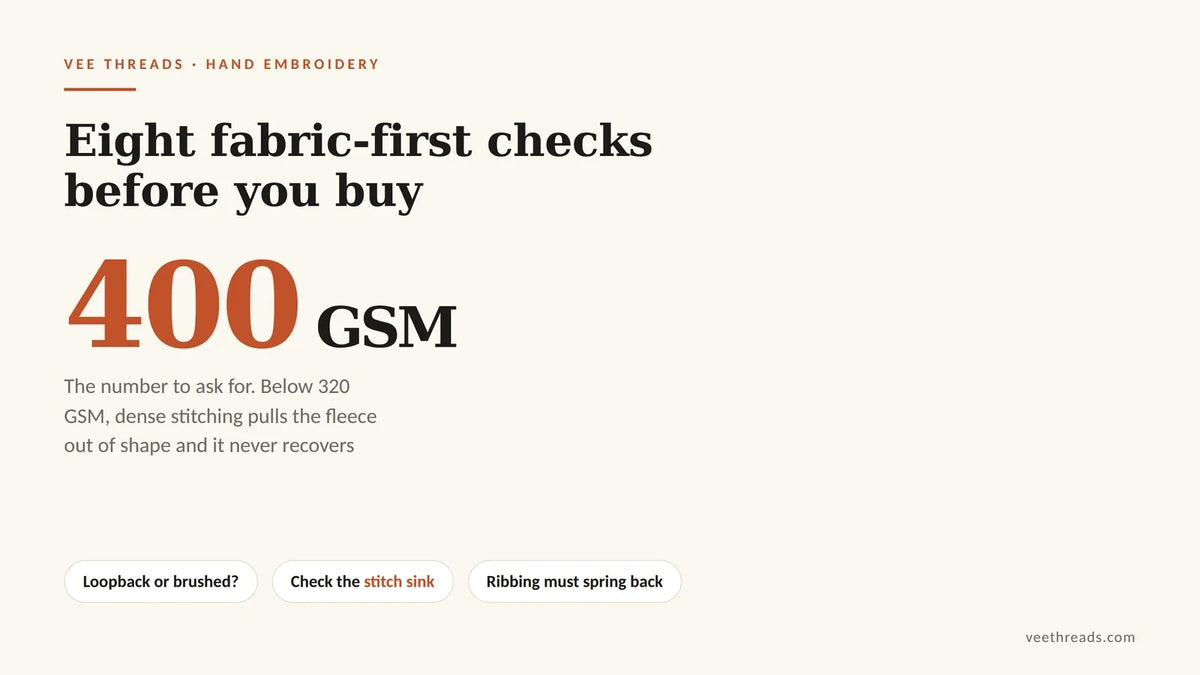
Short answer. Check the fabric before the design. Ask for the GSM as a number, whether the inside is loopback or brushed, and a photo of the fabric reverse. Then check that the motif sits proud of the pile rather than sunk into it, that no white topping residue is left in the stitching, and that the cuff ribbing springs back when pulled.

If you are still deciding what to buy, start with our embroidered sweatshirt buyer's guide, which covers fits, motifs and what suits whom. This page is the narrower job: the checking procedure you run on a listing once you have a shortlist.
Most buying guides start with the embroidery. On a sweatshirt that is the wrong order. The fabric decides whether good stitching stays looking good, and bad fleece will ruin excellent work inside one season.
So: fabric first, stitch second.
The eight checks

| # | Check | What good looks like | What it means if it fails |
|---|---|---|---|
| 1 | GSM as a number | 350 GSM stated on the page | Under 320, stitching distorts the fabric for good |
| 2 | Loopback or brushed | One of the two, named | Nobody who specifies fleece leaves this out |
| 3 | Stitch sits proud | Motif raised above the pile | Sunken stitches mean no topping was used |
| 4 | No topping residue | Clean thread, no white flecks | It was not rinsed properly after stitching |
| 5 | Motif clears seams | Design sits inside a flat panel | A seam-crossing motif could not have been hooped flat |
| 6 | Ribbing springs back | Cuff returns to shape when pulled | Weak ribbing sags by month three |
| 7 | Photo of the reverse | Knots and thread tails | A uniform bobbin grid means machine work |
| 8 | Stated stitch hours | 2.5 for initials, 18 for a panel | Vagueness means outsourced or automated |
The eight checks on one sweatshirt
Tap a check to see where to look and what good looks like.
GSM as a number. Good looks like 350 GSM stated on the page. Under 320, dense stitching distorts the fabric for good.
Loopback or brushed. The listing should name one of the two. Nobody who actually specifies their fleece leaves this out.
Stitch proud, no residue. The motif should sit raised above the pile, with clean thread and no white flecks. Sunken stitches mean no topping; flecks mean it was not rinsed properly.
Motif clears the seams. The design should sit inside one flat panel. A motif crossing a seam could not have been hooped flat.
Ribbing springs back. Pull the cuff and it should return to shape. Weak ribbing sags by month three.
Reverse and hours. Ask for a photo of the reverse: knots and thread tails are hand work, a uniform bobbin grid is machine work. Real stated hours run from 2.5 for initials to 18 for a panel; vagueness means outsourced or automated.

Check 3 is the one nobody knows about
This is the single most useful thing in this article, so I will be specific.
Fleece has a pile, a raised surface of fibres. Lay a stitch directly onto it and the thread settles down between the fibres, so the motif looks slightly out of focus and half-buried. The fix is a water-soluble film laid over the pile first. The artisan stitches through film and fabric together, then the film rinses away in cold water, leaving the stitching sitting cleanly on top.
Look at any product photo at full zoom. Good fleece embroidery has a crisp edge and casts a small shadow. Bad fleece embroidery looks like it is sinking. Once you have seen the difference you cannot unsee it, and it is visible in almost every listing online.
Check 3, in cross-section
Tap a stage to see why topping keeps the stitch on top of the pile.
No topping. Laid directly on the pile, the thread settles down between the fibres and the motif looks slightly out of focus.
Film first. The fix is a water-soluble film laid over the pile before any stitching.
Stitch through both. The artisan stitches through film and fabric together, so the thread cannot sink.
Rinse it away. The film rinses out in cold water. White flecks left in the thread mean it was not rinsed properly.
The result. Stitching sits cleanly on top. At full zoom, good fleece embroidery has a crisp edge and casts a small shadow; bad work looks like it is sinking.

Loopback or brushed, and which to choose
Two ways to finish the inside of cotton fleece.
- Loopback leaves the knit loops uncut. It holds shape well under dense stitching and pills more slowly, but it feels flatter against the skin and takes a few washes to soften.
- Brushed has the loops cut and raised, so it is warmer and softer from the first wear. The trade is that it pills sooner at the friction points. This is what we use, because most people buy a sweatshirt to be comfortable in, and we would rather manage pilling honestly than sell a fabric nobody wants to put on.
Neither is wrong, and we will tell you which you are getting. If a brand cannot say, they are buying whatever blank was cheapest that month, and that changes between production runs.

Two checks worth skipping
- “Is the cotton organic?” Almost every seller says yes and almost none hold certification. GSM is checkable, this is not.
- Brand follower count. Measures marketing spend. It has never predicted stitch quality.

Where we fail our own checks
Two places. Our delivery is slow, 7 to 11 days against 3 to 5 from a machine unit, and worse from October. And we do not publish a formal written repair policy with a stated turnaround, though we do restitch thread pulls. Both are fair criticisms.
Run these checks on us and on anyone else. The brand comparison framework is here, and the nine buying mistakes are here.

Close-up stitch photos of most of our range sit on Pinterest if you want to practise check 3 before you shop.
Frequently asked questions
What GSM should a hand embroidered sweatshirt be?
350 GSM cotton fleece. Below about 320 GSM, dense hand stitching pulls the fabric out of shape and it never recovers. Ask for the number, not a description.
How can I tell if fleece embroidery was done properly?
Zoom into a product photo. Good work sits proud of the pile with a crisp edge and a small shadow. Sunken, slightly fuzzy stitching means no water-soluble topping was used.
What is the difference between loopback and brushed fleece?
Loopback leaves the knit loops uncut, so it pills more slowly but feels flatter at first. Brushed has the loops cut and raised, so it is warmer and softer immediately but pills sooner. We use brushed 350 GSM cotton fleece.
Why does topping residue matter?
White flecks left in the stitching mean the water-soluble film was not rinsed out properly. It looks crusty and it is a sign the finishing stage was rushed.
Should I check the cuff ribbing?
Yes. Pull it and see if it springs back. Ribbing that stays stretched means the whole garment will lose its shape within about three months of regular wear.
See the stitching up close. New designs and studio detail shots go up on our Pinterest first. Shipping outside India is easiest through our Etsy shop, which handles the customs paperwork.
Who wrote this
Vee Threads is a hand-embroidery label run by Vikash Tomar and Mansi from a studio in Bulandshahr, Uttar Pradesh. Every piece is stitched by hand by women artisans on the studio floor, on 350 GSM cotton fleece for sweatshirts and hoodies and 220 GSM combed cotton for tees. We have shipped more than 5,000 orders. Mansi runs the studio and quality control, Vikash handles the digital side. Prices, timings and hours quoted here come from our own production records, not industry averages.
Browse hand embroidered sweatshirts and embroidered hoodies, start a custom order, or find us on Etsy and Pinterest.












Share and get 15% off!
Simply share this product on one of the following social networks and you will unlock 15% off!