



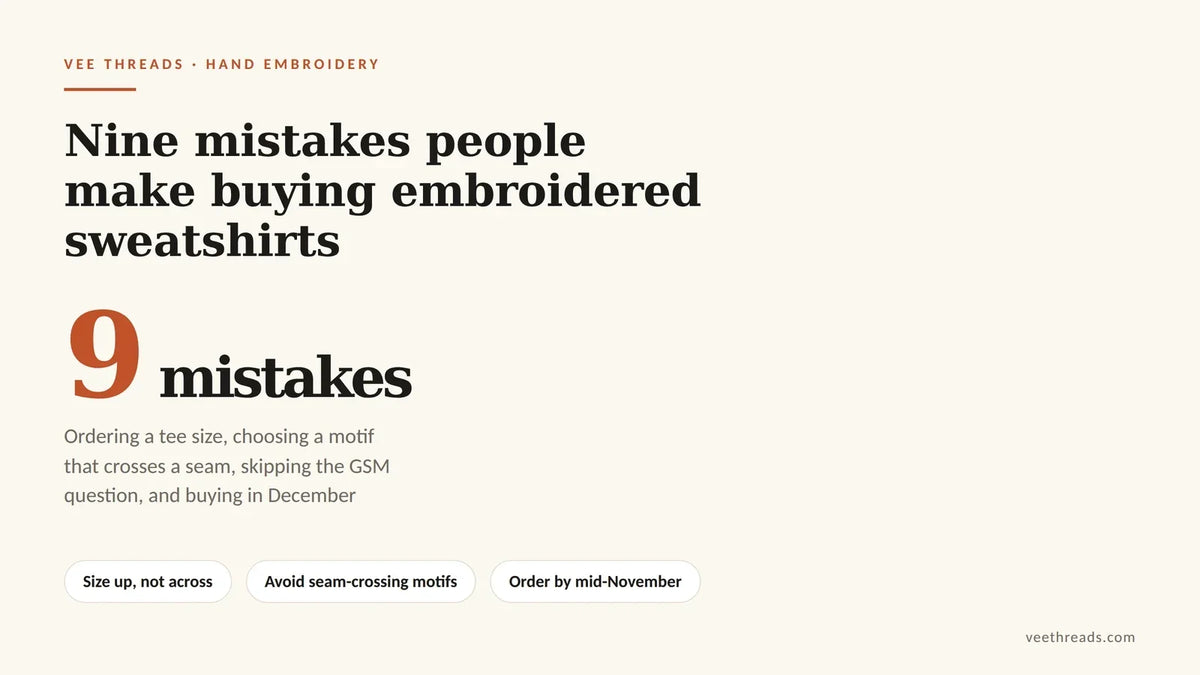
Short answer. The three mistakes that cost people most when buying embroidered sweatshirts: ordering your usual T-shirt size when loose-fit fleece is cut wider and longer, choosing a motif that crosses a shoulder or pocket seam so it cannot be hooped flat, and ordering in December when the studio queue is at its longest.

These come from our own order inbox rather than from anywhere else. Every one of them has cost a real customer either money, time or a garment that did not fit.
The nine

| # | Mistake | The fix |
|---|---|---|
| 1 | Ordering your T-shirt size | Loose-fit fleece is cut wider and longer. Read the flat measurement in cm, not the letter |
| 2 | Picking a motif that crosses a seam | Shoulder, side and pocket seams cannot be hooped flat. Ask before you fall in love with a placement |
| 3 | Never asking the GSM | Under 320, dense stitching distorts fleece permanently. Ask for a number |
| 4 | Ordering in December | Our queue is longest October to January. Order by 30 November for Christmas |
| 5 | Using a tee design unchanged | Thin lines vanish into pile. Motifs need thickening for fleece |
| 6 | Expecting a real bulk discount | Hours per garment do not fall. Expect 8 to 12 per cent at twenty pieces |
| 7 | Using fabric softener later | It coats fleece fibres and speeds up pilling around the motif |
| 8 | Hanging it to dry | Wet 350 GSM stretches its own shoulders permanently. Dry flat |
| 9 | Skipping the spelling proof | Eight hours of fleece work is expensive to redo over one wrong letter |
Mistake 2 is the one that causes real disappointment
Someone sends a design they love, we look at it, and we have to say it cannot go where they want it.
A hoop needs a flat single layer of fabric. A shoulder seam is three layers and a ridge; a kangaroo pocket is two layers with a bound edge; a hoodie's hood seam is the thickest join on the garment. None can be tensioned flat, and stitching across one produces a puckered motif that no amount of pressing corrects.

So the workable zones are left chest, centre chest below the seam line, upper back and mid-sleeve. On hoodies the upper chest goes too. Ask about placement in your first message and it costs nothing; ask after you have chosen, and you may have to start again. More on how the hood changes things.
Where a motif can and cannot go
Tap a zone, or a numbered dot, to see whether it can be hooped flat.
Left chest: workable. A flat single layer of fleece, which is exactly what a hoop needs to hold the fabric tight.
Centre chest: workable. Keep the motif below the seam line so every stitch sits on single-layer fabric.
Mid-sleeve: workable. Flat single-layer fleece between the seams, so the hoop can tension it evenly.
Upper back: workable. Single-layer fleece clear of the shoulder seams. Ask about placement in your first message and it costs nothing.
Shoulder and side seams: no. A shoulder seam is three layers and a ridge. It cannot be tensioned flat, and a motif stitched across it puckers in a way no pressing corrects.
Hoodies lose more. A kangaroo pocket is two layers with a bound edge, the hood seam is the thickest join on the garment, and the upper chest goes too.
Mistake 1 is the most common by volume
Loose-fit sweatshirts are cut generously on purpose. Someone who wears M in our tees often wants M in a sweatshirt too, and finds it roomier than expected across the chest and longer in the sleeve.

The flat measurements are on every product page in centimetres. Measure a sweatshirt you already own, lay it flat, compare. Two minutes, and it removes the single most common exchange request we get.
Mistake 4 has a hard deadline
Demand for fleece work roughly triples between mid-October and early January while our stitching capacity stays flat. The queue stretches from four days to about eight, couriers slow down in the same weeks, and the two compound.

For a Christmas or New Year gift, order by 30 November. The full timeline is here. Ordering on 18 December for the 25th does not work, however much everyone would like it to.
When to order for Christmas
Tap an order date to see where it lands against the 25th.
Outside the peak, about four days. That is how long a fleece order typically waits to be stitched before mid-October.
The peak: mid-October to early January. Demand for fleece work roughly triples while stitching capacity stays flat, so the queue stretches to about eight days, and couriers slow down in the same weeks.
30 November is the deadline. For a Christmas or New Year gift, order by the end of November so the longer queue and slower couriers both fit.
18 December does not work. About eight days in the queue takes an order placed on the 18th past the 25th before it even ships.
Two mistakes people make after delivery
Fabric softener and hanging to dry. Both feel like taking care of the garment and both actively damage it, softener by accelerating pilling and hanging by stretching wet 350 GSM through two shoulder points.

The full care routine is here, and it is genuinely six steps.
Care that feels right and is not
Tap each habit to see what it does to a 350 GSM sweatshirt.
Hanging to dry: mistake 8. Wet 350 GSM is heavy, and on a hanger it is stretched through two shoulder points. The shoulders stretch permanently.
Dry it flat instead. The fix from the table is two words: dry flat. Lay the wet sweatshirt down rather than hanging it from its shoulders.
Fabric softener: mistake 7. It coats fleece fibres and speeds up pilling around the motif, and it dulls raised satin stitch within a season.
Both feel like taking care of the garment. Both actively damage it.
The mistake we cannot fix for you
Buying a sweatshirt for a climate that does not need one. If your cold season is six weeks, a ₹2,500 fleece piece will be worn fifteen times a year and no amount of quality changes that arithmetic. Buy an embroidered tee instead and wear it all year.
Frequently asked questions
What size embroidered sweatshirt should I order?
Not automatically your T-shirt size. Loose-fit fleece is cut wider and longer. Measure a sweatshirt you already own flat and compare against the centimetre measurements on the product page.
Can embroidery go anywhere on a sweatshirt?
No. A hoop needs flat single-layer fabric, so shoulder seams, side seams and kangaroo pockets are out. Workable zones are left chest, centre chest, upper back and mid-sleeve, and hoodies lose the upper chest too.
When is the deadline for a Christmas embroidered sweatshirt?
30 November. Demand for fleece work triples from mid-October while stitching capacity stays flat, so the queue doubles and couriers slow in the same weeks.
Can I use a T-shirt design on a sweatshirt?
Not unchanged. Thin lines disappear into fleece pile, so motifs are redrawn thicker with denser fill. That redraw is part of why the same design costs more on a sweatshirt.
What damages an embroidered sweatshirt after delivery?
Fabric softener, which coats fleece fibres and accelerates pilling, and hanging it to dry, which lets wet 350 GSM stretch its own shoulders. Both feel like care and are not.
See the stitching up close. New designs and studio detail shots go up on our Pinterest first. Shipping outside India is easiest through our Etsy shop, which handles the customs paperwork.
Who wrote this
Vee Threads is a hand-embroidery label run by Vikash Tomar and Mansi from a studio in Bulandshahr, Uttar Pradesh. Every piece is stitched by hand by women artisans on the studio floor, on 350 GSM cotton fleece for sweatshirts, 400 GSM for hoodies, and 220 GSM combed cotton for tees. We have shipped more than 5,000 orders. Mansi runs the studio and quality control, Vikash handles the digital side. Prices, timings and hours quoted here come from our own production records, not industry averages.
Browse hand embroidered sweatshirts and embroidered hoodies, start a custom order, or find us on Etsy and Pinterest.









Share and get 15% off!
Simply share this product on one of the following social networks and you will unlock 15% off!