



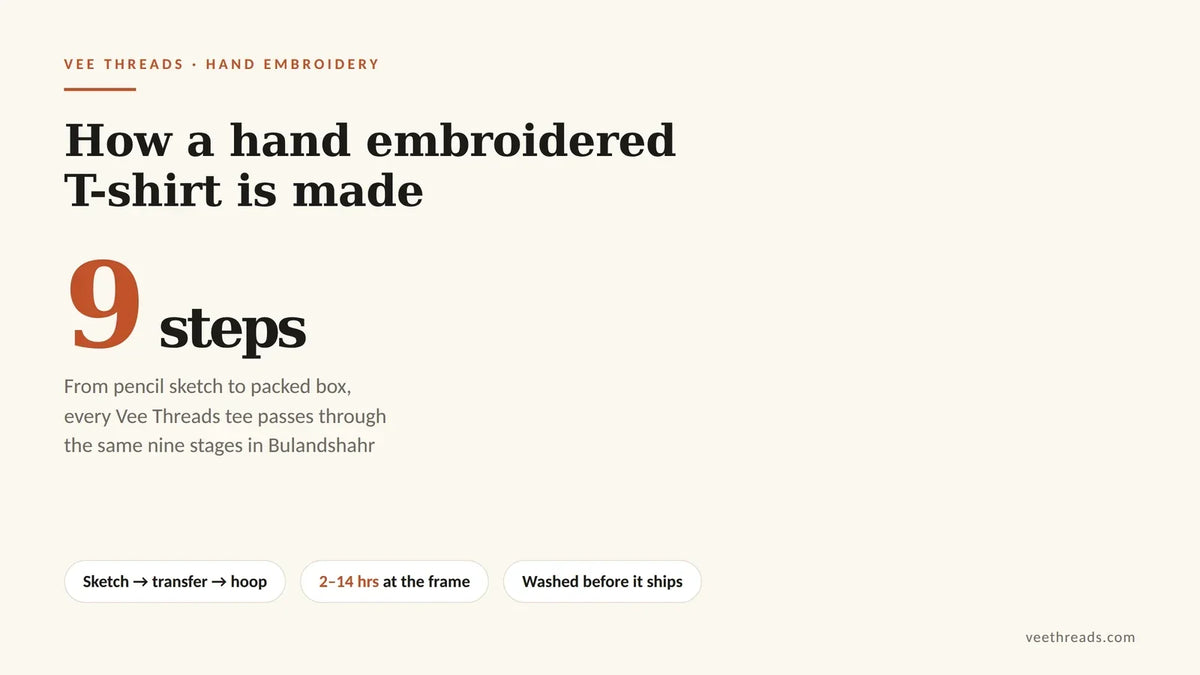
Short answer. Hand embroidered T-shirts are made in nine steps: sketch the motif to size, transfer it with washable marker, hoop the fabric, stitch for 2 to 14 hours, knot off every thread tail on the reverse, wash the marker out, press from the reverse, check tension and spelling, then fold stitch-side in and ship.

People assume the stitching is the whole job. Stitching is about 60 per cent of it. The steps either side are where most of the failures happen, and where most cheap sellers cut corners.
The nine steps

| Step | What happens | What goes wrong if it is rushed |
|---|---|---|
| 1. Sketch | Motif drawn to size on paper and held against the actual tee | Designs sized on screen look 20 per cent bigger on a chest |
| 2. Transfer | Traced onto fabric with washable blue marker | Ballpoint or pencil never comes out |
| 3. Hooping | Fabric tensioned in a wooden hoop | Over-tightened jersey stretches permanently and the motif sits in a dip |
| 4. Stitching | 2 to 14 hours. Satin, chain, back, French knot, long-and-short | Rushed satin fill goes gappy and shows fabric through |
| 5. Knot-off | Every thread tail secured on the reverse | One loose tail and a wash unravels a whole fill |
| 6. Wash | Marker lines removed in cold water | Skipped, and you get blue ghosting that shows up in daylight |
| 7. Press | Steamed from the reverse over a towel | A hot plate on the face flattens satin stitch and it never lifts again |
| 8. QC | Tension, spelling, seams, shade match checked against the proof | Misspelled names reach customers |
| 9. Pack and ship | Folded stitch-side in, boxed | Stitches abrade against each other in transit |
Nine steps, from sketch to shipping
Tap a stage to see what happens, and what goes wrong when it is rushed.
Sketch and transfer. The motif is drawn to size on paper and held against the actual tee, then traced on with washable blue marker. Rushed: designs sized on screen look 20 per cent bigger on a chest, and ballpoint or pencil never comes out.
Hooping. The fabric is tensioned in a wooden hoop, just enough to keep the surface flat. Rushed: over-tightened jersey stretches permanently and the motif sits in a dip.
Stitching. 2 to 14 hours in satin, chain, back stitch, French knot and long-and-short. Rushed: satin fill goes gappy and shows fabric through.
Knot-off. Every thread tail is secured on the reverse. Rushed: one loose tail and a wash unravels a whole fill.
Wash and press. The marker comes out in cold water, then the tee is steamed from the reverse over a towel. Rushed: blue ghosting in daylight, or a hot plate on the face flattens satin stitch for good.
Check and ship. Tension, spelling, seams and shade are checked against the proof, then the tee is folded stitch-side in. Rushed: misspelled names reach customers, and stitches abrade in transit.
Step 3 is where beginners lose the garment
Jersey is knit, not woven. It stretches in every direction, and a hoop tightened the way you would tighten it on cotton drill will pull the knit out of shape around the design area. The stitching then looks fine on the frame and sits in a visible dip once the hoop comes off.
Our artisans tension just enough to keep the surface flat and no more, and they re-check it every hour or so as the fabric relaxes. This is the single most common reason a home-embroidered tee looks slightly wrong without the maker being able to say why. More on that in the DIY guide.

Step 4: which stitch does what
| Stitch | Used for | Speed |
|---|---|---|
| Back stitch | Outlines, lettering, stems | Fast |
| Satin stitch | Solid fills, petals, letterforms | Slow, thread-hungry |
| Long and short stitch | Shaded fills, animal fur, gradients | Slowest |
| Chain stitch | Decorative borders, thick lines | Medium |
| French knot | Flower centres, texture, eyes | Fast but fiddly |
Five stitches, up close
Tap a stitch to see how it is built and what it does on a tee.
Back stitch. Outlines, lettering and stems. Fast: a design that is mostly back stitch comes off the frame in three or four hours.
Satin stitch. Solid fills, petals and letterforms. Slow and thread-hungry, and rushed satin goes gappy.
Long and short stitch. Shaded fills, animal fur and gradients. The slowest: a shaded animal across a full back panel takes fourteen hours or more.
Chain stitch. Decorative borders and thick lines. Medium speed.
French knot. Flower centres, texture and eyes. Fast, but fiddly.
A design that is mostly back stitch, like the line-drawn pieces in our Botanical AW26 collection, comes off the frame in three or four hours. A shaded animal using long-and-short across a full back panel, like the Eagle, takes fourteen or more.

Who is actually doing this
Women artisans on our floor in Bulandshahr, Uttar Pradesh. One person takes a garment from hooping to knot-off rather than passing it down a line, which is slower and produces more consistent tension across a single piece.
Mansi runs the floor and does the final QC on step 8 herself, including reading every custom name back against the customer's written proof. We have shipped over 5,000 orders on that process.

Why it takes days before stitching even starts
Because there is a queue. Orders are stitched in sequence, three to seven days out, longer around Diwali and wedding season. That queue is the honest reason hand embroidery cannot ship same-day, and the full timeline is here.
See the results across 100 hand embroidered T-shirts or start a custom order.

Frequently asked questions
How is a hand embroidered T-shirt made?
In nine steps: sketch to size, transfer with washable marker, hoop the fabric, stitch for 2 to 14 hours, knot off on the reverse, wash out the marker, press from the reverse, quality check, then pack stitch-side in.
How long does it take to hand embroider a T-shirt?
Two hours for a small initial, four to six for a chest monogram, and fourteen or more for a full back panel. That is time at the frame, on top of a three to seven day studio queue.
Why do you wash the T-shirt before shipping?
To remove the washable blue marker used to transfer the design. Skipping this leaves faint blue ghosting around the motif that shows clearly in daylight.
What stitches are used on embroidered T-shirts?
Back stitch for outlines and lettering, satin stitch for solid fills, long and short stitch for shaded areas, chain stitch for borders, and French knots for texture and flower centres.
Does one artisan make the whole T-shirt?
Yes. One person takes a garment from hooping through to knot-off rather than passing it along a line. It is slower but keeps stitch tension consistent across the piece.
Who wrote this
Vee Threads is a hand-embroidery label run by Vikash Tomar and Mansi from a studio in Bulandshahr, Uttar Pradesh. Every piece is stitched by hand by women artisans on the studio floor, on 220 GSM combed cotton tees and 400 GSM sweatshirts. We have shipped more than 5,000 orders. Mansi runs the studio and quality control, Vikash handles the digital side. Prices, timings and hours quoted in this article come from our own production records, not from industry averages. Browse the hand embroidered T-shirt collection or start a custom hand embroidery order.









Share and get 15% off!
Simply share this product on one of the following social networks and you will unlock 15% off!