



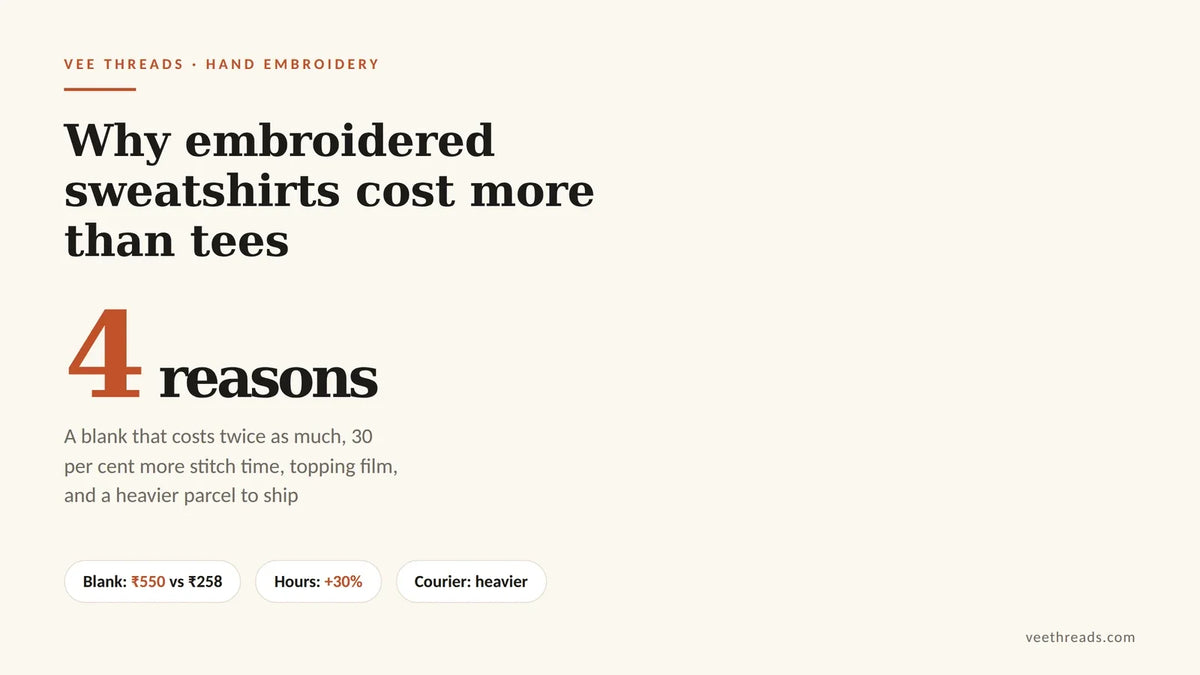
Short answer. Embroidered sweatshirts are expensive for four reasons, each with a number attached. The 350 GSM fleece blank costs about ₹550 against ₹258 for a tee. The same motif takes roughly 30 per cent longer to stitch. Fleece needs a water-soluble topping film that jersey does not. And the finished parcel is heavier to courier. Together that is ₹983 on a mid-range piece.

Why hand embroidery costs more than print at all is a separate argument, and we made it in why hand-embroidered clothing costs more. This page takes that as settled and answers a narrower question: “why is this ₹2,500 when the tee version is ₹1,517?” Two products, same studio, same artisan. It deserves an itemised answer.
Where the gap comes from

| Line | Tee, ₹1,517 | Sweatshirt, ₹2,500 | Added |
|---|---|---|---|
| Artisan wage and floor | ₹667 for 6 hours | ₹1,050 for 8 hours | +₹383 |
| Blank garment | ₹258 at 220 GSM | ₹550 at 350 GSM | +₹292 |
| Wash, press, QC, packaging | ₹121 | ₹200 with rinse and re-nap | +₹79 |
| Design and sampling | ₹106 | ₹175, motif redrawn for pile | +₹69 |
| Payment and platform fees | ₹137 | ₹200 on a larger order | +₹63 |
| Thread, needles, consumables | ₹91 | ₹150 including topping | +₹59 |
| Shipping | ₹137 | ₹175, heavier parcel | +₹38 |
Tee to sweatshirt, one line at a time
Tap a cost line to see it on both garments, drawn to scale.
Artisan wage and floor, +₹383. Six hours on a tee becomes eight on fleece for the same motif. It is the largest single line in the gap.
Blank garment, +₹292. 350 GSM fleece against 220 GSM jersey: about 60 per cent more fabric by weight, plus ribbed cuffs, hem and neckband.
Wash, press, QC, packaging, +₹79. Fleece adds a stage jersey never needs: the topping film is rinsed out and the nap brushed back up.
Design and sampling, +₹69. The tee motif is redrawn for pile before it goes onto fleece.
The three smaller lines. Payment fees rise by ₹63 on a larger order, thread and consumables by ₹59 including topping, and the heavier parcel adds ₹38 to shipping.

Reason one: the blank costs twice as much
350 GSM cotton fleece against 220 GSM combed jersey. About 60 per cent more fabric by weight, plus ribbed cuffs, hem and neckband that a tee does not have, plus a more complex make. That is ₹292 before anyone thinks about embroidery.

Reason two: the needle is slower
Roughly 30 per cent longer for the same motif, which on a six-hour tee design means eight hours on fleece. Three things cause it: more force per stitch through the heavier fabric, denser fill needed because pile swallows thin lines, and hourly re-tensioning because fleece relaxes in the hoop.
Why the needle is slower on fleece
Tap a cause to compare jersey and fleece side by side.
More force per stitch. The needle has to be pushed through much heavier fabric on every single pass.
Denser fill. A thin line reads on flat jersey, but pile swallows it, so the motif needs filling in. This is where much of the extra time goes.
Hourly re-tensioning. Fleece relaxes in the hoop, so the artisan stops to re-tension it every hour.
The result: six hours becomes eight. All three together make the same motif roughly 30 per cent slower on fleece.
The hour-by-hour comparison is here.

Reason three: a whole stage that does not exist on jersey
Water-soluble topping. A film goes over the pile, the artisan stitches through film and fabric together, and afterwards it gets rinsed out and the nap brushed back up.
Materially it is only about ₹59. But it adds close to an hour of handling on a mid-size design, and it is the reason our finishing line is ₹79 higher. Skip it and the motif sinks into the pile, which is what most cheap fleece embroidery looks like.

Reason four: the parcel is heavier
Small, but real. Sweatshirt-weight courier across India runs ₹160 to ₹200 against ₹120 to ₹160 for a tee.
What is not in the gap
No factory line, no marketing budget of any size, and no separate margin row. The margin sits inside the wage-and-floor line rather than beside it, which is why we publish the breakdown at all. The full rupee-by-rupee version is here.
Bulk barely helps, and this surprises people
Screen printing collapses in price at volume because setup is the expensive part. Burn a screen once and each additional pull costs pennies.
Hand embroidery has almost nothing to amortise. The tenth sweatshirt takes the same eight hours as the first. What does spread across a run is design and sampling, so a twenty-piece corporate order gets 8 to 12 per cent off. Not the 50 per cent people expect, and quoting a discount we cannot deliver would only move the argument to week three.
Why bulk barely moves the price
Tap an order size to see what happens to the cost of each sweatshirt.
One sweatshirt, eight hours. A mid-range chest motif on fleece takes about eight artisan hours, the largest single line in its ₹2,500 price.
The tenth takes the same eight hours. Hand embroidery has almost nothing to amortise. Every extra piece needs the same time at the frame as the first.
Twenty pieces: 8 to 12 per cent off. What does spread across a run is design and sampling, so a twenty-piece corporate order gets 8 to 12 per cent off. Not the 50 per cent people expect.
Screen printing collapses at volume. Setup is the expensive part. Burn a screen once and each additional pull costs pennies. Hand embroidery has no screen to burn.
Curves are schematic. The measured figure is the 8 to 12 per cent at twenty pieces.
When the price is not worth it
Gym wear, growing children, runs over fifty pieces, and anything needed inside a week. We refer that work out regularly. And if your cold season is short, the cost-per-wear case genuinely fails.
If budget is the constraint rather than the principle, real hand work starts at ₹1,785.
Frequently asked questions
Why are embroidered sweatshirts so expensive?
Four stacked reasons on a mid-range piece: ₹383 more artisan time, ₹292 more for the 350 GSM blank, ₹79 more finishing including the topping rinse, and smaller additions for design, fees, consumables and heavier courier.
How much more does a sweatshirt cost than a tee?
About ₹983 for a mid-range chest motif: ₹1,517 on a 220 GSM tee against ₹2,500 on 350 GSM fleece. The gap widens with design size because stitching hours scale and fabric cost does not.
What percentage of the price is labour?
About 42 per cent on a mid-range sweatshirt, against 44 per cent on a tee. The share is slightly lower only because the blank fleece takes a bigger bite, not because the work is cheaper.
Why does bulk ordering not cut the price much?
There is no setup cost to spread. The tenth garment takes the same hours as the first. Only design and sampling are shared, which is worth 8 to 12 per cent at twenty pieces.
Is a ₹900 hand embroidered sweatshirt possible?
No. The 350 GSM blank, courier and payment fees alone reach about ₹800, leaving nothing for four hours of skilled work. At that price it is machine embroidery, usually on thinner fleece.
See the stitching up close. New designs and studio detail shots go up on our Pinterest first. Shipping outside India is easiest through our Etsy shop, which handles the customs paperwork.
Who wrote this
Vee Threads is a hand-embroidery label run by Vikash Tomar and Mansi from a studio in Bulandshahr, Uttar Pradesh. Every piece is stitched by hand by women artisans on the studio floor, on 350 GSM cotton fleece for sweatshirts, 400 GSM for hoodies, and 220 GSM combed cotton for tees. We have shipped more than 5,000 orders. Mansi runs the studio and quality control, Vikash handles the digital side. Prices, timings and hours quoted here come from our own production records, not industry averages.
Browse hand embroidered sweatshirts and embroidered hoodies, start a custom order, or find us on Etsy and Pinterest.








Share and get 15% off!
Simply share this product on one of the following social networks and you will unlock 15% off!