



Embroidery has hundreds of named stitches. You do not need to know hundreds. On clothing, about six of them do almost all the work.
This guide covers those six. It is written for someone looking at a garment rather than someone holding a needle, so the useful part is learning to recognise each stitch and understand what it tells you about the piece.
Why the stitch matters when you are buying
Different stitches take different amounts of time, and time is most of what you pay for.
A filled shape worked in satin stitch takes far longer than the same shape outlined in a simple line. So two designs that look similarly sized in a photo can involve very different amounts of work. Once you can tell the stitches apart, product photos become a lot easier to read.
Six stitches, close up
These six do almost all the work on clothing. Tap one to see what it leaves on the cloth.
Running stitch. A broken line of even dashes. Worked in rows across a whole panel, it becomes kantha.
Back stitch. The gaps closed into a solid thin line. The standard for outlines, lettering and most stitched names.
Chain stitch. Loops linked into each other. Heavier and more textured than a plain outline, and it turns curves smoothly.
Satin stitch. Long stitches laid tightly side by side to fill a shape. Good satin has no cloth showing and a clean edge. It is the stitch that most rewards skill.
French knot. Raised dots you can feel with a fingertip. Slow and fiddly, so they are one of the clearest signs of hand work.
Shisha. A mirror held by a cage of thread around and across its rim. No glue anywhere. If it is glued, it is not shisha.

Running stitch
The simplest one, and the oldest. The needle goes in and out along a line, leaving a row of small dashes with gaps between them.
On its own it looks plain. Worked in rows across a whole panel it becomes something else entirely, which is the basis of kantha, the tradition from Bengal and eastern India. Rows of running stitch build up a rippled texture across the fabric rather than drawing a picture on it.
How to spot it: a broken line of even dashes. If you see whole areas of fabric covered in parallel dashed rows, that is kantha work.
Back stitch
A running stitch with the gaps closed. The needle comes forward, then goes back into the end of the previous stitch, so the line is solid instead of broken.
It is the standard choice for outlines, lettering and any fine detail that needs to read clearly. Most hand stitched names and initials use it or something close to it.
How to spot it: a solid thin line with no gaps, often used for the edges of shapes.
Chain stitch
Loops linked into each other, forming a line that looks like a tiny chain. Each loop is anchored by the next one.
Chain stitch gives a heavier, more decorative line than back stitch, and it turns corners and curves smoothly. It is used a great deal in Indian embroidery, both for outlines and for filling shapes by working rows side by side.
How to spot it: a line with visible links in it, thicker and more textured than a plain outline.
Satin stitch
Long straight stitches laid tightly side by side to fill a shape completely. Done well, the surface looks smooth and slightly glossy, which is where the name comes from.
This is the stitch that fills petals, leaves and solid letters. It is also the one that most rewards skill. Good satin stitch has no fabric showing between the threads and a clean edge all the way round. Rushed satin stitch shows gaps and a ragged outline, and once you know to look for it you cannot unsee it.
How to spot it: a solid filled area with visible thread direction running across it, usually smooth and slightly shiny.

French knot
A small raised dot. The thread is wound around the needle a few times before the needle goes back through the fabric, leaving a tight little bead sitting on the surface.
French knots are used for flower centres, textures like moss or foliage, eyes on small animals, and anything that needs to sit up off the cloth. A cluster of them adds real depth to a design.
How to spot it: raised dots you can feel with a fingertip. They are one of the clearest signs of hand work, because they are fiddly and slow.
Shisha, or mirror work
Not a stitch exactly, more a technique. A small mirror is held onto the fabric by a framework of thread stitched around and across it. No glue is involved anywhere. The thread itself is the fixing.
This is why the quality of shisha work matters so much. A well built frame holds a mirror for decades. A poorly built one lets it slip out. If you see mirrors attached with adhesive, that is not shisha, whatever the listing says.
We explain the technique properly in our guide to mirror work.
How to spot it: small mirrors held by a visible cage of thread around the rim.

Putting it together on a real garment
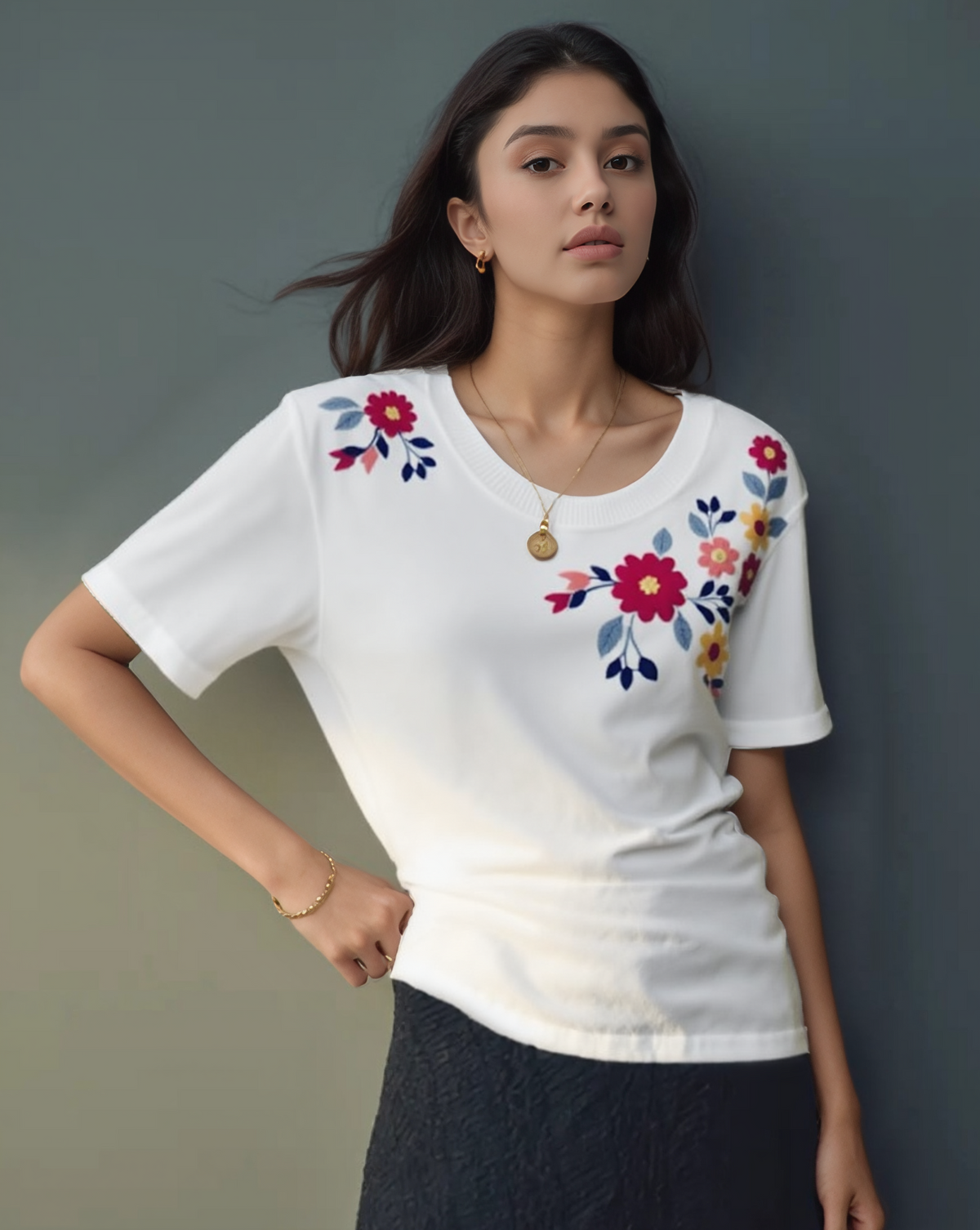
Most embroidered designs combine several of these. A sunflower on a tee might use satin stitch for the petals, French knots for the seeded centre, back stitch for the stem outline and chain stitch for the leaves.
That combination is worth noticing, because a design using four stitch types took longer and required more skill than one worked entirely in a single line stitch. It is a more reliable quality signal than the size of the motif.
One sunflower, four stitches
Tap a part to see which stitch made it. More stitch types in one design means more skill and more hours.
Petals: satin stitch. Filled edge to edge, with the thread direction running along each petal.
Centre: French knots. A seeded, raised centre you can feel. The slowest part of the design.
Stem: back stitch. Two solid lines drawing the outline of the stem.
Leaves: chain stitch. Linked loops worked along the leaf, heavier and more textured than an outline.

How to tell hand stitching from machine work
The stitch names above apply to machine embroidery too, since a machine imitates them. The difference is in the execution.
Turn the garment inside out. Machine work leaves a dense, uniform reverse sitting on a stiff backing sheet. Hand work leaves visible thread paths and knots and no backing at all. On the front, machine satin stitch is perfectly even, while hand satin stitch has very slight variation between threads.
French knots are the giveaway. They are slow and awkward, so machine designs tend to avoid them or fake them with a small filled circle that sits flat instead of raised. There is more on this in hand embroidery versus machine embroidery.
What this means for what you buy
You now have a way of reading a product photo that most buyers do not have.
Look for filled areas rather than only outlines. Look for raised knots. Look for more than one stitch type in a single design. Those three things separate a piece somebody spent a day on from one that took an hour.
If you want to see the stitches in use, our floral collection is mostly satin stitch and French knots, and the mirror work shirts show shisha frames clearly. There is more background on the regional traditions in our guide to Indian hand embroidery styles.










Share and get 15% off!
Simply share this product on one of the following social networks and you will unlock 15% off!