



Kantha is probably the most quietly influential embroidery tradition in India, and one of the least understood by people buying it. It looks simple. That simplicity is the point, and it hides a fairly remarkable history.
The short version
Kantha is embroidery made almost entirely from the running stitch, worked in rows across fabric. It comes from Bengal and eastern India. It began as a way of turning worn out cloth into something useful again, and it is now used decoratively on clothing, quilts and home textiles.
Where it came from
Kantha started in the home, not the workshop.
When a cotton sari became too thin to wear, it was not thrown away. Several worn saris were layered on top of each other and stitched together with running stitch, right through all the layers. The stitching held the layers as one cloth and produced something warm enough to use as a blanket or a wrap for a baby.
So the earliest kantha was repair work. The decoration came from the fact that the stitching had to cover the whole surface anyway, so the women doing it made the rows into patterns rather than plain lines.
That origin still shows in the finished look. Kantha has a slightly rippled, lived in surface because the stitching gathers the cloth very slightly as it goes.
How the stitch works
The running stitch is the first stitch anyone learns. The needle goes down through the fabric, comes back up a short distance along, and repeats, leaving a line of small dashes.
On its own that line is unremarkable. Kantha gets its character from repetition. Rows of running stitch are worked close together across an area, and the eye stops reading individual dashes and starts reading texture.
Traditional kantha usually keeps the rows following the shape of the design rather than running straight across, so the direction of the stitching itself becomes part of the picture. This is why good kantha reads as movement even when the motif is still.
One stitch, repeated until it becomes texture
Kantha is almost entirely running stitch. Watch what repetition does.
One row. Needle down, up a short way along, repeat. A line of dashes: the first stitch anyone learns.
Rows following the shape. Worked close together and following the motif, the eye stops reading dashes and starts reading movement.
A worked panel. The whole area is filled and the pattern emerges from the direction of the rows. Thousands of stitches, each placed by hand.
If you want the wider context, our guide to embroidery stitches covers running stitch alongside the other stitches used on clothing.

What kantha looks like on a garment
Three things give it away.
Visible dashes. The line is broken, not solid. If you look closely at a kantha area you can count individual stitches, which you cannot do with a satin filled shape.
Texture rather than outline. Kantha fills space. Where other embroidery draws a flower and fills the petals, kantha tends to work the whole panel and let the pattern emerge from the direction of the rows.
A slightly puckered surface. Not a flaw. The gentle gather is what tells you a person pulled that thread through by hand rather than a machine laying it flat.

Why it takes longer than it looks
This is the part that surprises people.
The stitch is easy. Anybody can learn it in five minutes. What takes the time is the sheer number of them. A panel of kantha might contain thousands of individual stitches, each placed by hand, each one requiring the needle to go down and come back up.
A design that looks plainer than a detailed floral can easily have taken longer to make. That is worth knowing when you are comparing two pieces on price, because the more decorative one is not automatically the more laborious one.

Kantha compared with the other traditions
India has many regional embroidery styles and they are not variations on one thing. They come from different places and do different jobs.
Chikankari, from Lucknow, is fine white thread on white or pale cloth, usually delicate and formal. Kantha is bolder and more textural.
Shisha or mirror work anchors small mirrors to the fabric with thread. It is decorative and reflective in a way kantha never tries to be. We cover it in our mirror work guide.
Phulkari, from Punjab, uses long floating stitches in bright silk thread to cover the cloth densely. Kantha is quieter and uses cotton.
Our guide to Indian hand embroidery styles puts all of them side by side.

How to care for kantha
Kantha is more forgiving than most embroidery, because the stitches are short and sit close to the cloth rather than floating across it. There is less to snag.
Wash it inside out in cold water on a gentle cycle. Skip fabric softener. Air dry it flat rather than tumble drying, and iron on the reverse if you need to. Do not press the front hard, because flattening the surface removes the gentle ripple that makes kantha look like kantha.
Our laundry guide covers the full routine.
Buying kantha honestly
Kantha has become a fashionable word, and it is now printed on things that have no kantha on them at all.
A printed pattern imitating running stitch is not kantha. If the dashes are perfectly identical and the surface is completely flat, you are looking at a print. Real kantha has slight irregularity between stitches and a texture you can feel with a fingertip.
Machine stitched imitation exists too. The tell there is the reverse of the fabric: machine work leaves a dense, uniform back, usually on a stiff backing sheet. Hand kantha leaves visible thread paths and no backing.
Real kantha, print, or machine?
Three close-ups. Only one was pulled through by hand.
Hand kantha. Dashes vary slightly in length, and the cloth ripples gently where the thread gathers it. You can feel the texture with a fingertip.
Printed. Every dash identical and the surface completely flat. It is a picture of kantha, not kantha.
Machine, from the back. A dense, uniform reverse on a stiff backing sheet. Hand kantha shows visible thread paths and no backing.
Where to see it
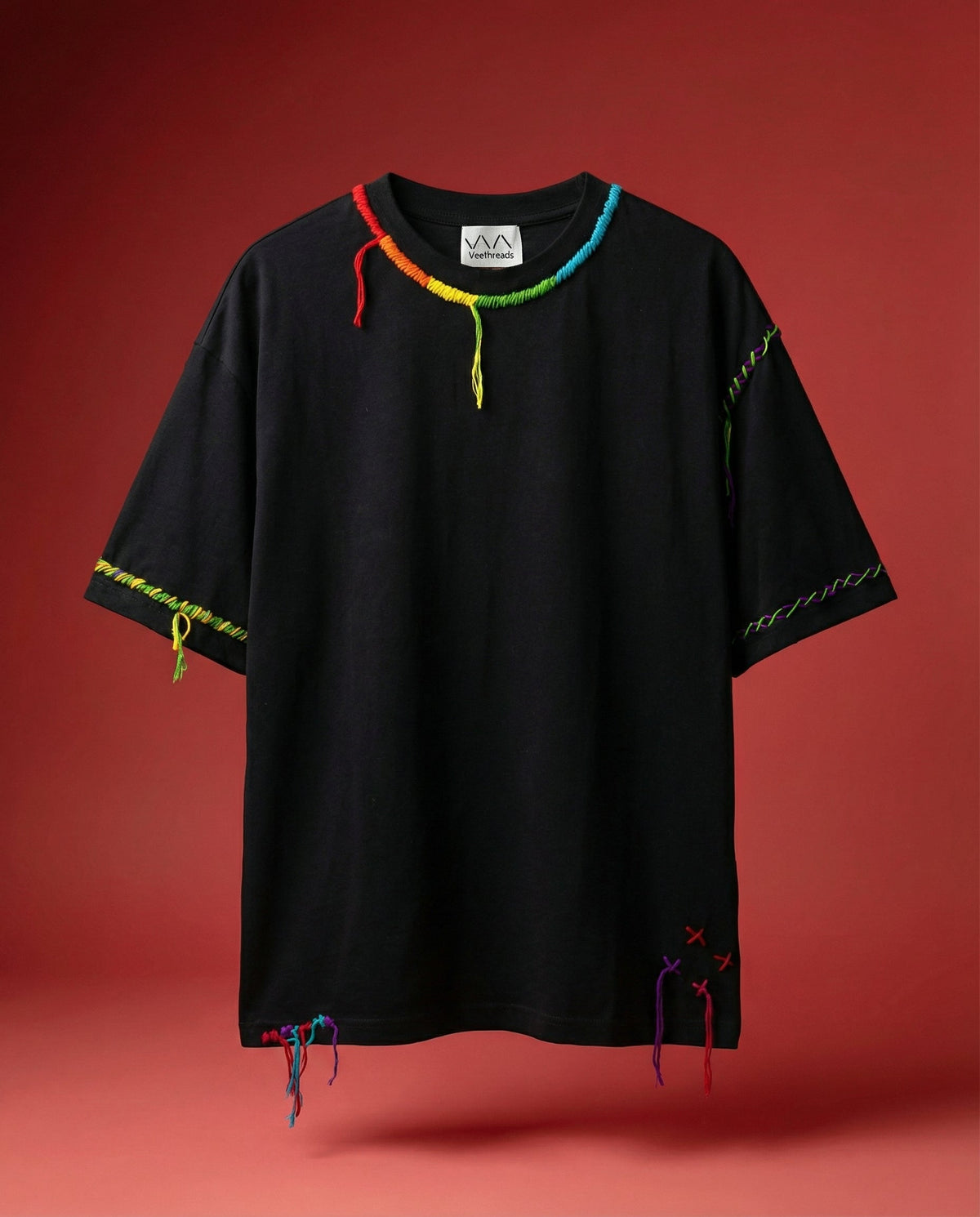
Our kantha work tee is stitched in this tradition, and you can find it with the rest of our embroidered tee shirts. Everything we make is hand stitched in Bulandshahr, Uttar Pradesh, with no machine embroidery step anywhere in the process. More about how we work is on our about page.







Share and get 15% off!
Simply share this product on one of the following social networks and you will unlock 15% off!