



Phulkari is the most immediately recognisable embroidery tradition in north India, and the one with the most unusual method behind it. It is worked from the wrong side of the fabric, which is not how most embroidery is done anywhere.
What the word means
Phulkari translates roughly as flower work. Phul is flower, kari is work.
The name is slightly misleading, because a great deal of phulkari is geometric rather than floral. Diamonds, chevrons, triangles and repeated grid patterns are as common as anything resembling a flower.
Where it comes from
Phulkari belongs to Punjab, on both sides of the modern border, and it goes back several centuries.
Like kantha, it began in the home rather than the workshop. Women embroidered shawls and head coverings for their own families, often starting on a piece when a daughter was born and working on it for years so it would be ready for her wedding.
That matters for understanding the craft. Phulkari was not made to be sold. It was made to be given, and the time it took was part of the meaning rather than a cost to be reduced. A heavily worked piece could represent years.
The unusual thing about how it is stitched
Most embroidery is worked from the front. You look at the surface you are decorating while you decorate it.
Phulkari is worked from the reverse. The embroiderer stitches on the back of the cloth, counting threads, and the pattern appears on the other side where she cannot see it while working.
The stitch itself is a darning stitch, laid in long floats across the surface. Because it is counted rather than drawn, the geometry stays regular without anything being marked out first.
This is why traditional phulkari has such precise repeating patterns. It is arithmetic as much as drawing, and it takes a kind of skill that is difficult to fake.
Phulkari is stitched from the back
Flip the cloth to see what the embroiderer sees, and what appears on the other side.
The reverse. She works here, counting the threads of the base cloth, and only tiny picks of thread show. Nothing is drawn out first; the geometry comes from counting.
The front. The pattern appears on the side she cannot see while working, as long darning floats. Long unbroken threads catch light along their whole length, and that is the shine.
Bagh, meaning garden. Worked so densely that no base cloth shows at all. If you can see plenty of fabric, it is not a bagh.

How to recognise it
Three things give phulkari away.
Long floating stitches. The thread lies across the surface in long straight runs rather than being anchored every few millimetres. This is what gives phulkari its shine, because a long unbroken thread catches light along its whole length.
Silk or silk like thread on cotton. Traditionally untwisted silk floss on hand spun cotton. The contrast between a matte base cloth and a lustrous thread is central to the look.
Bright colour, often on dark ground. Deep reds, oranges, yellows, pinks and greens on a dark or rust coloured base. The palette is warm and unapologetic.

Phulkari compared with the other traditions
Put next to the other Indian styles, the differences are clear.
Kantha, from Bengal, uses short running stitches to build texture across the cloth. Phulkari uses long floats to build shine. Kantha is quiet, phulkari is loud. Our kantha guide covers that tradition.
Chikankari, from Lucknow, is fine white thread on pale cloth, delicate and restrained. It is close to phulkari's opposite in temperament.
Shisha or mirror work anchors small mirrors with thread frames. It shares phulkari's love of catching light, but achieves it with glass rather than silk. We cover it in our mirror work guide.
Our guide to Indian hand embroidery styles sets all of them side by side.
Bagh, the dense version
Worth knowing, because you will see the word.
Bagh means garden. It refers to phulkari worked so densely that the embroidery covers the base cloth completely, so no fabric shows through at all.
A bagh represents an enormous amount of work and was traditionally reserved for the most significant occasions. If a seller uses the word for a piece with plenty of visible base cloth, they are using it loosely.
Why long stitches need more care
This is the practical consequence of the technique, and it applies to any phulkari style piece you own.
Long floating threads sit proud of the fabric, so there is more of them exposed to catch on a watch, a bag strap or a zip. Shorter anchored stitching has less to snag.
It does not make the work fragile, but it does mean handling it slightly more carefully than a densely filled design. Wash inside out in cold water, avoid anything with hooks in the same load, and air dry flat. Never iron directly on the front, because pressing flattens the floats and takes away exactly the shine the technique exists to create.
Our laundry guide has the full routine.

Buying phulkari honestly
Phulkari is heavily imitated, mostly by machine and increasingly by print.
Printed phulkari is flat. The pattern is right and the texture is missing entirely, and you can see it in a close up photograph if the seller provides one.
Machine imitation is harder to spot from the front but obvious from the back. Hand phulkari has a reverse full of visible working, because that is the side it was made on. Machine work leaves a dense uniform back on a stiff backing sheet.
Price is the other signal. Dense hand phulkari represents weeks of work, so anything priced like a printed garment is not what it says it is. Our guide to avoiding fake handmade clothing covers the checks in general.
Hand, machine or print? Turn it over
The front can fool you. The back rarely does.
Hand phulkari. The back is full of visible working, because that is the side it was made on. Dense pieces take weeks, and the price reflects it.
Machine imitation. Hard to spot from the front. Turn it over and you get a dense, uniform back on a stiff backing sheet.
Print. The pattern is right but flat: no raised floats, no shine, and nothing on the reverse. A close-up photo gives it away.
Where our work sits
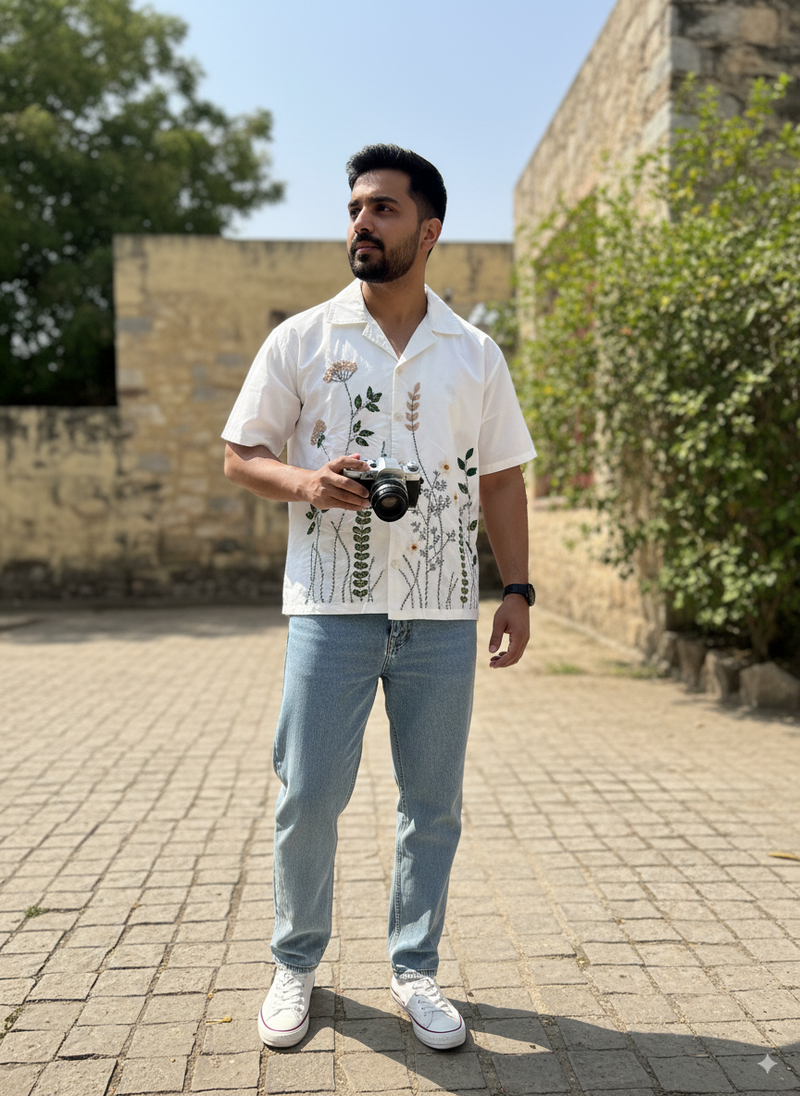
We work mainly in kantha, shisha and floral surface embroidery rather than traditional phulkari, and we would rather say so than claim a tradition we do not practise daily.
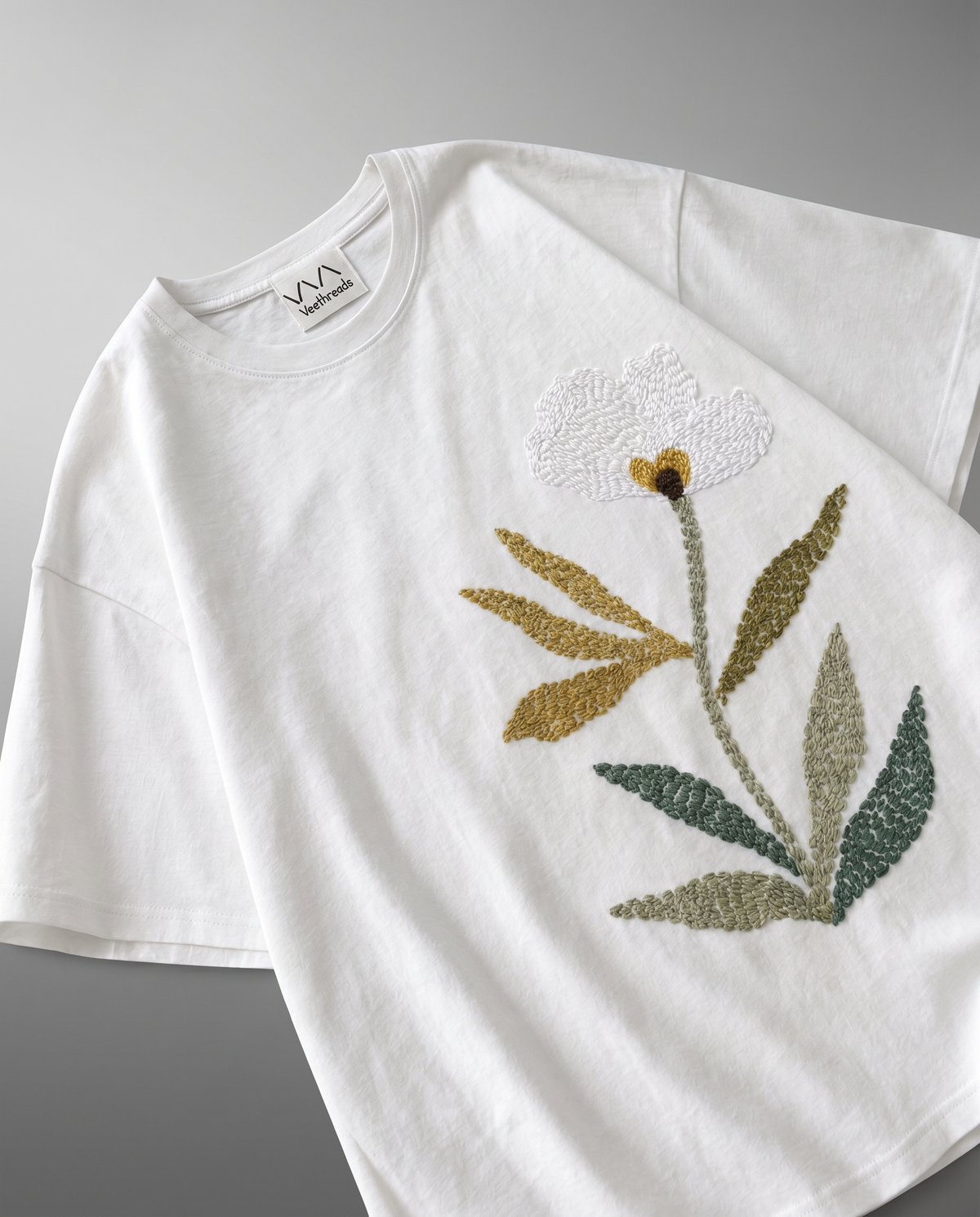
Everything we make is hand stitched in Bulandshahr, Uttar Pradesh, with no machine embroidery step anywhere. You can see the range in our embroidered tee shirts and read about how we work on our about page.









Share and get 15% off!
Simply share this product on one of the following social networks and you will unlock 15% off!